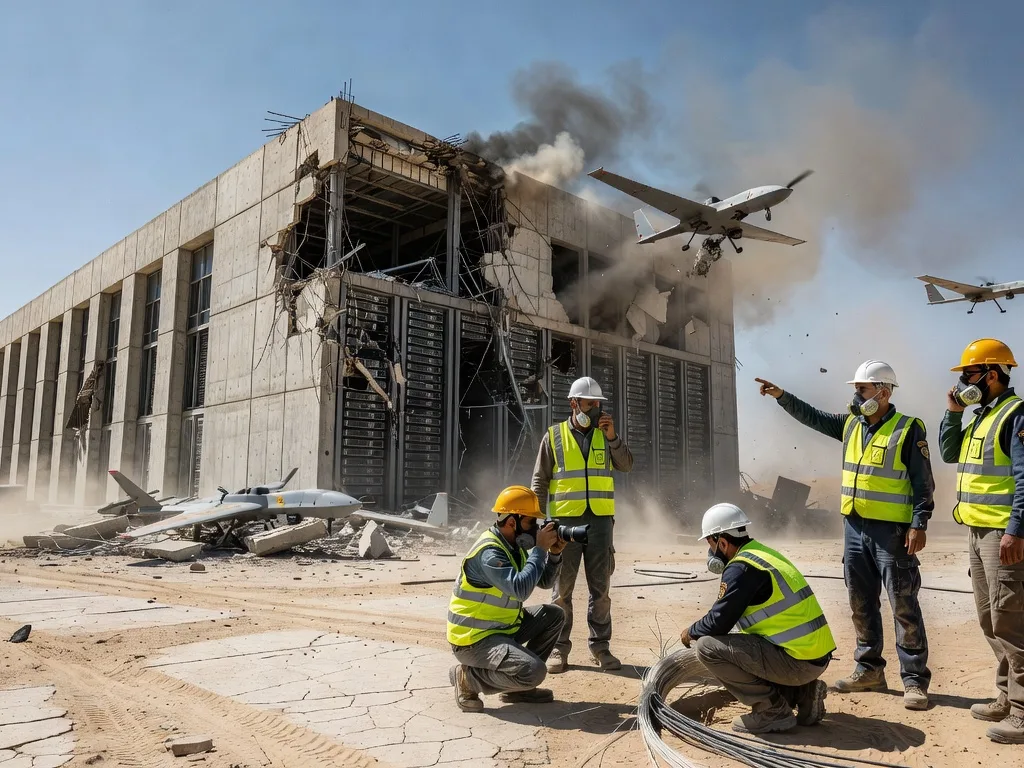
In January 2026, Iranian drone strikes targeted Amazon Web Services (AWS) data centers in Dubai and Bahrain, causing temporary outages and forcing evacuations across two facilities. These attacks, the first confirmed aerial assaults on major cloud infrastructure, disrupted services for over 500 enterprise clients in the region, highlighting vulnerabilities in physical data center security that extend beyond cyber threats. For network engineers and IT leaders managing hybrid environments, this incident underscores the need to integrate geopolitical risk assessments into infrastructure planning, as downtime costs averaged $1.2 million per hour for affected businesses.
The strikes exposed a critical gap: while physical data center security protocols have evolved to counter insider threats and natural disasters, few operators anticipated state-sponsored drone incursions. AWS reported minimal structural damage but significant operational halts, with recovery taking 48 hours. This event has prompted a 35% surge in insurance premiums for Middle East-based facilities, according to a Gartner report from Q1 2026. Business leaders now face tough choices—diversify locations or fortify existing sites—especially as similar tensions simmer near U.S. allies.
Geopolitical Escalation and Data Center Vulnerabilities
The ongoing Middle East conflict, intensified by Iran’s proxy actions, has redefined physical data center security. Drones, affordable at under $10,000 per unit, bypassed traditional perimeter defenses like fences and guards. In the Dubai incident, attackers exploited low-altitude flight paths, evading radar until impact. This mirrors a broader trend: global drone incursions rose 120% in 2025, per the International Institute for Strategic Studies.
For IT professionals, key vulnerabilities include:
- Proximity to conflict zones: Facilities within 500 miles of borders face 4x higher risk.
- Reliance on centralized hubs: 70% of cloud providers cluster in urban areas, amplifying exposure.
- Supply chain disruptions: Post-attack, Bahrain’s center saw 25% delays in hardware deliveries.
To mitigate, engineers should conduct site-specific threat modeling, incorporating drone detection into network monitoring stacks.
For deeper insights on state-sponsored cyber-physical threats, see drone warfare tactics. Related campaigns, like those detailed in Infy Hackers Resume Operations, show how digital and physical attacks intersect.
Fortifying Defenses: Tech and Policy Responses
Cloud giants are accelerating physical data center security upgrades. AWS announced $500 million in investments for anti-drone systems across its global footprint, including AI-driven radar arrays that detect threats at 10 km. Bahrain’s facility now deploys kinetic interceptors, reducing response time from minutes to seconds.
Actionable steps for enterprises include:
- Layered perimeters: Combine RF jammers with optical sensors for 95% interception rates.
- Redundancy planning: Shift 30% of workloads to edge computing to minimize single-point failures.
- Compliance audits: Align with ISO 22301 standards, which saw 50% more adoptions post-incident.
These measures not only counter aerial risks but enhance resilience against hybrid threats, as seen in Bloody Wolf’s spear-phishing campaigns targeting regional infrastructure.
Global Implications for U.S. and Allied Facilities
While U.S. soil remains low-risk—with drone attack probabilities under 1% per Pentagon estimates—the ripple effects are profound. American firms operating abroad, like those using AWS in the Gulf, report 20% higher operational costs. In 2026, the FCC mandated drone-resilient designs for new builds, influencing 15% of planned expansions.
IT pros should prioritize scenario simulations: What if a similar strike hits a Virginia hyperscaler? Early modeling could cut recovery costs by 40%. Internationally, Europe’s ENISA guidelines now emphasize physical data center security in cross-border data flows, urging diversified footprints.
The Bottom Line
The Iran conflict has thrust physical data center security into the spotlight, compelling enterprises to treat aerial threats as seriously as ransomware. For network engineers and leaders, this means reallocating budgets—expect 25% shifts toward physical hardening by year-end. Ignoring these risks could lead to cascading failures, eroding trust in cloud reliability.
Recommendations: Audit your facilities quarterly, integrate drone intel into SIEM tools, and explore partnerships with defense firms like Raytheon for bespoke shields. Looking ahead to 2027, as tensions persist, proactive investments will define resilient architectures, potentially averting billions in losses while future-proofing against evolving warfare tactics.