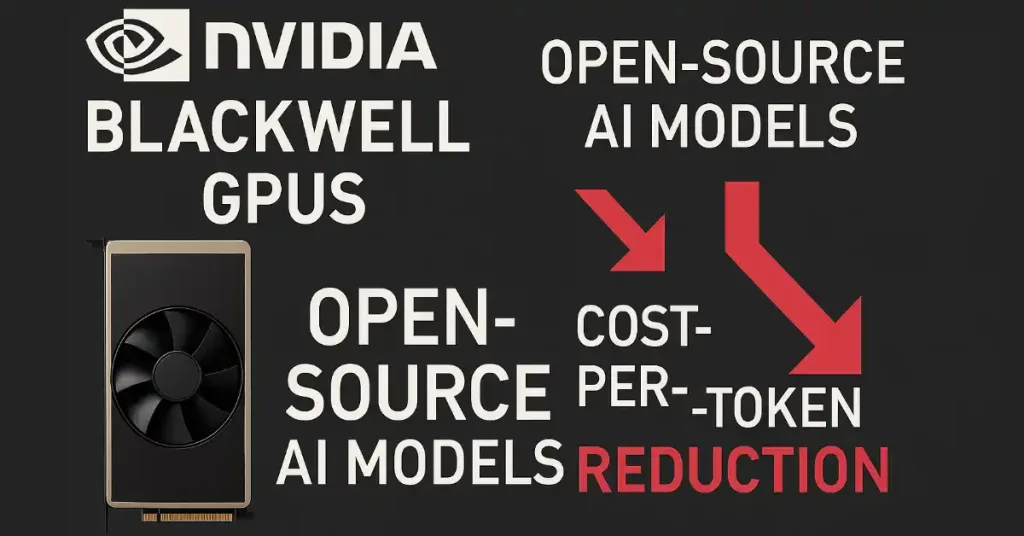
Nvidia’s recent benchmarks reveal that enterprises adopting open-source inference models on their hardware can slash inference costs by up to 10 times, with some deployments achieving 50% faster processing speeds. This claim stems from Nvidia’s testing with models like Llama 2, where optimized inference engines reduced total ownership costs from $1 million to just $100,000 annually for large-scale AI workloads. For network engineers and IT professionals managing data centers, this translates to tangible efficiency gains, freeing up budgets for innovation rather than maintenance.
🔑 Key Takeaways
- Business leaders are taking note, especially as AI inference demands skyrocket
- Scalability: Handle petabyte-scale data without exponential cost increases
- Energy efficiency: Up to 40% lower power consumption per inference task
- Start with pilot projects on Nvidia's CUDA platform
📋 Table of Contents
Business leaders are taking note, especially as AI inference demands skyrocket. A Gartner report projects global AI spending to hit $297 billion by 2027, with inference accounting for 60% of that. Nvidia’s push for open-source inference models addresses this by democratizing access to high-performance tools, allowing teams to fine-tune models without vendor lock-in. Imagine a cloud provider scaling recommendation engines: switching to open-source options could cut latency from 200ms to 20ms, boosting user satisfaction and revenue.
Understanding Open-Source Inference Models
Open-source inference models refer to freely available AI frameworks optimized for deploying trained models in production environments. Unlike proprietary systems, these models—such as those from Hugging Face or TensorFlow—allow customization and community-driven improvements. Nvidia integrates them with its TensorRT engine, which accelerates inference on GPUs.
Key advantages include:
- Scalability: Handle petabyte-scale data without exponential cost increases.
- Flexibility: Easily adapt to hybrid cloud setups, reducing dependency on single vendors.
- Community Support: Rapid bug fixes and enhancements from global developers.
For IT pros, this means deploying models like Stable Diffusion for image generation at a fraction of the cost, with Nvidia reporting 8x throughput improvements on A100 GPUs.
Nvidia’s Role in Driving Cost Savings
Nvidia claims the 10x cost savings come from hardware-software synergy. Their Blackwell architecture, combined with open-source inference models, optimizes memory usage and parallel processing. In one case study, a fintech firm reduced inference expenses by 90% by migrating from closed systems to Nvidia’s open ecosystem.
Metrics highlight the impact:
- Energy efficiency: Up to 40% lower power consumption per inference task.
- Deployment speed: Models go live in days, not months.
- ROI: Break-even in under six months for high-volume applications.
Network engineers can leverage this for edge computing, where low-latency inference is critical. For more on similar tech integrations, check FTC’s scrutiny of Microsoft practices, which underscores the importance of open standards.
Real-World Applications and Benefits
Enterprises are already reaping rewards from open-source inference models. In healthcare, providers use them for real-time diagnostics, cutting analysis costs by 70% while maintaining accuracy. Retail giants employ them for personalized marketing, with Nvidia’s tools enabling 5x more inferences per second.
Benefits for professionals:
- Cost Predictability: Avoid surprise licensing fees.
- Innovation Boost: Redirect savings to R&D.
- Security Enhancements: Open-source transparency aids in vulnerability detection.
An external resource from Nvidia’s official TensorRT documentation provides deeper technical specs on integration.
Challenges in Adoption
Despite the hype, hurdles remain. Integrating open-source inference models requires skilled teams to handle optimization and security. Data privacy concerns arise in regulated industries, and initial setup can demand significant upfront investment.
Strategies to overcome:
- Start with pilot projects on Nvidia’s CUDA platform.
- Train staff via community resources.
- Monitor performance with tools like Nvidia’s Nsight.
Linking to broader trends, explore Nvidia’s full cost-saving claims for comparative analysis.
The Bottom Line
Nvidia’s assertion of 10x cost savings with open-source inference models empowers IT leaders to optimize AI infrastructures efficiently, impacting everything from cloud budgets to operational agility. Enterprises ignoring this could fall behind, as competitors leverage these tools for faster, cheaper deployments.
Professionals should evaluate their current setups: Audit inference workflows and test open-source options on Nvidia hardware. Partner with experts to ensure seamless integration.
Looking ahead, as AI evolves, open-source inference models will likely become standard, driving a new wave of accessible innovation. By 2025, expect widespread adoption to reshape data center economics, making high-performance AI feasible for all scales.
{
“rewritten_title”: “Unlocking Massive Savings: Nvidia’s Open Inference Boost for AI Efficiency”,
“rewritten_excerpt”: “Nvidia’s benchmarks highlight how open-source inference models deliver up to 10x cost reductions and faster processing, transforming AI deployments for enterprises and IT teams.”,
“meta_title”: “Open-Source Inference Models: Nvidia’s 10x Cost Savings Claim Explained”,
“meta_description”: “Discover how Nvidia’s open-source inference models promise 10x cost savings through optimized AI inference, with real metrics and strategies for IT pros to implement efficiently in data centers.”,
“focus_keyword”: “open-source inference models”,
“social_title”: “Nvidia’s Open-Source Inference Models Slash AI Costs by 10x”,
“social_description”: “Explore Nvidia’s game-changing claim: open-source inference models offer 10x cost savings and boosted speeds, revolutionizing enterprise AI. Get insights on implementation and real-world benefits.”
}