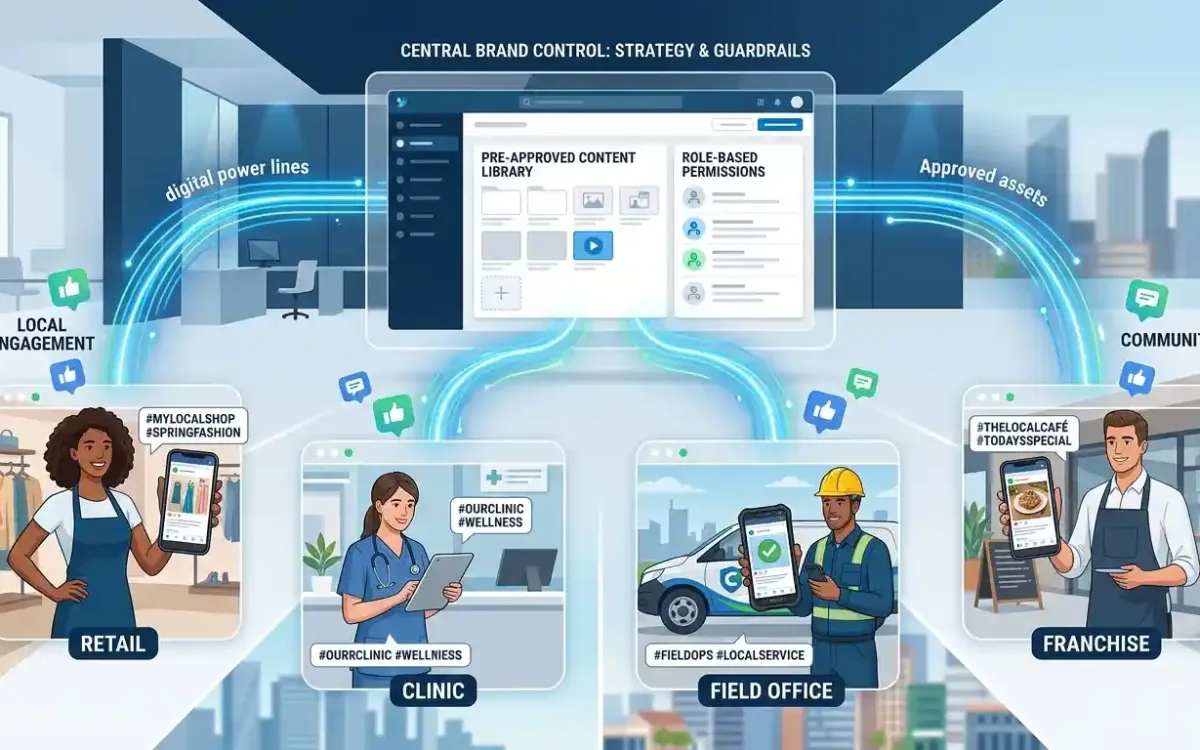
Large organizations with distributed workforces face a unique challenge when it comes to social media. Corporate teams craft polished brand strategies, but the employees closest to customers (frontline staff in retail stores, clinics, field offices, and franchise locations) often lack the tools to execute those strategies at a local level.
This disconnect leads to inconsistent messaging, compliance risks, and missed engagement opportunities across every market the business serves. In this article, we explore why enterprises are shifting toward dedicated social media management platforms for frontline teams, what sets these tools apart from general-purpose solutions, and how organizations can use them to align brand strategy with local execution.
The Growing Gap Between Corporate Strategy and Frontline Execution
Most enterprise social media strategies are designed at headquarters. Marketing teams create content calendars, brand guidelines, and campaign assets. But translating that vision into consistent action across dozens or hundreds of locations is where things break down.
The challenge isn’t a lack of effort. Frontline teams want to represent their brand well on social media. The problem is that they rarely have tools designed for how they actually work.
When Frontline Teams Operate Without Proper Tools
Frontline employees are often expected to manage local social media accounts with whatever tools are available. Some use personal accounts. Others rely on spreadsheets and email chains to coordinate posts.
The result is a patchwork of inconsistent content that dilutes the brand. A regional manager might share an outdated promotion. A store associate might post an image that doesn’t meet brand standards. These small missteps accumulate quickly across a large organization.
Why General-Purpose Social Media Tools Fall Short
Tools built for centralized marketing teams work well when one department manages a handful of accounts. They were not designed for enterprises that need to empower hundreds of frontline users while maintaining brand control.
General-purpose platforms lack the role-based permissions, content approval workflows, and localized scheduling features that distributed organizations require. Enterprises end up forcing a centralized tool onto a decentralized problem, creating bottlenecks and frustration on both sides.
This is exactly why the market for social media management platforms built specifically for frontline teams has grown so rapidly. Organizations need tools that match their operational reality.
What Dedicated Frontline Platforms Offer
Dedicated platforms designed for frontline social media management take a fundamentally different approach. Instead of assuming one team controls everything, they distribute publishing power while maintaining brand guardrails.
Organizations evaluating a social media management platform for frontline teams typically look for solutions that balance local autonomy with corporate oversight. The best platforms make it easy for field staff to publish relevant content without requiring marketing approval for every single post.
Pre-Approved Content Libraries and Brand Guardrails
One of the most effective features is a shared content library. Corporate teams create and approve posts, images, and templates. Frontline users then select from this library, customize for their local audience, and publish directly.
This approach eliminates the bottleneck of centralized publishing while ensuring every piece of content meets brand standards. Local teams feel empowered rather than restricted, and corporate marketing retains control over quality.
Role-Based Access and Localized Publishing
Not every frontline employee needs the same level of access. Effective platforms let administrators define roles: some users can publish freely from approved content, while others require manager approval before posting.
This tiered model scales across large organizations without overwhelming corporate marketing with review requests. Regional managers oversee their locations without involving headquarters for routine content. Each location can also schedule posts based on local events, time zones, and audience preferences, keeping content relevant to the community it serves.
Real Benefits Enterprises Are Seeing
The shift toward dedicated frontline platforms isn’t theoretical. Organizations that have made the transition report tangible improvements across several key areas.
Faster Publishing and Higher Local Engagement
When frontline teams can self-serve from approved content libraries, the time between content creation and publication drops significantly. What previously required email chains and approval delays now happens in minutes.
This speed matters most during time-sensitive situations: local events, seasonal promotions, or community response. Frontline teams react quickly while staying on-brand. According to Grand View Research, the global social media management market is projected to grow at over 23% annually through 2030, driven largely by enterprise demand for scalable, distributed publishing tools.
Local accounts also consistently outperform corporate accounts in engagement. People connect with businesses in their community, not faceless corporate brands. Dedicated platforms make it practical to maintain active local accounts at scale.
Reduced Compliance and Brand Risk
With approval workflows, content libraries, and role-based permissions in place, the risk of unauthorized or off-brand posts drops dramatically. Enterprises gain visibility into what every location publishes without manually monitoring each account.
For organizations in regulated industries like healthcare, finance, or insurance, this governance structure can be the difference between staying compliant and facing penalties. An audit trail for every published post provides documentation that manual processes simply cannot match.
The combination of speed, engagement, and risk reduction explains why social media management for frontline teams has become a strategic priority rather than a nice-to-have for enterprise organizations.
How to Evaluate the Right Platform
Choosing a frontline social media management platform requires different criteria than selecting a traditional social media tool. The decision should account for the realities of distributed teams and non-marketing users.
Focus on Ease of Use for Non-Marketers
Frontline employees are not social media professionals. The platform must be intuitive enough for someone with no marketing background to select content, customize it, and publish confidently.
If the tool requires extensive training or a steep learning curve, adoption will suffer. The best platforms feel as simple as posting from a personal social media account, with brand safety built into the background.
Plan for Scale and Integration
A platform that works for 20 locations needs to work just as well for 200. Evaluate how the tool handles growth, integrates with existing marketing technology, and supports the analytics needs of both local managers and corporate leadership.
The right platform should connect local publishing activity to broader business metrics, giving leadership visibility into which markets are most active and where engagement is strongest.
Look for platforms that offer centralized dashboards where corporate teams can monitor performance across all locations without logging into individual accounts. This visibility turns social media management for frontline teams from a guessing game into a measurable business function.
Final Thoughts
Enterprises are recognizing that social media success depends on more than a strong corporate presence. The organizations seeing the greatest results are those empowering frontline teams with purpose-built tools that balance local relevance with brand integrity.
Rather than controlling every message from headquarters, forward-thinking companies are building systems that let the people closest to customers represent the brand authentically. The result is stronger local engagement, faster content execution, and a more consistent brand experience across every market they serve.