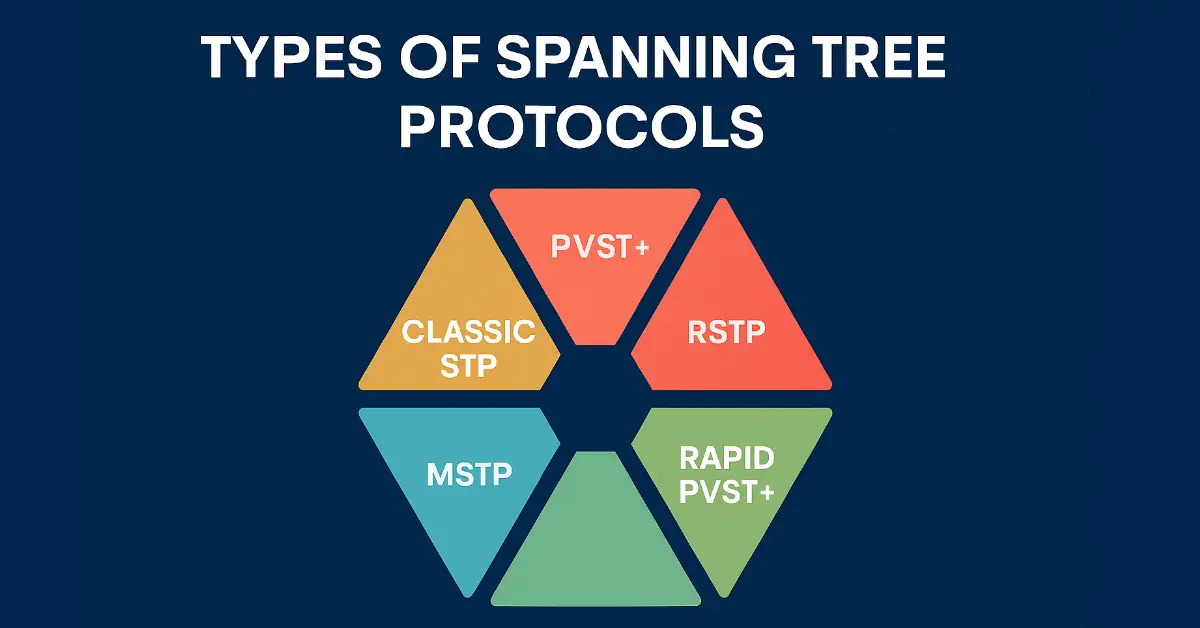
Spanning Tree Protocol (STP) is enabled by default on every Cisco switch port to prevent Layer 2 bridging loops in redundant topologies. Without STP, a loop would cause broadcast storms, MAC table corruption, and complete network meltdown. Cisco and IEEE have evolved multiple STP flavors over the years. Here are the types of spanning tree protocols you must master in 2025:
- STP (IEEE 802.1D)
- PVST+ (Cisco proprietary per-VLAN)
- RSTP (IEEE 802.1w)
- Rapid PVST+ (Cisco default on modern IOS-XE)
- MSTP / MST (IEEE 802.1s – Cisco & standards-based)
Note (2025): Catalyst 9200/9300/9500 series running IOS-XE 17.12+ default to Rapid PVST+ and include sub-second failover enhancements when paired with StackWise Virtual or VXLAN fabrics.
Spanning-Tree Protocol (STP)
The STP is the original IEEE 802.1D version, providing redundant network connectivity without a loop. It is also known as the CST (Common Spanning Tree). Despite the number of VLANs, it assumes one spanning tree instance for the entire bridged network.
The whole network has only one root bridge, so all the traffic flows over the same path. The STP is very slow and takes a long time for convergence. The time of convergence for STP is 32 seconds. The updated version of the standard spanning-tree protocol is 802.1D-2004
Because of using only one root bridge, the CPU and memory requirements for CST are lower than for the other protocols. However, because there are only one root bridge and one tree, traffic for all VLANs flows over the same path, leading to suboptimal traffic flows.
Pros & Cons
| Aspect | Pros | Cons |
|---|---|---|
| Resource Use | Very low CPU/Memory | Single tree = suboptimal for multi-VLAN |
| Convergence | Reliable baseline | Slow (30–50s) |
| Use Case | Legacy/small networks | Avoid in modern designs |
Engineer Tip: Only use classic STP today for interoperability with very old non-Cisco devices or in lab exams that explicitly require 802.1D.
Per VLAN Spanning Tree + (PVST+)
PVST+ is the improved version of STP, which provides a dedicated 802.1D spanning-tree root bridge for every VLAN configured in the network. It is the default version of STP. It provides compatibility with the Common Spanning Tree (CST). It is slower than Common Spanning Tree (CST). PVST+ consumes less bandwidth than CST and provides more network performance optimization than CST. PVST+ also required more CPU and memory.
The speed of convergence is comparable to the original STP. Still, the difference is the separate instance and root bridge, which support Port Fast, Uplink Fast, Backbone Fast, BPDU filter, BPDU guard, loop guard, and root guard.
Port roles are the same as those in RSTP. Separate instances and separate root bridges for each VLAN increase the CPU and memory requirements. PVST+ allows the spanning-tree optimization for the traffic of each VLAN. The convergence of this PVST+ is similar to 802.1D. Though, it provides per-VLAN convergence.
Pros & Cons
| Aspect | Pros | Cons |
|---|---|---|
| Load Balancing | Excellent (different roots) | High BPDU overhead |
| Convergence | Same as classic STP (slow) | 30–50s per VLAN |
| Use Case | Medium networks with <50 VLANs | Not scalable beyond that |
Rapid Spanning Tree Protocol (RSTP)
RSTP is also known as IEEE 802.1w. This advanced version of STP provides faster convergence than CST but holds with the same single root bridge in the topology. The bridge resources needed in RSTP are higher than CST but less than PVST+. RSTP resolves many convergence issues, except it still provides a single instance of STP, it does not address the suboptimal traffic flow issues. Due to faster convergence, more CPU and memory are required for this version than CST but less than Rapid PVST+. RSTP (2001) dramatically improves convergence while remaining backward compatible with 802.1D.
Key Improvements
- Edge ports (PortFast) transition immediately
- Convergence: 3–6 seconds (or sub-second with proposal/agreement)
- New port roles: Alternate, Backup
- New port states: Discarding → Learning → Forwarding
Key Port Roles in RSTP
| Role | Description |
|---|---|
| Root | Best path to root bridge |
| Designated | Forwarding port for segment |
| Alternate | Backup path to root (quick failover) |
| Backup | Backup for shared segment |
| Edge | Access port – immediately forwarding |
Pro Tip: Always enable spanning-tree portfast default or per-port PortFast + BPDU Guard in production.
Rapid Per VLAN Spanning Tree + (Rapid PVST+)
Rapid PVST+ is a Spanning Tree standard providing faster convergence than PVST+ and a separate instance of 802.1w per VLAN but with much more CPU and memory requirements than other STP standards. The separate instance supports Port Fast, BPDU guard, BPDU filter, root guard, and loop guard. It resolves the convergence issues and suboptimal traffic flow issues. It is Cisco’s most popular mode today, which combines per-VLAN instances with RSTP fast convergence.
Why It Wins in 2025
- One fast-converging instance per VLAN
- 3–6 second recovery even with 500+ VLANs
- Default on Catalyst 9000 series
Engineer Recommendation: Use Rapid PVST+ in 90% of campus deployments unless you have >500 VLANs (then move to MSTP).
Multiple Spanning-Tree Protocols (MSTP)
MSTP is the IEEE 802.1s standard, inspired by the earlier Cisco proprietary MISTP implementation. It maps many VLANs into a small number of RSTP instances (0–64), drastically reducing BPDU overhead.
Core Concepts
- MST Region = same name, revision, VLAN-to-instance mapping
- Instance 0 = Internal Spanning Tree (IST) – always exists
- Common and Internal Spanning Tree (CIST) for inter-region
When to Use MSTP
- 200 VLANs
- Service provider or large enterprise cores
- Interoperability with non-Cisco switches running 802.1s
Multiple Spanning Tree (MST)
MST is Cisco proprietary and equal to MSTP. It provides up to 16 instances of RSTP (802.1w) and combines many VLANs with the same physical and logical topology into a common RSTP instance. Each RSTP instance supports PortFast, BPDU guard, BPDU filter, root guard, and loop guard. This version’s CPU and memory requirements are less than Rapid PVST+ but more than RSTP.
Full Comparison Table (2025)
| Protocol | Standard | Instances | Convergence | CPU/Memory | Best Use Case |
|---|---|---|---|---|---|
| STP | 802.1D | 1 (global) | 30–50s | Low | Legacy devices |
| PVST+ | Cisco | 1 per VLAN | 30–50s | Medium | <50 VLANs, load-balancing |
| RSTP | 802.1w | 1 (global) | 3–6s | Medium | Simple fast single-tree |
| Rapid PVST+ | Cisco+802.1w | 1 per VLAN | 3–6s | High | Default for most campus networks |
| MSTP/MST | 802.1s | Up to 64 | 3–6s | Medium-High | Large-scale (>200 VLANs) or multi-vendor |
Best Practices & Troubleshooting (2025)
- Always set root bridge priorities in multiples of 4096
- Enable BPDU Guard + Root Guard on all access ports
- Use s
panning-tree portfast bpduguard defaultglobally - In DNA Center/SD-Access environments, let the controller auto-tune STP
- Verify with:
show spanning-tree summary,show spanning-tree detail,show spanning-tree inconsistentports
Common Issues & Fixes
- Unidirectional link → enable Loop Guard
- Rogue root bridge → Root Guard
- Slow convergence → upgrade to Rapid PVST+ or MSTP
FAQs – Types of Spanning Tree Protocols
What is the primary function of Spanning Tree Protocol (STP) in networks?
STP, defined by IEEE 802.1D, prevents bridging loops in redundant Ethernet topologies by creating a loop-free logical tree structure. It elects a root bridge, assigns port roles (root, designated, blocked), and uses timers for convergence (up to 32 seconds). Ideal for basic Cisco setups, but limited to one instance across all VLANs, leading to suboptimal traffic paths.
How does PVST+ differ from traditional STP on Cisco switches?
PVST+ enhances STP with a separate 802.1D instance per VLAN, allowing dedicated root bridges for load balancing and better optimization. It’s the default on Catalyst switches, supports features like PortFast and BPDU Guard, but increases CPU/memory usage and maintains slow 32-second convergence. Great for medium networks with multiple VLANs.
What advantages does Rapid Spanning Tree Protocol (RSTP) offer over STP?
RSTP (IEEE 802.1w) accelerates convergence to 3-6 seconds via proposal/agreement handshakes and new roles like alternate ports, while backward-compatible with STP. It reduces downtime in single-instance setups but still faces suboptimal flow issues in multi-VLAN environments; requires moderate CPU boost for faster processing.
When should you use Multiple Spanning Tree Protocol (MSTP)?
MSTP (IEEE 802.1s) maps multiple VLANs to fewer RSTP instances (up to 16), cutting resource overhead in large networks. Inspired by Cisco’s MST, it groups similar topologies for efficient convergence (3-6s) and supports guards like Loop Guard. Best for scalable, multi-vendor setups with 100+ VLANs to avoid Rapid PVST+ bloat.
What is the default STP mode on modern Cisco Catalyst switches?
PVST+ is the default on switches like Catalyst 2960 (IOS 15.0+), blending per-VLAN instances with 802.1D basics. It incorporates 802.1D-2004 updates for compatibility, enabling features like Root Guard. For faster needs, upgrade to Rapid PVST+; note higher resource demands but superior VLAN optimization over single-instance CST.