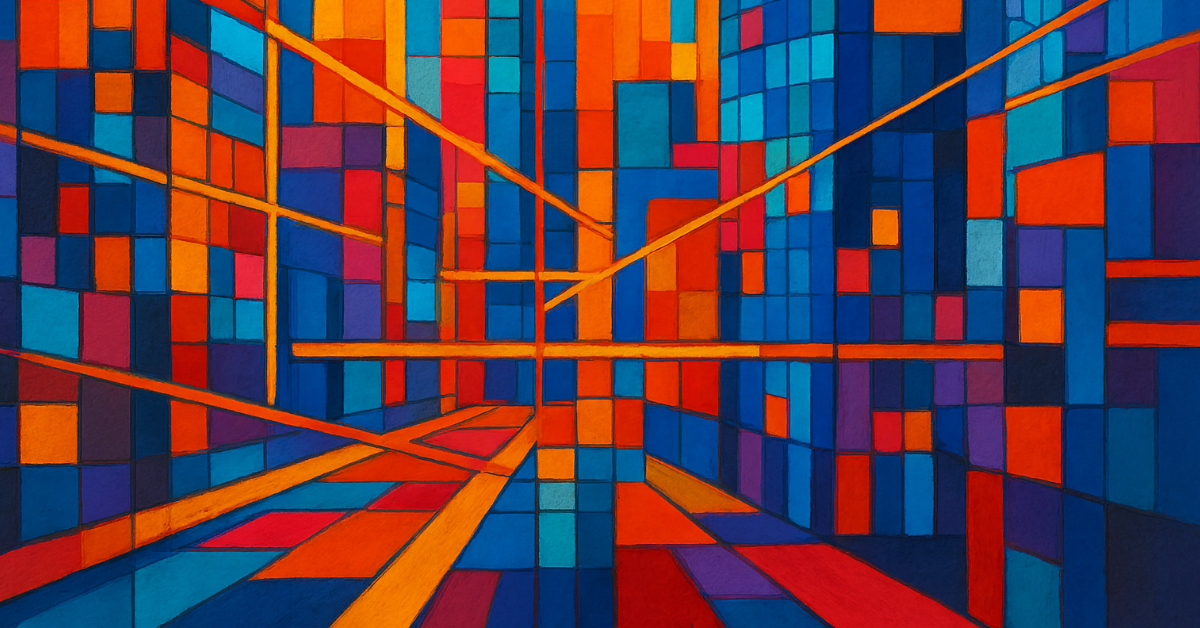
Have you ever been attracted to a painting that contains nothing but geometric shapes laid out in a way that fascinates you? At that moment, you might stop and wonder what it is about a simple painting like that that attracts you so much even if there is nothing extraordinary there—just a few geometrical figures combined haphazardly.
In 2025, this fascination persists and evolves, with geometric art gaining renewed popularity through digital innovations. According to recent art market reports, abstract geometric works have seen a 25% increase in online searches, driven by integrations with AI and virtual reality, making these timeless shapes more interactive and accessible than ever.
But there is more to the paintings than just an assortment of geometrical figures lying around. Geometric shapes have been assimilated into paintings for a long time now. Several abstract art movements connect to the larger concept of geometric shape usage.
Artists’ geometric artists are eye-catching due to their placement and positioning. In the simplest form, geometric shapes come from their math counterparts in geometry. Abstract geometric art has also advanced the idea of minimalism. Therefore, geometric art uses shapes that string together a piece of art and bring it to life.
The psychological allure of these shapes resides in their capacity to elicit order and harmony amidst chaos. Studies from art psychology journals in 2024 indicate that viewers are drawn to geometric patterns because they activate brain regions associated with pattern recognition and emotional stability, similar to how mandalas promote mindfulness.
Types of Shapes used in Geometric Art
Geometrical art employs a variety of shapes. Perhaps the most common and widely used ones are squares or any quadrilateral, triangles, circles, lines, pentagons, and so on. However, recently there are also some organic shapes that have been paving their way into such an art form.
In 2025, artists are blending traditional geometric forms with organic elements inspired by nature, creating hybrid shapes that reflect sustainability trends. For instance, eco-friendly materials like recycled plastics are shaped into pentagons and circles, emphasizing environmental themes in geometric abstract art.
Expanding on these, squares symbolize stability and structure and are often used in urban-inspired pieces. Triangles show direction and energy, while circles show unity and infinity. Pentagons add complexity, drawing from mathematical precision, and lines serve as connectors, guiding the viewer’s eye across the canvas. The rise of organic shapes, such as irregular curves mimicking natural forms like leaves or waves, softens the rigidity, making geometric art more approachable in contemporary galleries.
Usage Of Shapes In Geometric Art
The foremost objective of using shapes in art is to control the person’s feelings and mood. These shapes play a key role in evoking emotions in us. Shapes with rounded edges are more approachable and soft, while the shapes with sharp, distinct lines depict a sense of strength, stability, and presence.
Triangles are used because they lead the eye in an upward movement, whereas inverted triangles provide an effect of imbalance as well as tension. The famous painter Cezanne spoke about the two-dimensional effect of a painting. His works try to assert the depth and form with natural properties of color that create a balanced arrangement of shapes.
Abstract geometric artists fully utilize shapes in their work. This helps in awakening an emotional trigger by organizing the visual elements in either a harmonic fashion or a dynamic one. The process helps transform the painting into a complete masterpiece.
Every artist is different and has different sensibilities, but the one thing that artists of geometric abstract art have in common is their work, which transcends boundaries and is almost analogous with a piece of musical composition that combines the sound, tempo, and pitch.
When looking at a piece of abstract art, one must prepare their mind to take a transcendent flight, view the metaphysical properties of the visuals, and embrace a spiritual response rather than an analytical one.
In modern applications, shapes are manipulated digitally to create interactive experiences. For example, in VR art installations of 2025, viewers can rotate triangles or expand circles in real-time, enhancing emotional engagement. Research from the 2024 Art Basel report indicates that such dynamic uses increase viewer retention by 40%, making geometric art a staple in immersive exhibitions.
Furthermore, the contrast between soft and sharp shapes can evoke specific moods: rounded forms promote calm, ideal for therapeutic art spaces, while angular ones stir excitement, common in corporate lobbies. Cezanne’s influence extends to 2025, where artists use color gradients within shapes to simulate depth on flat surfaces, blending traditional techniques with AI tools for precision.
Artists Who Used Geometric Art
- François Morellet , a renowned painter and sculptor, developed a radical way in the creation of geometric abstraction.
- Carloz Cruz Diez who was a prolific artist of the twentieth century, also advanced and participated in this geometric abstraction movement.
- Another notable name among the forerunners of this art movement is Vera Molnar, who, as the pioneer of computer-assisted art revolutionized the scene of this art movement. She says, “I have no regrets. My life is squares, triangles, lines”.
- The Swiss artist , Gottfried Honeggar is also a big name. His paintings comprise bold, geometric monochromes. His initial works consist of an oeuvre that included paintings, sculptures, and even tableaux-reliefs. He created objects that expanded one’s visual understanding of shapes, lines, curves, colors, and dimensional shapes.
- Victor Vasarely heralded the Op art movement. His works were carefully designed to cater to the brain and eye working together to perceive color, light, perspective, temperature, depth, and size. Utilizing geometrical shapes and graphics that are colorful and vibrant, the artist has created several compelling pieces.
- Some other notable names who took geometric art abstraction to new heights are Ariele Rozowy, Nicolas Dubreuille, Brent Hallard, Gerhard Fromel, and Paul Klee.
Updating for 2025, note that Vera Molnár passed away in December 2023 at age 99, leaving an indelible impression as the “godmother of generative art.” Her pioneering use of computers in the 1960s to create algorithmic geometric patterns influenced today’s AI artists. François Morellet (died 2016) and Carlos Cruz-Diez (died 2019, corrected spelling) remain influential through retrospectives, with Cruz-Diez’s chromatic works fetching high prices at auctions.
Gottfried Honegger (died 2016) and Victor Vasarely (died 1997) remain foundational, with their optical illusions gaining new life in digital recreations. Paul Klee’s playful geometry blends organic and structured forms, a trend echoed in 2025’s hybrid styles.
Emerging Geometric Artists in 2025
To keep pace with contemporary scenes, several emerging artists are redefining geometric art. Leigh Bagley draws from mid-century design, using overlapping color blocks for architectural optimism. Kevin Jackson’s minimalist lines pulse with precision, evoking subtle movement. Elbi Elem stretches threads into tense, fragile spaces, blending 2D and 3D.
Sassoon Kosian creates sculptural paintings that shift with light, while Maria Tuzhilkina geometrizes natural landscapes like mountain dawns. Bernardo Mora abstracts seasons in rhythmic panels, and Viviana Moncayo fuses urban grids with topography. Alla Grande adds whimsy to precision with butterfly-like mirrors, Sumit Mehndiratta crafts hypnotic optical vortices, and James Bonachea explores fractal intricacies.
Jo Moloney’s pared-down puzzles evoke memory, Albrecht Behmel’s works glow with chromatic light, Vanessa Ryan captures nostalgic rhythms, Guzaliya Xavier balances dark tensions, Angelica Tcherassi layers personal journeys, and Sohwa Yeongok infuses spirituality into subtle gradients. These artists, featured in platforms like The Artling, push boundaries with sustainable and digital elements.
Famous Artworks Featuring Geometric Shapes
There are several works that include shapes in general – Starry Night by Vincent Van Gogh, The Snail by Henri Matisse, Three Musicians by Pablo Picasso, Spring Turning by Grant Wood, and The Sunflower by Edward Steichen.
These are some of the artworks that used geometric shapes – Broadway Boogie-Woogie by Piet Mondrian, Night – and Some Flowers by Marson Hartley, The Red Balloon by Paul Klee, Geometric Mouse- Scale A by Claes Oldenburg, and Squares with Concentric Circles by Wassily Kandinsky are just some of the many amazing works.
Recently, these classics have inspired high-value sales. In May 2025, Mondrian’s signature grid painting sold for $47.5 million at auction, highlighting opposing forces through geometry. Kandinsky’s rediscovered Composition No. II (1910) fetched $72 million in 2025, emphasizing his pioneering abstract shapes.
Additional notable pieces include Felipe Pantone’s chromatic illusions, blending graffiti with op art, and Esther Stocker’s disorienting black-and-white installations that play with perception. Rana Begum’s light-reflective geometries and Josh Sperling’s curved canvases add modern twists, often featured in 2025 art fairs like Frieze and Art Basel.
Geometric Art in the Digital Age: Trends for 2025
As we enter 2025, geometric art evolves dramatically in the digital realm. AI tools generate infinite variations of shapes, allowing artists to create personalized pieces via algorithms, much like Vera Molnár’s early work. VR installations let viewers immerse themselves in expansive polygons, enhancing emotional impact.
NFTs have matured, with geometric collections like those on platforms such as Foundation linking digital assets to physical prints. Sustainable trends incorporate eco-materials, while oversized abstracts with textures dominate interiors. Neo-geometric abstraction mixes precision with fluidity, and interactive art responds to viewer movements.
According to the Art Basel and UBS 2025 report, digital art sales rose 15%, with Gen Z collectors favoring AI-enhanced geometrics for their accessibility. Events like ArtMeta 2025 in Basel showcase robots and AI creating live geometric works, bridging traditional and futuristic aesthetics.
Wrapping It Up
The appeal of geometric shapes in artwork and design is linked together by several factors that appeal to human sensibility. Balance is one of the most defining elements in this form. With the use of these abstract figures and shapes, the artist is able to create a sense of suspension that lingers over the artwork.
With the use of colors that might range from vibrant to monochromatic, the artist taps into the feelings of its viewers. Geometric art has evolved into a highly respected and popular style in the modern millennial world.
Conclusion
In 2025, paintings that attract us with ideal geometric shapes continue to captivate, blending timeless principles with cutting-edge technology. From AI-driven creations to sustainable hybrids, this art form fosters emotional connections and visual harmony. Whether exploring classics like Mondrian or emerging talents, geometric art invites us to find order in abstraction. Dive deeper into these trends to enrich your appreciation—search for local exhibitions or digital galleries today for an inspiring journey into shape and color.
FAQs
What makes geometric paintings so attractive to viewers?
Geometric paintings draw us in through their simplicity and order, evoking emotions like calm or tension via shapes. In 2025, digital enhancements like AI add interactivity, making them more engaging. This balance of math and art taps into our innate pattern recognition, creating a mesmerizing visual experience.
Who are some renowned artists known for geometric abstract art?
Pioneers include Piet Mondrian, Wassily Kandinsky, and Vera Molnár, who used shapes for optical effects. Emerging 2025 artists like Leigh Bagley and Felipe Pantone blend tradition with digital twists, pushing boundaries in galleries and NFTs for fresh, vibrant interpretations.
How have geometric shapes evolved in art by 2025?
From traditional canvases to AI-generated and VR-interactive pieces, geometric shapes now incorporate sustainability and textures. Trends like neo-geometric abstraction mix precision with organic forms, reflecting environmental awareness and tech integration for broader appeal.
What are examples of famous geometric artworks?
Classics like Mondrian’s Broadway Boogie-Woogie and Kandinsky’s Squares with Concentric Circles use shapes for rhythm. Recent auctions highlight their value, with Mondrian fetching $47.5M in 2025, showcasing enduring attraction through color and form harmony.
Why do shapes in paintings evoke specific emotions?
Rounded shapes feel soft and approachable, while sharp lines convey strength. Triangles direct the eye, creating tension or uplift. In 2025 psychology studies, these trigger brain responses for stability, making geometric art therapeutic in chaotic times.