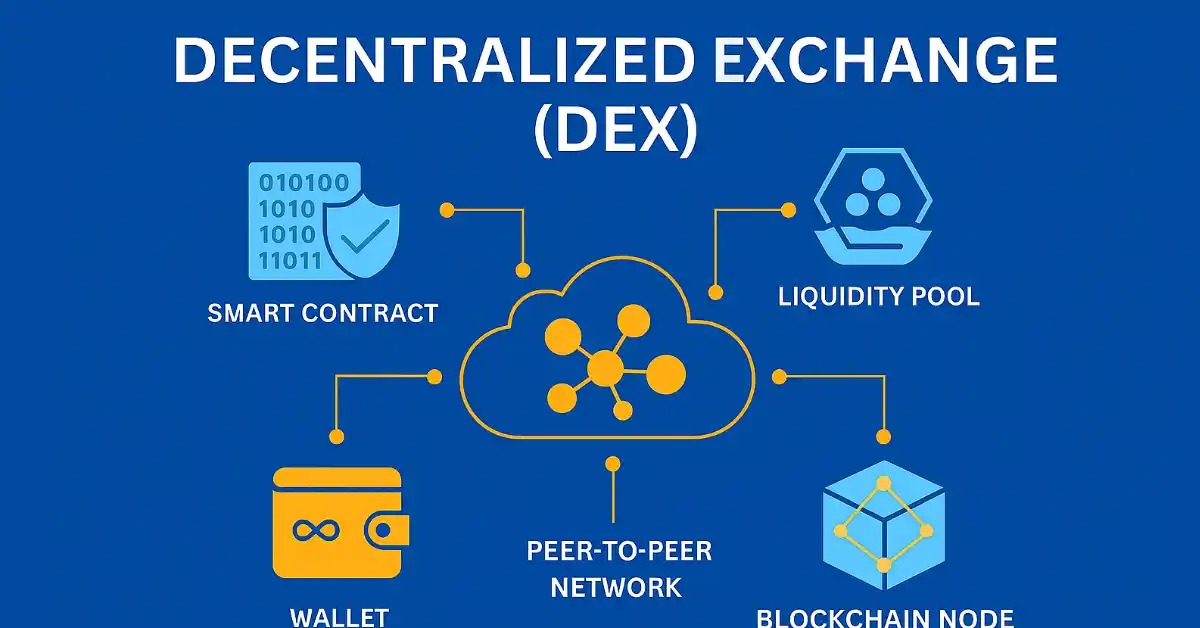
DEX is a completely peer-to-peer marketplace. It is a platform where users can trade non-custodial cryptocurrencies directly, without intermediaries, ensuring transparency and enhanced security in the custody and transfer of funds. That is, the management of funds and trusts does not fall entirely on the central figure.
Instead, users of the exchange can always maintain control over their assets. However, this system has been perceived as a convenience that ensures anonymity, a high level of security, and confidentiality while operating in this type of exchange house. Check out here if you’re curious about how oil companies are using blockchain to improve trade.
It has emerged as a cornerstone for decentralized finance (DeFi). It can function as a major “money Lego”, a place where permissionless composability can result in more sophisticated financial products. But how can we get away from decentralized exchanges or traditional exchanges, and what benefits do DEXs provide us? To learn more about these decentralized exchanges, see the following.
In 2025, the DEX landscape has exploded, with total 24-hour trading volumes surpassing $4.77 billion as of December (per CoinGecko), up from modest figures in 2022. DefiLlama reports spot volumes across top protocols hitting $5.72 billion daily, while projections from Eco estimate the global DEX market could reach $3.48 trillion by year-end. This surge is fueled by institutional adoption, layer-2 scaling solutions, and real-world asset (RWA) tokenization, making DEXs indispensable for traders seeking sovereignty in a post-FTX era. With over 1,122 DEXs tracked worldwide (CoinGecko), from Ethereum-based giants like Uniswap to Solana speedsters like Raydium, the ecosystem is more vibrant and accessible than ever. Whether you’re a DeFi novice or a yield farmer, understanding DEXs unlocks the true potential of Web3.
How Is a Decentralized Exchange Able to Work?
This exchange uses smart contracts to facilitate trades between individuals, but it does not assume ownership of their currency. The DEX utilizes techniques to manage these sorts of circumstances, including automated market creators, an off-chain order book, or an on-chain order book. DEXs deal with this easily by using one of these methods.
In 2025, these mechanisms have evolved significantly with advancements in blockchain scalability. For instance, layer-2 solutions like Optimism and Arbitrum have reduced gas fees by up to 90% on Ethereum-based DEXs, enabling seamless high-frequency trading. According to Messari, DEX protocols now handle over 20% of total crypto spot volume—$877 billion in Q2 alone—demonstrating their maturity beyond experimental phases.
On-chain Order Book
Here, if we talk about an on-chain order book, it is a place where all the transactions to be done are recorded on a blockchain. It may even include a request to cancel or buy an item itself as well as a transaction. Also, while it’s the best in decentralization, keeping all data on the blockchain can be time-consuming and costly.
While still the gold standard for transparency, on-chain order books in 2025 face less friction thanks to sharding and rollups. Platforms like Serum (on Solana) exemplify this, processing 65,000 orders per second at fractions of a cent per trade. However, costs remain a hurdle: Ethereum mainnet transactions can still exceed $10 during peaks, per Etherscan data, pushing many users to hybrid models.
Off-chain Order Book
On the other hand, the off-chain order book handles the entire process. Here the final transaction is resolved in the blockchain. This has emerged as a solution that can come in handy in some of the security difficulties of centralized exchanges, as orders cannot be stored on-chain. Moreover, it is not as expensive or dull as the on-chain order book.
Off-chain books have gained traction in 2025 for their speed, with protocols like 0x v4 aggregating liquidity across chains. This hybrid approach mitigates centralization risks while slashing latency to milliseconds. A Dune Analytics dashboard shows off-chain DEX volume up 35% year-over-year, totaling $1.2 trillion in H1 2025, as traders prioritize efficiency amid volatile markets.
Automated Market Maker (AMM)
Order books are not used by Automated Market Makers (AMMs). , Also, if you use Chainlink tokens and are considering acquiring Compound, you may need to find one who already has Compound as well as an order book and also consider trading at the agreed price. AMMs can replace counterparties with price-setting algorithms, allowing you to trade Chainlink for the free compound from the other end of the exchange.
AMMs dominate 2025’s DEX scene, powering 70% of trades via liquidity pools and constant product formulas like x*y=k. Uniswap V4’s hooks allow customized pools, boosting capital efficiency by 20–30% (per Uniswap Labs). Impermanent loss remains a risk, but tools like Bancor V3’s single-sided staking have mitigated it, with TVL in AMMs reaching $120 billion (DefiLlama, Dec 2025).
User Interaction
Unlike centralized exchanges, there is no account available; special restrictions can control who can use a DEX or Know Your Customer check. Visually, decentralized exchanges (DEXs) are permissionless and trustworthy, providing a platform where individuals with a bitcoin wallet and funds can engage in trading. Thus, clients cannot hold any digital currency directly on a decentralized exchange; instead, they must connect to various cold or hot wallets to store their digital assets, such as MetaMask, which is a non-custodial software wallet.
In addition, once your wallet is linked, you will be able to anonymously trade any cryptocurrency you wish to keep in the wallet. However, dApps and related protocols can also be accessed within a decentralized exchange, allowing it to be fully converted into a DeFi (decentralized finance) gateway as well.
User experience has leaped forward in 2025 with mobile-first interfaces and account abstraction (ERC-4337), enabling gasless trades via wallets like Argent. Over 50 million unique DEX users (DappRadar) now interact via intuitive UIs, swapping tokens, providing liquidity, or farming yields—all while retaining private keys.
Pros and Cons of Using DEXs in 2025
To balance the narrative, DEXs offer transformative advantages but aren’t without challenges.
Pros:
- Self-Custody and Security: No third-party hacks—users control funds, reducing risks like the $600 million Ronin breach (2022). In 2025, audited smart contracts (via Certik) ensure 99.9% uptime.
- Permissionless Access: Global, 24/7 trading without KYC barriers, ideal for underbanked regions (World Bank estimates 1.7 billion users).
- Composability: “Money Legos” enable yield stacking, with DeFi TVL at $250 billion (DefiLlama).
- Lower Fees Long-Term: Post-layer-2, average swap costs under $0.01 vs. CEX’s 0.1-0.5%.
Cons:
- Liquidity Fragmentation: Smaller pools lead to slippage; 2025 cross-chain bridges like LayerZero help but add 1-2% fees.
- User Complexity: Wallet management daunts newcomers—onboarding drop-off at 40% (Mixpanel).
- Regulatory Uncertainty: Evolving rules could impose compliance (see below).
- Scalability Hiccups: Network congestion spikes fees during bull runs.
Despite these, 65% of traders prefer DEXs for sovereignty (Chainalysis 2025 report).
Top DEXs by Volume in 2025
Based on DefiLlama and CoinGecko data (Dec 2025), here’s the leaderboard:
| Rank | DEX | 24h Volume | Chain(s) | Key Feature |
|---|---|---|---|---|
| 1 | Uniswap V4 | $2.25B | Ethereum, L2s | Hooks for custom pools |
| 2 | PancakeSwap V3 | $1.80B | BNB Chain | Low-fee perpetuals |
| 3 | HumidiFi | $1.17B | Solana | AI-optimized liquidity |
| 4 | Fluid | $612M | Arbitrum | Concentrated liquidity |
| 5 | Aerodrome | $523M | Base | RWA integrations |
Uniswap leads with 40% market share, while Solana DEXs like Jupiter aggregate for 15% efficiency gains.
Key DeFi Trends Impacting DEXs in 2025
DEXs thrive amid DeFi’s evolution:
- Real-World Asset (RWA) Tokenization: Platforms like Centrifuge bring $10B+ in bonds/stocks on-chain, with DEXs like Aerodrome facilitating trades (TokenMinds).
- Cross-Chain Interoperability: Bridges (Wormhole) enable seamless swaps across 20+ chains, reducing fragmentation by 50%.
- AI-Powered DeFi: Bots on DEXs predict slippage, optimizing trades—AI DeFi TVL up 300% (SoluLab).
- Mobile-First Apps: Wallets like Phantom hit 20M downloads, making DEX swaps as easy as Venmo.
- Stablecoin Dominance: USDC/USDT pairs dominate 60% volume, with yields via Aave integrations.
These trends project DeFi TVL to $500B by 2026 (a16z).
Regulatory Landscape for DEXs in 2025
While DEXs remain largely unregulated—exempt from KYC/AML per current U.S. SEC guidelines (Persona)—2025 brings scrutiny. The EU’s MiCA mandates reporting for high-volume DEXs, while U.S. bills like the FIT21 push self-regulation via SROs (Columbia Law). Compliance costs: $10K-$50K initial (RocknBlock). Innovations like privacy mixers (Tornado Cash 2.0) navigate this, but front-end operators may need licenses by 2026 (CryptoPotato). Overall, regs foster trust without stifling innovation.
How to Get Started with a DEX in 2025
- Choose a Wallet: Download MetaMask or Phantom; fund with ETH/SOL via ramps like MoonPay.
- Connect to DEX: Visit Uniswap.org; approve wallet—gasless options via relayers.
- Swap Tokens: Select pair (e.g., ETH/USDC), set slippage (0.5%), confirm.
- Provide Liquidity: Add to pools for yields (5-20% APY).
- Monitor: Use Zapper.fi for portfolio tracking.
Pro Tip: Start small—a $100 test swap—to grasp impermanent loss.
Future of Decentralized Exchanges
By 2030, DEXs could capture 50% of global trade volume via zero-knowledge proofs for privacy and scalability (Forbes). The integration of CBDCs and SocialFi will blur the distinction between decentralized finance (DeFi) and traditional finance (TradFi), while quantum-resistant contracts will offer security against potential threats.
FAQs
What is a decentralized exchange (DEX)?
It is a peer-to-peer platform for trading cryptocurrencies without intermediaries, using smart contracts for non-custodial swaps. Users retain asset control via wallets like MetaMask, ensuring anonymity and security in DeFi. Volumes hit $4.77B daily in 2025 (CoinGecko).
How do AMMs work in DEXs?
AMMs replace order books with liquidity pools and algorithms (e.g., x*y=k) for instant trades. No counterparties needed—swap Chainlink for Compound directly. In 2025, Uniswap V4 boosts efficiency by 30%, powering 70% of DEX volume (DefiLlama).
What are the benefits of using a DEX over CEX?
DEXs offer self-custody, permissionless access, and lower long-term fees (<$0.01 post-L2). Ideal for global traders; 20% of spot volume in Q2 2025 ($877B). Drawback: Higher complexity for beginners (Chainalysis).
Which DEX will have the highest volume in 2025?
Uniswap leads with $2.25B daily volume on Ethereum/L2s, followed by PancakeSwap ($1.8B) on BNB. Top 5 handle $5.72B spot (Messari), driven by RWA tokenization and AI optimizations.
Are DEXs regulated in 2025?
DEXs evade KYC/AML but face EU MiCA reporting and U.S. self-reg pushes. Compliance costs $10K-$50K; privacy tools like ZK-proofs adapt. Regs build trust without centralization (CryptoPotato). (
Conclusion
Decentralized exchanges represent the pinnacle of financial autonomy in the blockchain era, empowering users with control, transparency, and innovation. From AMMs revolutionizing liquidity to cross-chain trends bridging ecosystems, DEXs aren’t just alternatives—they’re the future of trading. As volumes soar toward $3.48 trillion in 2025, now’s the time to dive in: Secure your wallet, explore top protocols, and harness DeFi’s potential. Stay informed, trade wisely, and remember—in Web3, your keys are your coins. For more on crypto’s evolution, explore NetworkUstad’s DeFi guides.
Disclaimer: This article is for informational and educational purposes only and does not constitute financial, investment, or legal advice. Cryptocurrency trading, including on DEXs, involves significant risks, including the potential loss of all invested capital due to market volatility, smart contract failures, regulatory changes, and security breaches. Always conduct your research (DYOR), consult a qualified financial advisor, and only invest what you can afford to lose. NetworkUstad and its authors are not liable for any losses incurred. Data referenced is as of December 2025 and subject to change.