Electric cars have moved past the “will this actually work for me” phase for a lot of drivers, but the honest picture in 2026 is more nuanced than either the enthusiast pitch or the skeptic’s dismissal suggests. Some of what made EVs compelling a few years ago has gotten better. One major piece of the financial picture — the federal purchase incentive — has actually gotten worse. Here’s an honest, current look at what electric driving actually offers right now.
What Genuinely Hasn’t Changed: The Driving Experience Itself
The core appeal of driving an EV is still real and still worth talking about. Electric motors deliver power essentially instantly, with no gear-shifting delay, which makes acceleration feel notably different from a comparable gas engine — smoother and more immediate rather than necessarily just “faster” on paper. The near-silence at low speeds is genuinely one of the most noticeable differences for new EV drivers, and it carries a real urban-noise benefit at the city level, not just a personal comfort one, when EV adoption reaches meaningful scale in dense areas.
Electric motors are also fundamentally more energy-efficient than internal combustion engines — they convert a much higher share of their stored energy into actual forward motion, with much less lost as waste heat, and regenerative braking recovers energy during deceleration that a gas car simply loses as friction and heat. This efficiency advantage is real and well-documented, even though it doesn’t always translate into dramatically longer range, since EV range depends heavily on battery size, driving conditions, and climate (cold weather measurably reduces usable range in virtually all EVs).
Emissions: The Honest, Complete Picture
Electric cars genuinely produce no tailpipe emissions, which matters directly for local air quality, especially in dense urban areas where tailpipe pollution concentrates. The complete picture requires looking further upstream, though: an EV’s full lifecycle emissions depend significantly on how the electricity used to charge it was generated.
In a region with a cleaner electricity grid, an EV’s total emissions footprint is meaningfully lower than a comparable gas car’s; in a region still heavily reliant on coal-fired power, the gap narrows, though EVs still typically come out ahead over the vehicle’s full lifetime in most published lifecycle analyses, even accounting for battery manufacturing’s upfront emissions cost. The honest claim is “generally lower lifetime emissions, with the exact margin depending on your local grid,” not a blanket “zero emissions” framing that skips the generation question entirely.
The Incentive Landscape Changed Significantly in 2025
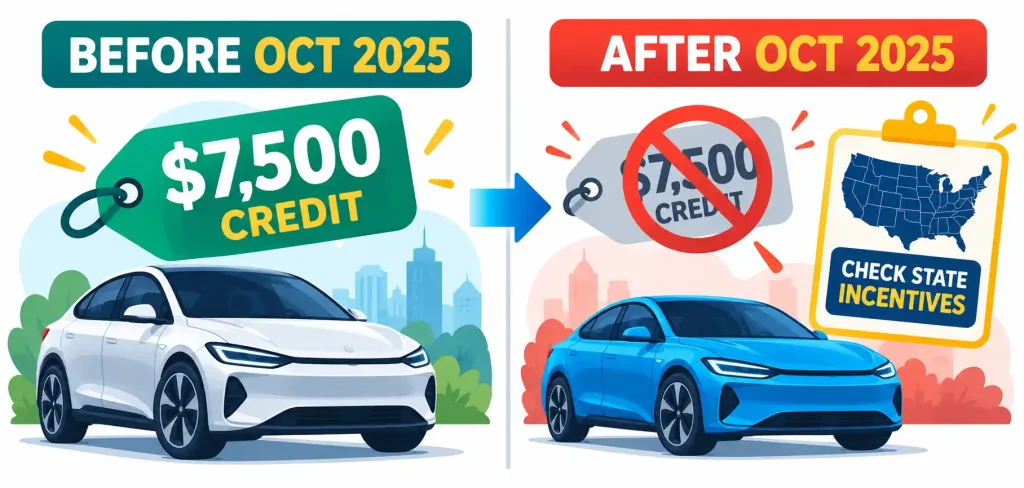
This is the piece that’s genuinely out of date in older EV content, and it matters for anyone budgeting a purchase: the federal EV tax credit (up to $7,500 for new vehicles, up to $4,000 for qualifying used ones, under Internal Revenue Code Sections 30D and 25E) ended for vehicles placed in service after September 30, 2025, under the 2025 tax and budget legislation that eliminated it ahead of its original scheduled expiration.
If you’re pricing out an EV purchase now, don’t assume that credit applies — it doesn’t, for purchases after that date. State and local EV incentives are a separate matter and vary considerably; some remain active independent of the federal credit’s status, so checking your specific state’s current program is worth doing before assuming a purchase price either way.
Total Cost of Ownership: Still Favorable, Just Not Automatically
EVs still typically carry a higher upfront purchase price than a comparable gas vehicle, though that gap has narrowed as battery costs have come down and more EV models have entered the market at lower price points. Where EVs still generally win is in running costs: electricity is typically cheaper per mile than gasoline (though this varies by local electricity rates and gas prices), and EVs have meaningfully fewer moving parts in their drivetrain — no oil changes, no spark plugs, no exhaust system — which tends to mean lower routine maintenance costs over the vehicle’s life.
Without the federal purchase credit narrowing the upfront price gap the way it used to, the total-cost-of-ownership math now depends more heavily on how many miles you drive annually (more miles means the running-cost savings offset the higher purchase price faster) than it did when the credit was active.
Charging: Better Than a Few Years Ago, Still a Real Consideration
Public charging infrastructure has expanded substantially, including federally-funded network buildouts and the opening of previously proprietary fast-charging networks (notably Tesla’s Supercharger network) to vehicles from other manufacturers using adapters or built-in compatible connectors. That said, public charging density still doesn’t match gas station density everywhere, and charging time, even on a fast charger, is longer than a gas fill-up — meaningfully longer on a standard home outlet.
For most EV owners with access to home charging, the practical reality is charging overnight and rarely needing public infrastructure for daily driving, with public fast-charging reserved mainly for longer trips. Drivers without reliable home or workplace charging access face a genuinely different, more complicated calculation, and that gap is worth being honest about rather than glossing over.
Who EVs Make the Most Sense For Right Now
- Drivers with reliable home or workplace charging access, since that removes most of the day-to-day friction around charging.
- Higher-mileage drivers, since running-cost savings accumulate faster and offset the purchase price gap more quickly.
- Drivers in regions with a cleaner electricity grid and active state-level incentives, since both improve the emissions and cost picture further.
- Drivers prioritizing the driving experience itself — quiet, smooth, instant-torque acceleration — independent of the financial calculation.
The Bottom Line
Electric driving still offers a genuinely different, often preferable driving experience and a real (if more modest than a couple of years ago) cost and emissions advantage over gas vehicles — but the math changed meaningfully when the federal purchase credit ended in late 2025. Anyone considering a purchase now should run the numbers with current incentive eligibility (state-level, not federal) and their own actual mileage and charging access in mind, rather than relying on cost comparisons that assumed a credit that no longer applies.
Frequently Asked Questions
Is the federal EV tax credit still available?
No — the federal credit of up to $7,500 for new EVs and $4,000 for qualifying used EVs ended for vehicles placed in service after September 30, 2025, under 2025 tax legislation. Check your state’s separate incentive programs, since many remain active independent of the federal credit’s status.
Are EVs actually better for the environment than gas cars?
Generally yes over the vehicle’s full lifetime, though the exact margin depends on how clean the local electricity grid is. Tailpipe emissions are genuinely zero, but a complete comparison has to account for how the charging electricity was generated, not just the tailpipe.
Is charging an EV still inconvenient?
Less than it used to be, especially with home charging access, but public charging is still less dense than gas stations in many areas, and charging takes longer than a gas fill-up even on a fast charger. For owners with home or workplace charging, most daily driving doesn’t require public charging at all.
Do EVs really cost less to maintain than gas cars?
Generally yes — EVs have far fewer moving parts in the drivetrain (no oil changes, spark plugs, or exhaust system), which tends to reduce routine maintenance costs over the vehicle’s life, even though the upfront purchase price is still typically higher.