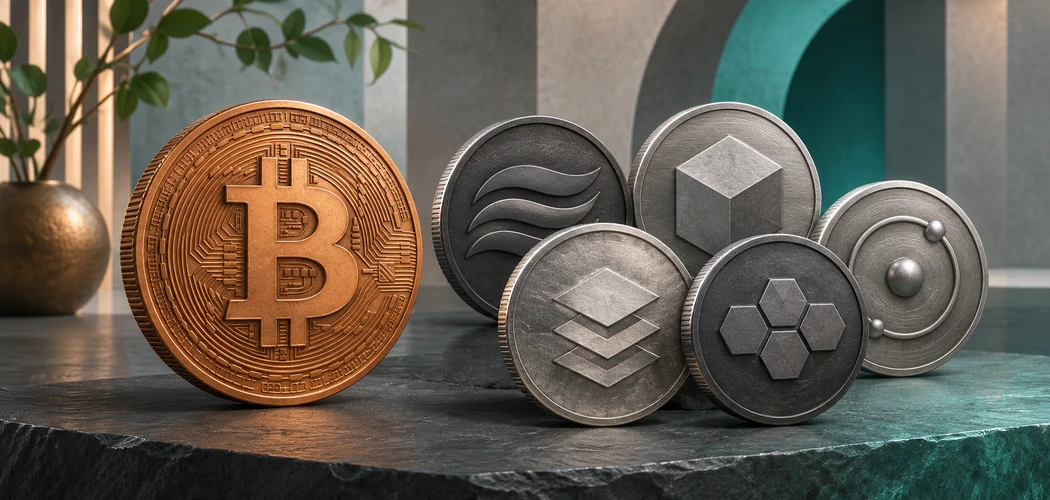
Bitcoin and altcoins are often discussed as competing investment choices. That framing can hide more than it explains. The cryptocurrency market contains payment networks, application platforms, stablecoins, governance tokens, and speculative assets with very different designs.
A useful comparison starts with what an asset does, how its supply works, and what risks come with holding it. A familiar name, a low unit price, or a large online following does not answer those questions.
This guide explains Bitcoin versus altcoins through practical distinctions: network purpose, token supply, market capitalization, liquidity, custody, and the limits of market indicators. It does not rank coins or predict returns.
Bitcoin vs altcoins: what the terms mean
Bitcoin is both the name of a blockchain network and, in everyday usage, its native asset. BTC is the asset’s common ticker. The network records transfers and uses proof of work as part of its consensus process.
Altcoin is a broad informal term for a cryptocurrency other than Bitcoin. It does not identify one technical design, legal category, or level of risk. Depending on the speaker’s convention, the term can include ether, native coins from other networks, and tokens issued through smart contracts.
That breadth matters. Comparing Bitcoin with a stablecoin is different from comparing it with a token used in a lending application. The first comparison may involve an intended currency peg. The second may involve software permissions, governance, or incentives.
Before comparing two assets, write down their full names, tickers, networks, and official documentation. Similar tickers can refer to unrelated projects. A token’s identity should be established before its price or marketing is evaluated.
What distinguishes Bitcoin
Bitcoin’s issuance rules limit its supply to approximately 21 million BTC. New issuance follows a schedule in which the block subsidy falls over time. That predictable design is one reason scarcity features prominently in discussions of Bitcoin.
Scarcity alone does not establish a fair price or guarantee demand. An asset can have a limited supply and still experience large losses. Bitcoin.org’s information for new users explicitly warns about price volatility and the need to protect a wallet.
Bitcoin is sometimes described as digital gold or an inflation hedge. Those descriptions express a proposed role or investment thesis. They should not be read as a promise that its price will rise when consumer prices rise, or that it will preserve value over a particular period.
For a reader comparing assets, the useful questions are concrete. What are the issuance rules? What activity does the network support? What fees apply? How will the asset be held? These questions are more informative than a label such as “safe crypto.”
Altcoins represent different technical models
Ethereum illustrates why altcoins should not be treated as one uniform group. Ethereum supports smart contracts, which are programs deployed on the network. Its native asset is ether, commonly identified as ETH. Ethereum uses proof of stake, and transaction fees on the network are denominated in ETH.
Tokens issued through Ethereum smart contracts are distinct from ETH itself. Holding one of those tokens does not necessarily confer ownership in the Ethereum network, a claim on a company, or a right to receive income.
Another example is XRP. XRP is the native asset of XRP Ledger. Ripple is a technology company associated with parts of that ecosystem. The company, the network, and the asset should be named separately when their roles matter.
The same discipline applies elsewhere. A project may operate a network, publish software, issue a token, and maintain a foundation. Those are different components. Ask which component performs the claimed function and what role the asset actually plays.
Stablecoins need a separate risk discussion
Stablecoins generally aim to maintain a value linked to a reference asset, often a national currency. That purpose differs from an asset whose market price is allowed to fluctuate freely.
An intended peg is not a guarantee. Designs can depend on reserves, collateral, redemption arrangements, market incentives, or combinations of these. The relevant risks depend on the particular arrangement.
For example, Circle’s USDC disclosures identify secondary-market price dislocation, reserve-related risks, and technological risks. These disclosures are a reminder to examine the issuer and product documentation rather than interpreting the word “stable” as a promise of no loss.
When comparing a stablecoin with Bitcoin or another volatile asset, separate the intended purpose from the actual protections. Check redemption eligibility, supported networks, custody terms, and the difference between an issuer’s token and a bridged representation supplied by another service.
A practical comparison framework
| Question | Bitcoin | Altcoins |
|---|---|---|
| What is being compared? | A particular network and native asset | A broad group requiring asset-by-asset research |
| How does supply work? | Scheduled issuance with a supply limit | Rules vary by network or token |
| What gives the asset a role? | Uses and demand associated with Bitcoin | Payments, applications, governance, pegs, or other designs |
| What technical risks apply? | Network, wallet, and service risks | Network, wallet, service, and potentially additional contract risks |
| Can value be lost? | Yes | Yes, with the risk profile depending on the asset |
The table is a starting point. A complete comparison requires the current documentation and terms for each asset and service involved.
Market capitalization is more useful than unit price
A coin priced at a few cents is not automatically cheaper in valuation terms than one priced in thousands of dollars. The number of units in circulation matters.
Market capitalization is commonly calculated as price multiplied by circulating supply. Consider a hypothetical token priced at $0.10 with 100 billion units circulating. Its calculated market capitalization would be $10 billion. A different token priced at $100 with 10 million circulating units would have a market capitalization of $1 billion.
These are arithmetic examples, not live market figures or investment recommendations. They demonstrate why unit price alone creates a misleading comparison.
Also examine how circulating supply is determined and whether additional units may enter circulation. Scheduled unlocks, ongoing issuance, and allocations can change the supply picture. A project’s maximum supply, total supply, and circulating supply may be different quantities.
Market capitalization is not the amount of money invested in an asset. Nor does it mean every holder could sell at the displayed price.
Bitcoin dominance measures a share, not a trading instruction
Bitcoin dominance expresses Bitcoin’s market capitalization as a percentage of the total cryptocurrency market capitalization used by a data provider.
In a hypothetical market worth $2 trillion, a Bitcoin market capitalization of $1.2 trillion would imply 60% dominance. The calculation describes relative size at that point. It does not establish what any asset will do next.
Dominance can rise while both Bitcoin and other assets fall, if the other assets fall more. It can also decline while Bitcoin rises, if the rest of the measured market grows faster. The direction of dominance therefore needs to be read alongside absolute price changes.
CoinMarketCap cautions that dominance is not a definitive guide to investment strategy or market health. Data coverage and the assets included in a provider’s total also matter when comparing measurements.
A change in market share is an observation. Turning it into a forecast requires assumptions that may prove wrong.
Liquidity and costs affect the experience
A displayed market price is only part of a transaction. Liquidity describes the ability to trade without substantially moving the price. The amount you intend to trade and the particular trading venue both matter.
Compare the bid-ask spread, available order depth, and trading fees. A small fee percentage may look attractive while a wide spread makes the overall transaction costly. Thin markets can also make it difficult to exit a position near the quoted price.
Distinguish platform charges from network fees. A service may impose a withdrawal fee separately from the cost of processing a blockchain transaction. Supported networks, minimum withdrawal amounts, and processing rules should be checked before funds are committed.
Avoid assuming that a larger project guarantees uninterrupted access through a particular platform. The asset and the service holding it create separate areas of risk.

Custody changes who controls access
The SEC’s crypto asset custody bulletin explains the difference between self-custody and third-party custody. With self-custody, the holder manages access to private keys. With third-party custody, a provider manages that access.
Each arrangement introduces responsibilities. Losing access to private keys or a recovery phrase may cause permanent loss. A third-party provider can create exposure to hacking, shutdown, or insolvency.
Before choosing an arrangement, identify who controls the keys, how recovery works, and what happens if the provider stops operating. Read whether assets may be pooled or used for other purposes. Understand account and transfer fees as well.
Never disclose a seed phrase or private key to someone claiming to provide customer support. Use strong account authentication and verify the destination network and address before making a transfer. Technical familiarity and careful procedures matter regardless of the asset’s market rank.
Build a research checklist around the asset
A short written checklist can prevent marketing from setting the direction of research. Start with the project’s purpose and official technical documentation. Then examine supply rules, governance arrangements, and the asset’s actual role.
Look for an explanation of who can change important parameters or exercise administrative powers. If a contract has been audited, identify the audit’s date, scope, and software version. An audit is evidence about particular work, not a promise that every risk has been removed.
Record your sources and the date you checked them. Fees, service availability, software, and regulatory requirements can change. When a claim is unclear, mark it as unresolved instead of replacing missing evidence with confidence.
NetworkUstad’s crypto and blockchain coverage provides broader background on networks, custody, and decentralized finance. Use educational material to frame questions, then verify product-specific details through current primary sources.
Compare risks before expecting rewards
Bitcoin and altcoins share exposure to market uncertainty, but their designs and dependencies differ. Supply limits, smart-contract features, or payment capabilities do not guarantee investment performance.
A useful comparison explains the asset’s purpose, how it operates, what its market metrics show, and how access will be protected. It also leaves room for uncertainty. If the mechanics or risks remain unclear, further research is a reasonable outcome.
The goal is to understand what you are evaluating. A sound explanation should make the differences clearer without promising a winning asset, a reliable trading signal, or a secure return.