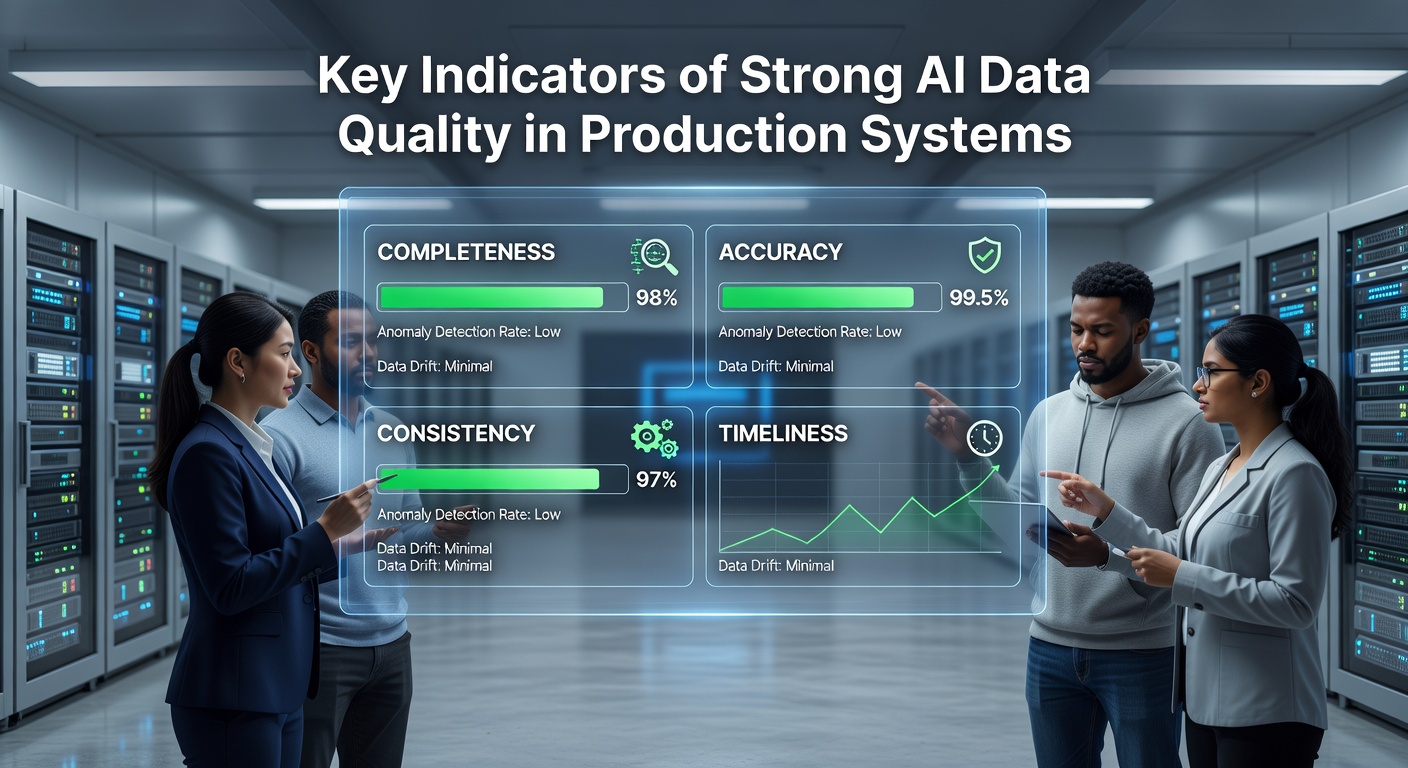
AI systems operating in production environments are held to defined performance thresholds, compliance mandates, and operational reliability standards. When data quality degrades, model performance follows, introducing compliance exposure, output instability, and downstream application failures.
AI data quality is not a fixed attribute but a governed state, maintained through structured processes and continuous oversight. It reflects the dataset’s ability to produce consistent model behavior, align with operational use cases, and withstand evaluation under production conditions.
Consistency Across Annotation and Labeling
Consistency in annotations is a foundational indicator of data quality in any production-grade training pipeline. Labeling should remain consistent across all inputs, regardless of scale or the number of annotators contributing to the workflow.
In enterprise environments, annotation consistency is enforced through standardized frameworks, recurring calibration sessions, and multi-tiered quality assurance. When ambiguity arises, structured escalation protocols route contested labels to domain experts for adjudication. These experts refine annotation guidelines to close gaps, ensuring organizational consistency as edge cases surface.
Alignment With Real-World Use Cases
High-quality datasets are directly aligned with the environment in which models operate. This is demonstrated through domain-specific language, task-specific inputs, and policy-sensitive scenarios based on real-world conditions.
Misaligned datasets produce models that pass benchmark evaluations but fail under production conditions, a common and preventable failure mode. Quality data includes adversarial and boundary-condition inputs designed to stress-test model behavior at its operational limits.
The alignment allows for an effective evaluation process based on relevant scenarios.
Coverage of Edge Cases and Risk Scenarios
Comprehensive data coverage is another key indicator of quality. Beyond nominal inputs, production-grade datasets must include rare, atypical, and adversarial examples that reflect real-world risk scenarios.
Red-team datasets and synthetic data generation are often used to expand coverage into underrepresented input distributions. These inputs function as risk management tools, as they allow organizations to evaluate model behavior against high-risk conditions without relying solely on organic data.
However, uncontrolled expansion of coverage introduces noise that can dilute training signals and degrade model consistency.
Integration With Evaluation and Benchmarking
The quality of data is closely tied to the performance of the datasets within structured evaluation frameworks. High-quality datasets produce stable, repeatable benchmark results across defined performance metrics.
Evaluation frameworks use benchmark datasets, policy-aligned prompts, and adversarial inputs to evaluate the behavior of models.
Human-in-the-loop (HITL) evaluation provides another layer of validation that automated benchmarks cannot replicate. Domain experts assess model outputs against operational criteria, including tone alignment, policy adherence, and contextual accuracy.
Traceability and Governance Controls
Traceability is a defining characteristic of enterprise-grade training data. Organizations must be able to track records against dataset creation, labeling, revision, and deployment.
This is achieved through a governance layer that includes dataset versioning, audit trails, and documentation of annotation guidelines. Recurring quality assurance cycles, calibration reviews, and performance monitoring sustain data quality over time. This lifecycle approach allows teams to identify when changes in data impact model performance and to respond with controlled adjustments.
Stability Across Model Iterations
Data quality is also reflected in model stability across multiple training cycles. When training data is properly governed, retraining with updated data should produce comparable or improved performance relative to prior baselines.
Significant performance variance across training runs is a strong indicator of underlying data quality issues. Monitoring systems track performance over time, providing early signals when data changes introduce unintended effects. This allows organizations to intervene before issues impact production systems.
Conclusion
AI data quality is a foundational determinant of model performance and reliability in production environments. It is assessed through five governance-aligned indicators: annotation consistency, use-case alignment, edge-case coverage, lifecycle traceability, and cross-iteration stability.
Organizations that implement structured data annotation systems, integrate datasets into evaluation mechanisms, and maintain governance controls reduce the risk of producing unreliable results at scale. In regulated, performance-critical environments, governed data quality is foundational infrastructure that supports reliable deployment outcomes and sustained compliance.