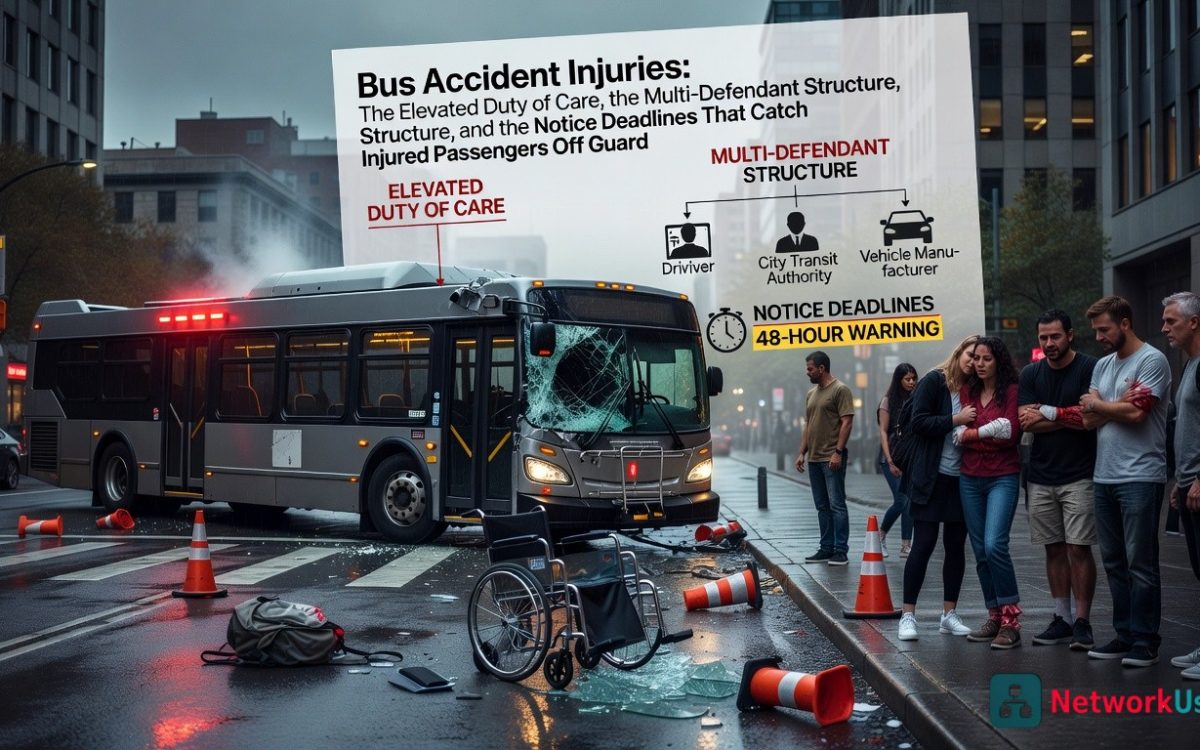
A bus accident is not legally equivalent to a car accident that happens to involve a larger vehicle. Bus operators, whether they operate public transit, school buses, charter coaches, or intercity carriers, are classified as common carriers under the law, and that classification imposes a standard of care that is specifically more demanding than the reasonable care standard applicable to ordinary drivers. When a bus crash causes serious injuries, that elevated standard is the legal foundation, and the multi-defendant structure that almost every bus accident case involves is the practical mechanism through which the full accountability available under it is pursued.
The Common Carrier Doctrine and What It Demands
A common carrier is an entity that holds itself out to transport members of the public for compensation. The law imposes upon common carriers the highest degree of care consistent with the practical operation of their enterprise for the safety of their passengers. This standard is not simply reasonable care. It is the maximum care that could reasonably be exercised given the nature of the operation. A bus driver who makes an error that a careful private motorist might also make may still have breached the common carrier standard if a bus operator exercising the highest degree of care would not have made that error.
The practical effect of the common carrier standard is that bus operators are held to greater accountability than ordinary drivers for the same conduct. A sudden stop that throws a standing passenger, a lane change executed without adequate mirror checks, a turn made without yielding to a pedestrian already in the crosswalk, and an acceleration from a stop that pitches passengers who have not yet sat down each satisfy the breach element under the common carrier standard even when the vehicle’s speed was modest and the maneuver was ordinary. The elevated duty demands greater precaution than ordinary driving requires.
Government Notice Deadlines for Public Transit Claims
When the bus involved in the crash was operated by a public transit authority, a city transportation department, or any other government entity, the resulting injury claim is subject to pre-suit notice requirements that differ by state but that uniformly operate on shorter timelines than the general personal injury statute of limitations. These notice deadlines require the injured person to file a formal written notice of their claim with the government entity within a specified period, often ranging from 30 to 180 days depending on the jurisdiction, before any lawsuit can be filed.
The government notice deadline is the most commonly missed procedural step in bus accident claims because injured passengers do not recognize that a government entity is involved or do not know about the notice requirement until they attempt to file suit after the deadline has passed. A passenger injured on a city bus, a county transit vehicle, or a school bus is a passenger injured by a government entity, and the notice requirement runs from the date of the injury regardless of whether the passenger has identified the operator’s government status.
The Multi-Defendant Structure in Bus Accident Cases
Bus accident cases regularly involve defendants beyond the driver and the operating company. The complete liability picture in a serious bus crash investigation typically includes:
- The bus company or transit authority: For negligent hiring and retention of unqualified drivers, failure to enforce safety protocols, inadequate driver training programs, and unrealistic scheduling that pressures drivers into fatigue
- Third-party maintenance contractors: When brake failures, tire blowouts, or steering defects contributed to the crash and those systems had been serviced by an outside contractor, the maintenance company bears independent liability for the work it performed
- The vehicle manufacturer: When a design or manufacturing defect in the bus itself, including structural failures, brake system defects, or rollover protection inadequacies, contributed to the crash or to the severity of passenger injuries, the manufacturer faces strict product liability claims
- The entity that contracted for the transportation: In charter, employer shuttle, and school contract bus cases, the organization that arranged and paid for the transportation may share liability when it selected an operator with inadequate safety credentials or failed to verify the operator’s qualifications
The Injury Profile Bus Crashes Produce
Buses injure their occupants through mechanisms that differ from passenger vehicle crashes. Standing passengers are particularly vulnerable to sudden stops, sharp turns, and the forces generated when a bus strikes another vehicle, because they have no seatbelt restraint and no structural protection between them and the interior surfaces of the vehicle. Seated passengers face airbag-free interiors and seats that are designed differently from passenger vehicle seats, producing specific impact patterns when the bus decelerates rapidly or rolls over.
The National Transportation Safety Board’s bus accident investigation resources document the mechanical and operational causes of serious bus crashes nationally. Wor
king with experienced attorneys
who provide legal help after a bus accident gives seriously injured passengers access to
the multi-defendant investigation, the government notice compliance, and the
common carrier duty framework that these cases require from the first days
after the crash.