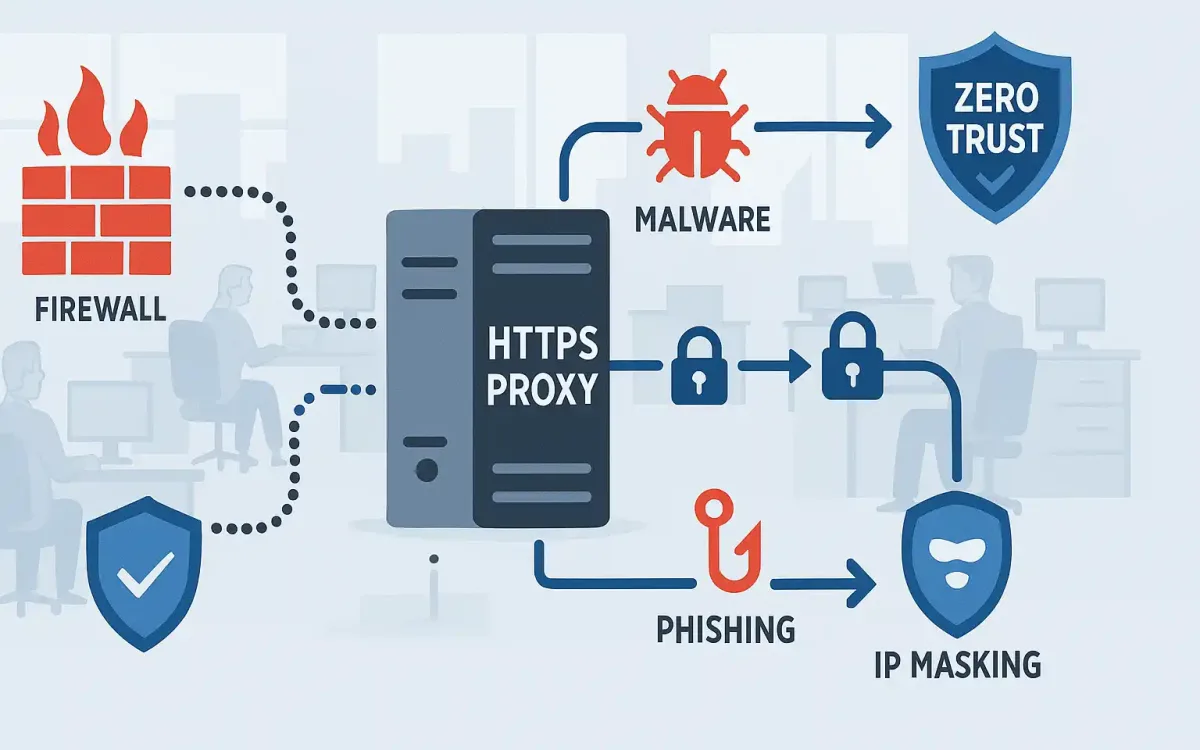
How does your team handle visibility when most of your traffic uses TLS? If you work in a large firm, enterprise network security is likely a top priority for your department. Modern threats hide inside encrypted packets, making them hard to find. We often use tools like HTTPS proxies to look inside these streams. But why do we need them? They are an intermediate point between the user and the web. They help teams inspect data without breaking the trust of the network security.
The Role of Traffic Inspection in Enterprise Network Security
Visibility is a big problem for modern IT teams. Did you know that over 95% of web requests across Google are now encrypted? Because of this, traditional firewalls often miss malicious code. An intermediate server helps by performing encrypted traffic management to see what is inside the packets. What it does:
- intercepts the client request;
- establishes a separate connection;
- decrypts the traffic for a short time;
- checks for malware or file leaks;
- re-encrypts the information and sends it to the user.
This process allows for deep inspection. Without it, your defenses are blind to encrypted threats. But how do you make sure this does not slow down the user? We use caching and optimized routing to keep speeds high. This makes the system more efficient while adding a layer of defense.
Improving Visibility and Control
Large organizations need to know what happens on their wires. Have you ever wondered whether your users are transferring sensitive files to personal clouds? Proxies help with 2 monitoring by logging every request. These logs indicate the sites visited by users and the amount of data transferred.
And in case you have dynamic routing protocols, you can route flows to these servers according to certain rules. This assists you in balancing the load at various points of inspection. You are also able to block certain types of files or websites that are not in line with the company security policy.
Performance Optimization Through Caching
It is believed that proxies make things slow. But the right setup actually helps with performance optimization. These gateways maintain replicas of common web pages. The proxy will provide the same page when requested by a second user, but this time it will be provided out of its own storage.
- Less external bandwidth consumption.
- Reduced load time of popular resources.
- Reduced latency of branch offices.
This is useful in firms that have numerous international destinations. With VLAN configuration best practices, it is possible to isolate traffic to particular segments. This keeps your inner ways clear and quick. It also saves you on your internet bills.
Tradeoff Between Load and Scalability
Your bandwidth increases as your business expands. You need a scalable network infrastructure that can handle peak times. We often use load balancing with proxies to spread the work across many servers. This helps to avoid overcrowding of any one point.
- The request is sent to a hardware or software balancer.
- It selects the least occupied server.
- The node does the hard work of TLS decryption.
This configuration keeps the network steady. In case of failure of one server, the load is absorbed by the other servers. This is essential to 24/7 operations.
Remote Access and Enterprise Compliance
Working remotely has become the norm in business. But how do you secure remote connections? Proxies ensure that internal tools are not exposed to the public web. This serves as a filter to your personal applications.
| Requirement | Solution |
| Activity Logging | Record all URLs and timestamps. |
| Leak Prevention | Scan outgoing files to find sensitive information. |
| Access Control | Authenticate user identity before permitting connections. |
Companies are usually obligated by regulatory rules to record all web activity. You have to demonstrate that you safeguard confidential information. Using these tools guarantees corporate network compliance by creating a detailed audit trail.
Technical Integration with Detection Systems
Gateways are not only URL filters. They provide intrusion detection support by sending packet copies to analysis tools. In case the system detects a familiar pattern of a virus, it can terminate the connection instantly. This occurs prior to the threat reaching the end-user device.
In selecting an HTTPS proxy, you need to consider its compatibility with your existing stack. A good proxy provider offers APIs and standard logging formats. It is easy to insert the solution into your SIEM (Security Information and Event Management) system.
Advanced IP Rotation
In some cases, internal tools used in the enterprise require the collection of public records on the web to conduct research. In these cases, we use IP rotation techniques to avoid being blocked by target sites. This is by employing a pool of various addresses to make outgoing requests.
- It prevents rate limiting.
- It enables a more precise collection.
- It checks the appearance of your site in other areas.
However, these tools should be used in an ethical manner. We scale them well within platform constraints in the collection. This enables teams to obtain the data they require without manual effort.
Analyzing the Costs of Enterprise Network Security Tools
The prices depend on the nature of the service and the number of requests. The following are some of the common prices that you would encounter with a reputable vendor:
- IPv4: Approximately $2.00 to $2.50 per IP/month.
- IPv6: It is significantly cheaper, typically between $0.15 and $0.20 per IP.
- ISP: Typically costs between $3.00 and $5.00 per IP since they are more stable.
- Mobile: These are the most costly, and they may cost between $30.00 and $50.00 per month.
Purchasing in large quantities normally reduces the cost. You are also to check whether the vendor provides 24/7 support.
Pros and Cons for Enterprises
There are trade-offs in every technology. You have to choose whether the work is worth the benefits.
Pros:
- Increased transparency of encrypted information.
- Quick web browsing by local caching.
- Less difficult adherence to corporate rules.
- Greater regulation of user activities on the internet.
Cons:
- Increased complexity to the network design.
- Increased latency when the node is underpowered.
- Unless it is balanced, the server turns into a single point of failure.
- Possible privacy issues when not handled properly.
We discover that these cons are accepted by most large firms to enable them to have the control they require. It is important to create a backup system. This ensures that a single malfunctioning server does not destroy the entire office.
Enterprise Network Security Best Practices for Deployment
To begin with, you need to set your objectives. Would you like to conserve bandwidth or locate threats? Next, you will be able to select the appropriate software, such as Squid, Nginx, or a cloud-based solution.
- Begin with a limited pilot group of users.
- Watch any broken websites (not all apps are friendly with the inspection of the SSL).
- Fine-tune your bypass lists for banking or healthcare sites.
- Scale up to the rest of the company slowly.
And you should always update your software. New vulnerabilities come out all the time. Keeping the system patched is the most important part of enterprise network security.
Managing Work Profiles
Instead of tracking individuals, we use work profile management to group users. You can give different permissions to the HR team and the Dev team. This simplifies your rules. It also makes it easier to change settings as people join or leave the company.
Future Trends in Enterprise Network Security
What is next for this technology? We see a move toward Zero Trust architectures. In this model, the gateway checks the device’s health before allowing any traffic. This means even if a user has the right password, they cannot get in if their laptop is infected.
We also see more AI being used in enterprise network security. Intermediaries will soon be able to spot “weird” behavior without needing a specific rule. This will catch zero-day threats that have never been seen before. But for now, a well-configured server remains a strong asset for any IT team.
FAQs
What are the key benefits of using HTTPS proxies in enterprise networks?
HTTPS proxies enhance security by encrypting traffic to prevent interception, masking IP addresses for anonymity, filtering malicious content like malware and phishing, and enabling content control to block unauthorized sites. They support Zero Trust models, improve performance through caching, and allow monitoring for compliance, making them essential for protecting sensitive corporate data in modern digital environments.
How do HTTPS proxies support Zero Trust security architectures?
In Zero Trust, HTTPS proxies act as intermediaries verifying every request, regardless of origin, by filtering traffic, enforcing multi-factor authentication, and detecting anomalies like rapid login attempts. They provide granular access control, TLS termination for encryption, and IP masking to limit targeted attacks, ensuring no implicit trust and continuous validation in enterprise networks.
What challenges might enterprises face when implementing HTTPS proxies?
Challenges include configuration complexity for SSL decryption, potential performance overhead from traffic inspection, compatibility issues with legacy systems, and risks of man-in-the-middle attacks if not properly secured. Enterprises must balance security with usability, ensure proxy reliability, and train staff on policies to avoid bypassing, while complying with privacy regulations.
How does TLS termination work with HTTPS proxies?
TLS termination involves the proxy decrypting incoming HTTPS traffic to inspect and filter contents before re-encrypting and forwarding to the destination. This enhances security by blocking threats in transit, but requires trusted certificates to avoid warnings; it’s crucial for enterprises to detect hidden malware while maintaining end-to-end encryption integrity.
Can HTTPS proxies improve network performance in enterprises?
Yes, by caching frequently accessed content, HTTPS proxies reduce bandwidth usage and speed up responses, minimizing latency for users. They also optimize traffic routing and compress data, benefiting large organizations with high web activity, though initial setup may require tuning to avoid bottlenecks from intensive filtering or decryption processes.