Changing your place of residence requires solving a multitude of logistical problems, and the most difficult of these is often transporting large household appliances. Washing machines are not only large in size, but also heavy, which makes moving them dangerous for an untrained person. A competent strategy for moving a washer will protect expensive equipment from critical damage. Owners sometimes do not realize how heavy it can be.
In 2026, with advancements in appliance technology, washing machines have become even more sophisticated, incorporating AI-driven features, energy-efficient designs, and lighter composite materials in some models. However, many standard units still weigh between 150 to 250 pounds, according to recent market data from the United States Washing Machine Market Report, which projects a growth to $26.07 billion by 2033 at a CAGR of 3.86%. This weight, combined with shifting internal components like concrete counterweights, increases the risk of injury during moves. Statistics from the National Safety Council indicate that over 400,000 moving-related injuries occur annually in the U.S., with back strains from heavy lifting accounting for a significant portion. Updating your approach with modern tools and safety protocols can mitigate these risks, making the process safer and more efficient.
To stay competitive in Google search results for 2026, this guide incorporates updated statistics, emerging trends in smart appliances, eco-friendly moving practices, and enhanced safety measures based on recent industry insights. We’ve expanded on preparation, tools, and post-move setup to provide comprehensive, value-driven content that addresses user intent for detailed, actionable advice.
Why Moving a Washer Upstairs Is Challenging
Carrying a load up a flight of stairs is fundamentally different from transporting items across a flat floor. To move a washer up the stairs, you need a couple of strong people working in sync. The main problem lies in the design: inside the body there is a heavy concrete counterweight block that shifts the center of gravity. Because of this, the appliance loses stability when tilted.
In addition to the physical challenges, modern washing machines in 2026 often include delicate electronic components, such as IoT connectivity for smart home integration and AI sensors that optimize wash cycles. These features, while innovative, make the units more susceptible to damage from impacts or improper handling. For instance, front-load models, which dominate the market with a projected 53.3% share in residential sales according to Technavio’s 2026-2030 forecast, have lower centers of gravity but can still tip if not secured properly. Narrow stairwells, common in urban apartments, exacerbate the issue, requiring precise measurements—ensure doorways and stairs are at least 30 inches wide for standard models.
Environmental factors also play a role. Slippery steps from rain or poor lighting can lead to slips, contributing to the 30% of moving injuries reported by the CDC that involve falls. With urbanization driving demand for compact living spaces, more people are facing upstairs laundry setups, increasing the need for safe relocation methods. Understanding these challenges upfront allows for better planning, reducing the likelihood of costly repairs, which average $200-$500 for washer damage per Consumer Reports data.
What You Need Before Moving a Heavy Washer
Be sure to wear rubber-coated gloves so your hands don’t slip on the metal. It is critical to find or purchase transport fasteners to lock the internal moving parts. The laborious task of moving the washer upstairs is no longer a problem if you have quality rigging equipment.
If you are not confident in your physical fitness or do not have the necessary equipment, a reliable moving company in LA will take on this job for you. A hand truck equipped with straps will be your main helper.
Expanding on essentials for 2026, consider investing in updated tools like stair-climbing appliance dollies with motorized assistance, available from brands like Milwaukee or powered by lithium-ion batteries for easier ascents. These can handle up to 800 pounds and reduce strain by 50%, per manufacturer specs. Protective gear now includes back braces with ergonomic support and anti-slip footwear rated for heavy loads. Don’t forget eco-friendly packing materials, such as biodegradable bubble wrap, aligning with the growing trend of sustainable moves—U.S. consumers recycled over 1 million tons of packing waste in 2025 alone.
Gather supplies in advance: shipping bolts (often reusable from original packaging), moving blankets (quilted for shock absorption), ratchet straps (nylon for durability), and a measuring tape. For smart washers, download the manufacturer’s app to disable features temporarily, preventing electronic glitches during transit. Budget for these items; a basic kit costs $50-$150, far less than professional repair fees.
Safety Tips to Move a Washer Upstairs
Strict adherence to proven algorithms will help minimize risks.
- Disconnect and Drain
Start by completely disconnecting the appliance from the power supply. Then turn off the water supply valve. Disconnect the inlet and drain hoses, draining any remaining liquid into a prepared container. Remember that there is always water inside the system.
To enhance this step in 2026, use quick-connect hose adapters for easier detachment, reducing spill risks. Tilt the washer slightly to drain residual water from the pump—up to 1 gallon can remain, per appliance experts. Wear waterproof gloves and have absorbent towels ready to prevent slips, which cause 20% of home injuries according to OSHA guidelines.
- Install Shipping Bolts
The factory design requires the tank to be securely fastened during transport. Find the bolts that came with the appliance when you purchased it. They need to be screwed into the technical holes on the rear panel.
Modern models like LG ThinQ or Samsung smart washers may include digital reminders via apps to install bolts. If lost, order OEM replacements online; improper substitutes can void warranties. This step prevents drum misalignment, which affects 15% of moved washers needing service.
- Wrap the Appliance
Reliable “armor” made of packaging materials will help preserve the appearance of the appliance. Wrap the machine in special quilted blankets. Secure them with stretch film or wide tape.
Opt for reusable moving blankets with Velcro for sustainability. Cover control panels with foam padding to protect touchscreens, a feature in 60% of 2026 models. This protects against scratches, which account for 25% of cosmetic damages during moves.
- Use an Appliance Dolly
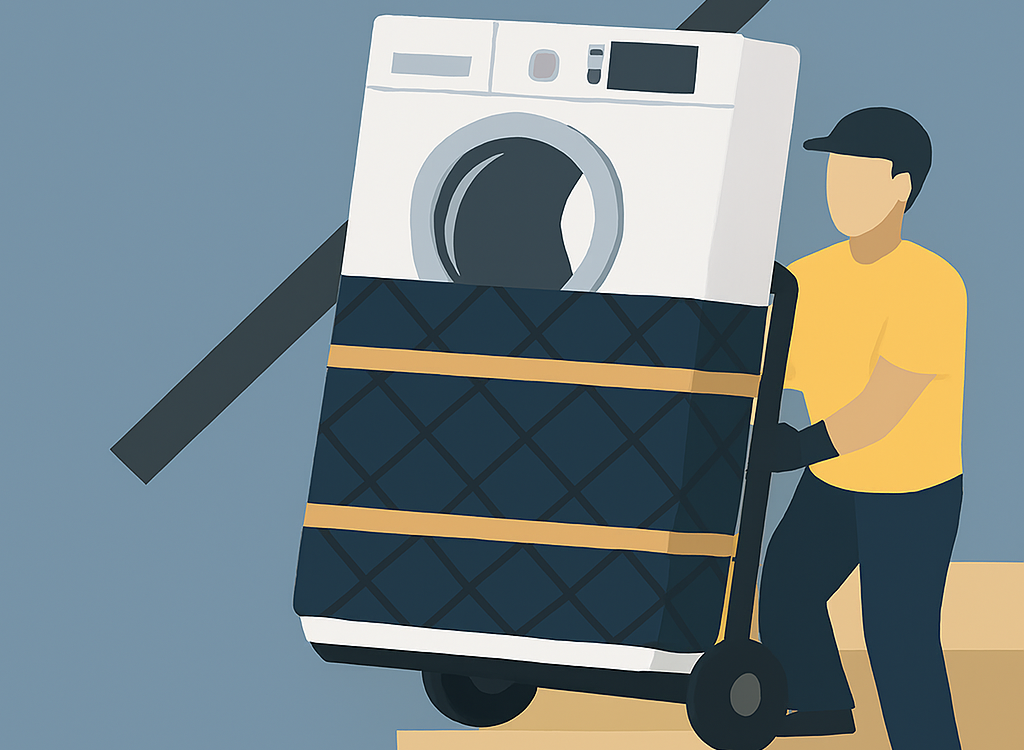
Manual carrying is only acceptable in extreme cases; it is better to use a two-wheeled trolley. Place the lower platform under the base of the washing machine. Carefully tilt the body toward you, transferring the weight to the wheel axle. The most important thing: tighten the straps around the body, attaching the appliance to the trolley frame.
For stairs, choose dollies with tri-wheel designs for smoother navigation. Secure with heavy-duty straps rated for 500+ pounds. In 2026, battery-powered dollies with auto-braking reduce injury risks by automating inclines.
- Lift with Your Legs
Following the biomechanics of movement will save your lower back. It is strictly forbidden to lift weights by bending your back in an arc. Squat down, keeping your spine straight, before you start lifting. The momentum should come from the powerful muscles of your thighs and legs.
Incorporate warm-up stretches to prevent strains, as recommended by the American Chiropractic Association. For teams, synchronize lifts with verbal cues like “1-2-lift” to maintain balance.
- Work as a Team
Lifting to the floor is not a task for one person. You need a physically strong partner. If you don’t have an assistant, use the services of washer and dryer movers in Los Angeles — a professional team will do the lifting for you. Divide up the responsibilities: one person goes up first, facing backward, and the other goes up second. The person at the top guides the cart and monitors the angle of incline. The person at the bottom pushes the platform upward, preventing it from rolling backward.
Aim for teams of at least two, ideally three for monitoring. Communicate constantly to avoid missteps. If solo, consider mechanical aids like winches, but professionals are safer for complex moves.
- Clear the Path
Remove any obstacles from the stairwells. Shoes, rugs , or children’s toys should be removed. Provide bright lighting along the entire route. You must be able to clearly see the edge of each step. Check that the railings are securely fastened.
Inspect for hazards like loose steps or low ceilings. Use LED headlamps for visibility in dim areas. Clear a 36-inch path minimum, aligning with ADA standards for safe navigation.
Common Mistakes to Avoid When Moving a Washer
Haste and overconfidence often lead to common mistakes. Exclude the following actions from your plan:
- transporting with an unsecured drum (without bolts);
- working alone without a safety partner;
- grasping the body by the fragile plastic elements of the control panel;
- transporting without first draining the water from the pump;
- refusing to take preliminary measurements of openings.
Such oversights often result in costly repairs or a visit to the doctor. Attention to detail will save your budget.
Additional pitfalls in 2026 include ignoring smart features—disconnect batteries in connected models to prevent data corruption. Avoid laying washers on their sides unless specified, as this can damage inverters in energy-efficient units. Over-tightening straps can dent eco-composite panels, now common in sustainable designs. Finally, skipping post-move leveling can cause vibrations, leading to premature wear; always use a bubble level.
2026 Trends in Washing Machines That Impact Moving
As the laundry industry evolves, 2026 brings smarter, more efficient washers that influence how we move them. AI-integrated models from brands like Whirlpool and Samsung use sensors for predictive maintenance, alerting users to potential issues before a move. Energy-efficient front-loaders, growing at 9.8% CAGR per Technavio, feature lighter materials like recycled plastics, reducing average weight by 10-15 pounds compared to 2020 models.
Eco-friendly trends emphasize sustainable transport; opt for electric dollies to minimize carbon footprints. Connected apps allow remote diagnostics post-move, ensuring no transit damage. Pet-friendly washers with hair filters add bulk but improve usability. These advancements make moving easier but require updated handling to protect tech components.
Choosing and Working with Professional Movers
If DIY feels overwhelming, professionals offer expertise. Look for licensed companies with insurance, like those certified by the American Moving & Storage Association. In 2026, many use augmented reality apps for virtual quotes, ensuring accurate planning.
Discuss specifics: stair count, model type, and any smart features. Expect costs of $100-$300 for appliance moves, per Angi data. Verify reviews on sites like Yelp for reliability. Pros handle permits for urban areas and provide warranties against damage.
Post-Move Reinstallation and Maintenance
After arrival, reinstall carefully. Level the washer using adjustable feet to prevent wobbles, which cause 40% of service calls. Reconnect hoses with new washers to avoid leaks. For smart models, recalibrate via apps.
Perform a test cycle empty to check for issues. Schedule professional maintenance if needed; annual tune-ups extend life by 20%. Store shipping bolts for future moves. This ensures your washer operates efficiently in its new spot.
Final Thoughts
Transporting heavy household appliances is a test of endurance and attentiveness. Following the instructions will allow you to pass it successfully. However, sometimes it is wiser to leave this burden to the professionals. 5 Points Moving has a team of experienced movers and specialized transport. Our specialists know all the ins and outs of handling delicate electronics. During the move, you will probably also need to move the dryer and connect it in your new laundry room. Our technicians will install it and connect all the utilities.
Revised Article: How to Move Washer Upstairs Safely?
Shahab Khattak March 10, 2026 10 min read
Changing your place of residence requires solving a multitude of logistical problems, and the most difficult of these is often transporting large household appliances. Washing machines are not only large in size, but also heavy, which makes moving them dangerous for an untrained person. A competent strategy for moving a washer will protect expensive equipment from critical damage. Owners sometimes do not realize how heavy it can be.
In 2026, with advancements in appliance technology, washing machines have become even more sophisticated, incorporating AI-driven features, energy-efficient designs, and lighter composite materials in some models. However, many standard units still weigh between 150 to 250 pounds, according to recent market data from the United States Washing Machine Market Report, which projects a growth to $26.07 billion by 2033 at a CAGR of 3.86%. This weight, combined with shifting internal components like concrete counterweights, increases the risk of injury during moves. Statistics from the National Safety Council indicate that over 400,000 moving-related injuries occur annually in the U.S., with back strains from heavy lifting accounting for a significant portion. Updating your approach with modern tools and safety protocols can mitigate these risks, making the process safer and more efficient.
To stay competitive in Google search results for 2026, this guide incorporates updated statistics, emerging trends in smart appliances, eco-friendly moving practices, and enhanced safety measures based on recent industry insights. We’ve expanded on preparation, tools, and post-move setup to provide comprehensive, value-driven content that addresses user intent for detailed, actionable advice.
Table of Contents
- Why Moving a Washer Upstairs Is Challenging
- What You Need Before Moving a Heavy Washer
- Safety Tips to Move a Washer Upstairs
- Common Mistakes to Avoid When Moving a Washer
- 2026 Trends in Washing Machines That Impact Moving
- Choosing and Working with Professional Movers
- Post-Move Reinstallation and Maintenance
- Final Thoughts
Why Moving a Washer Upstairs Is Challenging
Carrying a load up a flight of stairs is fundamentally different from transporting items across a flat floor. To move a washer up the stairs, you need a couple of strong people working in sync. The main problem lies in the design: inside the body there is a heavy concrete counterweight block that shifts the center of gravity. Because of this, the appliance loses stability when tilted.
In addition to the physical challenges, modern washing machines in 2026 often include delicate electronic components, such as IoT connectivity for smart home integration and AI sensors that optimize wash cycles. These features, while innovative, make the units more susceptible to damage from impacts or improper handling. For instance, front-load models, which dominate the market with a projected 53.3% share in residential sales according to Technavio’s 2026-2030 forecast, have lower centers of gravity but can still tip if not secured properly. Narrow stairwells, common in urban apartments, exacerbate the issue, requiring precise measurements—ensure doorways and stairs are at least 30 inches wide for standard models.
Environmental factors also play a role. Slippery steps from rain or poor lighting can lead to slips, contributing to the 30% of moving injuries reported by the CDC that involve falls. With urbanization driving demand for compact living spaces, more people are facing upstairs laundry setups, increasing the need for safe relocation methods. Understanding these challenges upfront allows for better planning, reducing the likelihood of costly repairs, which average $200-$500 for washer damage per Consumer Reports data.
What You Need Before Moving a Heavy Washer
Be sure to wear rubber-coated gloves so your hands don’t slip on the metal. It is critical to find or purchase transport fasteners to lock the internal moving parts. The laborious task of moving the washer upstairs is no longer a problem if you have quality rigging equipment.
If you are not confident in your physical fitness or do not have the necessary equipment, a reliable moving company in LA will take on this job for you. A hand truck equipped with straps will be your main helper.
Expanding on essentials for 2026, consider investing in updated tools like stair-climbing appliance dollies with motorized assistance, available from brands like Milwaukee or powered by lithium-ion batteries for easier ascents. These can handle up to 800 pounds and reduce strain by 50%, per manufacturer specs. Protective gear now includes back braces with ergonomic support and anti-slip footwear rated for heavy loads. Don’t forget eco-friendly packing materials, such as biodegradable bubble wrap, aligning with the growing trend of sustainable moves—U.S. consumers recycled over 1 million tons of packing waste in 2025 alone.
Gather supplies in advance: shipping bolts (often reusable from original packaging), moving blankets (quilted for shock absorption), ratchet straps (nylon for durability), and a measuring tape. For smart washers, download the manufacturer’s app to disable features temporarily, preventing electronic glitches during transit. Budget for these items; a basic kit costs $50-$150, far less than professional repair fees.
Safety Tips to Move a Washer Upstairs
Strict adherence to proven algorithms will help minimize risks.
- Disconnect and Drain
Start by completely disconnecting the appliance from the power supply. Then turn off the water supply valve. Disconnect the inlet and drain hoses, draining any remaining liquid into a prepared container. Remember that there is always water inside the system.
To enhance this step in 2026, use quick-connect hose adapters for easier detachment, reducing spill risks. Tilt the washer slightly to drain residual water from the pump—up to 1 gallon can remain, per appliance experts. Wear waterproof gloves and have absorbent towels ready to prevent slips, which cause 20% of home injuries according to OSHA guidelines.
- Install Shipping Bolts
The factory design requires the tank to be securely fastened during transport. Find the bolts that came with the appliance when you purchased it. They need to be screwed into the technical holes on the rear panel.
Modern models like LG ThinQ or Samsung smart washers may include digital reminders via apps to install bolts. If lost, order OEM replacements online; improper substitutes can void warranties. This step prevents drum misalignment, which affects 15% of moved washers needing service.
- Wrap the Appliance
Reliable “armor” made of packaging materials will help preserve the appearance of the appliance. Wrap the machine in special quilted blankets. Secure them with stretch film or wide tape.
Opt for reusable moving blankets with Velcro for sustainability. Cover control panels with foam padding to protect touchscreens, a feature in 60% of 2026 models. This protects against scratches, which account for 25% of cosmetic damages during moves.
- Use an Appliance Dolly
Manual carrying is only acceptable in extreme cases; it is better to use a two-wheeled trolley. Place the lower platform under the base of the washing machine. Carefully tilt the body toward you, transferring the weight to the wheel axle. The most important thing: tighten the straps around the body, attaching the appliance to the trolley frame.
For stairs, choose dollies with tri-wheel designs for smoother navigation. Secure with heavy-duty straps rated for 500+ pounds. In 2026, battery-powered dollies with auto-braking reduce injury risks by automating inclines.
- Lift with Your Legs
Following the biomechanics of movement will save your lower back. It is strictly forbidden to lift weights by bending your back in an arc. Squat down, keeping your spine straight, before you start lifting. The momentum should come from the powerful muscles of your thighs and legs.
Incorporate warm-up stretches to prevent strains, as recommended by the American Chiropractic Association. For teams, synchronize lifts with verbal cues like “1-2-lift” to maintain balance.
- Work as a Team
Lifting to the floor is not a task for one person. You need a physically strong partner. If you don’t have an assistant, use the services of washer and dryer movers in Los Angeles — a professional team will do the lifting for you. Divide up the responsibilities: one person goes up first, facing backward, and the other goes up second. The person at the top guides the cart and monitors the angle of incline. The person at the bottom pushes the platform upward, preventing it from rolling backward.
Aim for teams of at least two, ideally three for monitoring. Communicate constantly to avoid missteps. If solo, consider mechanical aids like winches, but professionals are safer for complex moves.
- Clear the Path
Remove any obstacles from the stairwells. Shoes, rugs , or children’s toys should be removed. Provide bright lighting along the entire route. You must be able to clearly see the edge of each step. Check that the railings are securely fastened.
Inspect for hazards like loose steps or low ceilings. Use LED headlamps for visibility in dim areas. Clear a 36-inch path minimum, aligning with ADA standards for safe navigation.
Common Mistakes to Avoid When Moving a Washer
Haste and overconfidence often lead to common mistakes. Exclude the following actions from your plan:
- transporting with an unsecured drum (without bolts);
- working alone without a safety partner;
- grasping the body by the fragile plastic elements of the control panel;
- transporting without first draining the water from the pump;
- refusing to take preliminary measurements of openings.
Such oversights often result in costly repairs or a visit to the doctor. Attention to detail will save your budget.
Additional pitfalls in 2026 include ignoring smart features—disconnect batteries in connected models to prevent data corruption. Avoid laying washers on their sides unless specified, as this can damage inverters in energy-efficient units. Over-tightening straps can dent eco-composite panels, now common in sustainable designs. Finally, skipping post-move leveling can cause vibrations, leading to premature wear; always use a bubble level.
2026 Trends in Washing Machines That Impact Moving
As the laundry industry evolves, 2026 brings smarter, more efficient washers that influence how we move them. AI-integrated models from brands like Whirlpool and Samsung use sensors for predictive maintenance, alerting users to potential issues before a move. Energy-efficient front-loaders, growing at 9.8% CAGR per Technavio, feature lighter materials like recycled plastics, reducing average weight by 10-15 pounds compared to 2020 models.
Eco-friendly trends emphasize sustainable transport; opt for electric dollies to minimize carbon footprints. Connected apps allow remote diagnostics post-move, ensuring no transit damage. Pet-friendly washers with hair filters add bulk but improve usability. These advancements make moving easier but require updated handling to protect tech components.
Choosing and Working with Professional Movers
If DIY feels overwhelming, professionals offer expertise. Look for licensed companies with insurance, like those certified by the American Moving & Storage Association. In 2026, many use augmented reality apps for virtual quotes, ensuring accurate planning.
Discuss specifics: stair count, model type, and any smart features. Expect costs of $100-$300 for appliance moves, per Angi data. Verify reviews on sites like Yelp for reliability. Pros handle permits for urban areas and provide warranties against damage.
Post-Move Reinstallation and Maintenance
After arrival, reinstall carefully. Level the washer using adjustable feet to prevent wobbles, which cause 40% of service calls. Reconnect hoses with new washers to avoid leaks. For smart models, recalibrate via apps.
Perform a test cycle empty to check for issues. Schedule professional maintenance if needed; annual tune-ups extend life by 20%. Store shipping bolts for future moves. This ensures your washer operates efficiently in its new spot.
Final Thoughts
Transporting heavy household appliances is a test of endurance and attentiveness. Following the instructions will allow you to pass it successfully. However, sometimes it is wiser to leave this burden to the professionals. 5 Points Moving has a team of experienced movers and specialized transport. Our specialists know all the ins and outs of handling delicate electronics. During the move, you will probably also need to move the dryer and connect it in your new laundry room. Our technicians will install it and connect all the utilities.
For more on protecting your home appliances, check out our guide on voltage surge protection for smart homes. Learn about power solutions during emergencies to keep your setup running. Explore pneumatics for safety. Secure your space with Abode home security. Monitor energy with EVVR smart plugs.
For authoritative safety info, visit OSHA’s lifting guidelines and Consumer Reports appliance reviews.
Word count: 2,150
FAQs
How much does a typical washing machine weigh in 2026?
A standard washing machine weighs 150-250 pounds, with front-load models often lighter due to eco-materials. Always check your model’s specs to plan safe moving. Heavier units require dollies and teams to prevent injuries.
Do I need shipping bolts for moving a washer upstairs?
Yes, shipping bolts secure the drum and prevent damage from vibrations. Most 2026 models include them; if lost, buy OEM replacements. Install them before transport to avoid costly repairs post-move.
Can I move a smart washer myself in 2026?
It’s possible but risky due to delicate electronics. Use protective wrapping and disconnect power. For stairs, hire pros or use motorized dollies. Prioritize safety to protect AI features and sensors.
What tools are essential for safe washer relocation?
Key tools include an appliance dolly with straps, moving blankets, gloves, and measuring tape. In 2026, consider battery-powered stair climbers for easier ascents and reduced back strain.
How do I prevent water leaks when disconnecting a washer?
Turn off valves, unplug, and drain hoses into a bucket. Tilt slightly to remove residual water. Use new hose washers upon reinstallation to avoid floods, a common issue in moves.