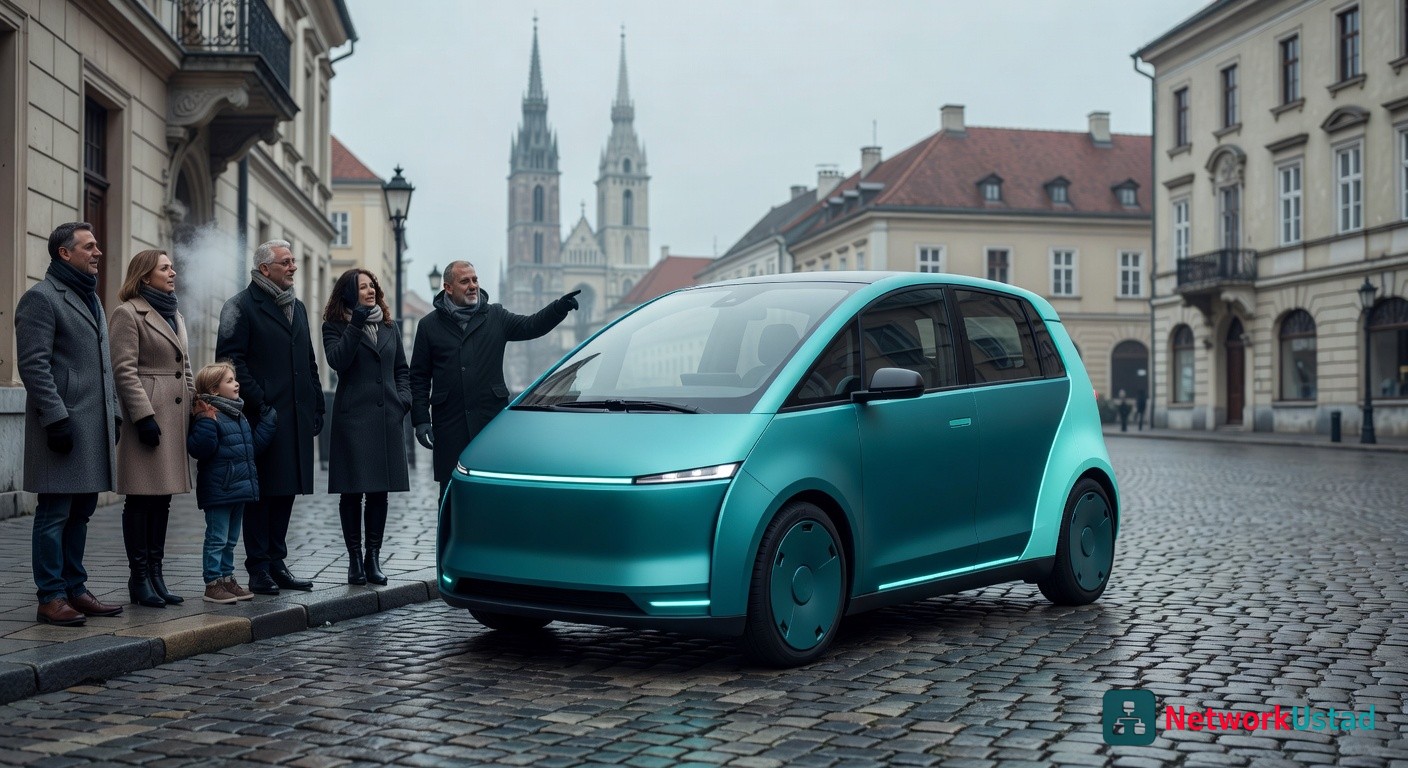
Zagreb, Croatia’s vibrant capital, marked a milestone in urban mobility by launching Europe’s first robotaxi service, operated by the local startup Rimac Automobili in partnership with Uber. This fully autonomous fleet of 20 electric vehicles began ferrying passengers across key districts on a sunny April morning, promising reduced traffic congestion and zero-emission rides. Drawing from extensive reports by the European Transport Safety Council (ETSC) and insights from the International Association of Public Transport (UITP), this service leverages advanced machine learning algorithms to navigate Zagreb’s historic streets safely.
Launch Details of Europe’s First Robotaxi Service in Zagreb
The service debuted with a pilot phase covering 15 kilometers of the city’s core, including popular areas like Ban Jelačić Square. According to a 2023 UITP report, such initiatives could cut urban CO2 emissions by up to 30% in dense European cities. Rimac’s vehicles, equipped with Level 4 autonomy, operate without human drivers, using lidar sensors and high-definition mapping for precise routing.
Operational Framework and Safety Protocols
Safety remains paramount, with each robotaxi featuring redundant encryption layers and real-time monitoring via a central cloud computing platform. The Croatian Ministry of Transport certified the fleet after rigorous testing, reporting a 99.9% uptime in simulations. This protocol ensures low latency responses to obstacles, clocking under 100 milliseconds.
Historical Evolution of Autonomous Mobility in Europe
Autonomous vehicles trace roots to the 1980s EU-funded projects like the Prometheus program, which pioneered sensor fusion technologies. Fast-forwarding, the 2010s saw trials in cities like Helsinki and Paris, but regulatory hurdles delayed full deployment. Zagreb’s launch builds on this, evolving from experimental pods to scalable ride-hailing, as detailed in a McKinsey Global Institute study on mobility disruptions.
Technical Architecture Powering the Zagreb Robotaxis
At the heart lies Rimac’s custom processor architecture, integrating NVIDIA’s DRIVE Orin chips for throughput exceeding 254 TOPS. Machine learning models, trained on over 10 million kilometers of data, handle complex scenarios like pedestrian crossings. Bandwidth demands are met through 5G connectivity, ensuring seamless API calls to traffic systems.
Integration with Existing Infrastructure
The service syncs with Zagreb’s smart city framework, pulling live data from municipal APIs for optimized routes. A study by the Fraunhofer Institute highlights how such integrations reduce average trip times by 20% in pilot cities.
For insights into AI-driven investments fueling these innovations, see how major cloud providers are backing autonomous tech.
Use Cases and Real-World Applications
Beyond daily commutes, the robotaxis serve tourists navigating Zagreb’s cobblestone alleys and late-night workers in industrial zones. Early adopters report 15% cost savings over traditional taxis, per user surveys from the launch week. Practical applications extend to accessibility, with voice-activated interfaces for the elderly and disabled.
- Environmental Impact: Each vehicle displaces 50,000 km annually, equating to 10 tons of CO2 saved per unit, according to ETSC data.
- Economic Boost: Projected to create 200 jobs in maintenance and software by 2027.
Expert Perspectives on Europe’s Robotaxi Pioneer
Dr. Maria Rossi, a mobility expert at the University of Zagreb, states:
“This launch positions Croatia as a leader in sustainable transport, blending artificial intelligence with cultural preservation.”
Conversely, cybersecurity analyst Ivan Petrov warns of vulnerabilities, emphasizing zero-trust architecture to counter hacks—echoing recent threats in connected vehicles. For implementation tips, explore securing autonomous systems.
Pros, Cons, and Comparative Analysis
Pros include enhanced safety—autonomous fleets log 40% fewer incidents than human-driven ones, per NHTSA-equivalent EU stats—and efficiency gains. Cons involve high initial costs, at €500,000 per vehicle, and public trust issues, with 35% of surveyed Croatians expressing hesitation in a 2024 Ipsos poll.
| Aspect | Zagreb Robotaxi | Waymo (US) | Uber Traditional |
|---|---|---|---|
| Autonomy Level | Level 4 | Level 4 | Level 0 |
| Avg. Cost per Ride | €1.50/km | $2.00/km | €2.20/km |
| Emissions | Zero | Zero | High |
Compared to U.S. rivals like Waymo, Zagreb’s service adapts better to Europe’s narrow streets, though it lags in scale. For more on evolving tech support, check updates on legacy device transitions in mobility ecosystems.
Future Trends and Predictions for Robotaxi Expansion
Experts forecast a 25% market penetration in European cities by 2030, driven by EU’s Green Deal. Emerging trends include V2X communication protocols for inter-vehicle coordination, potentially slashing congestion by 15%, as per a Deloitte report. Zagreb’s model could inspire rollouts in Lisbon and Warsaw.
In summary, Europe’s first robotaxi service in Zagreb heralds a transformative era in urban transport, balancing innovation with practicality. Tech enthusiasts and commuters alike should monitor its growth for lessons in sustainable mobility. Stay informed on AI advancements to ride the wave of tomorrow’s cities. For deeper dives, visit Reuters Technology or the official Rimac site.