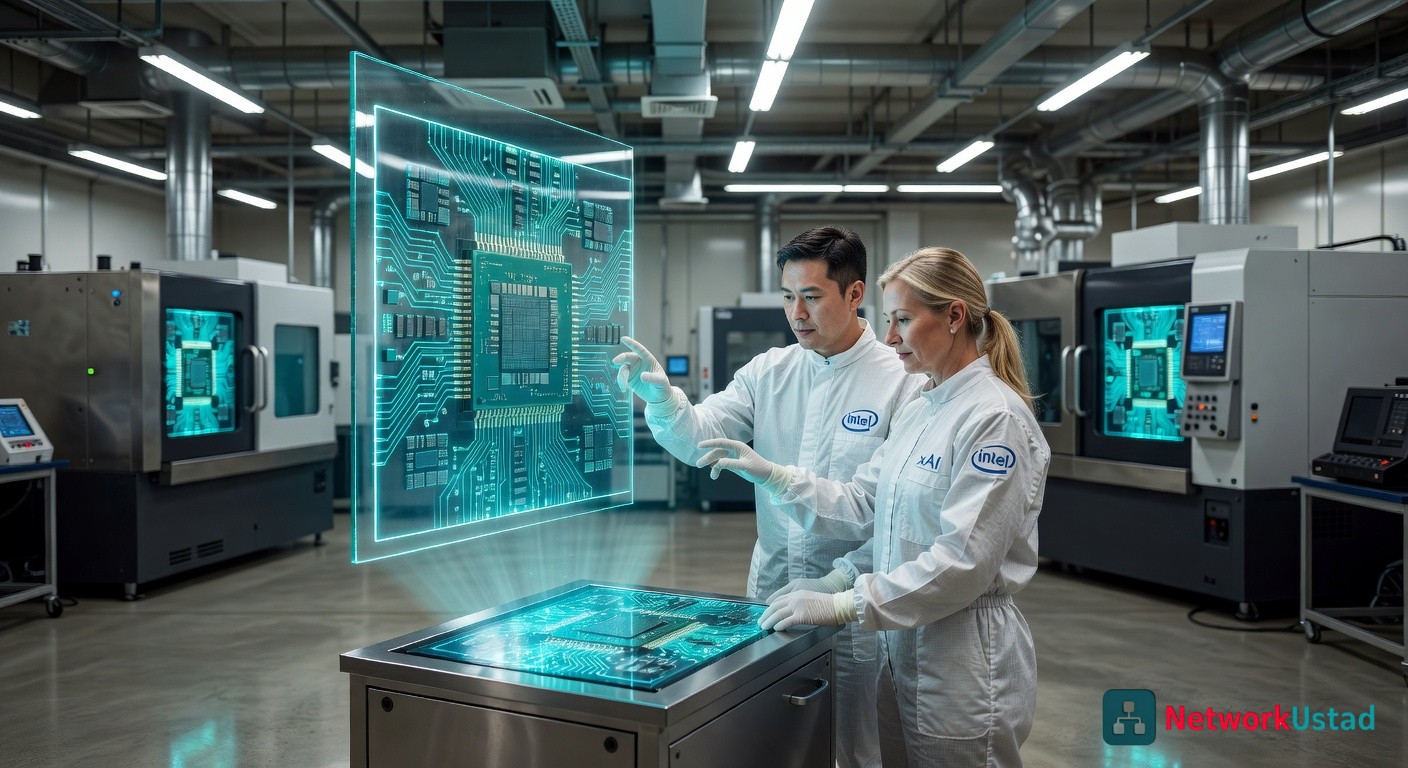
Intel Joins Elon Musk’s Terafab Chip Project
Santa Clara, California-based Intel Corporation announced on Monday its partnership with Elon Musk’s Terafab initiative, a ambitious project aimed at developing next-generation terahertz-frequency chips for advanced computing applications. The collaboration, revealed during a joint press event in Austin, Texas, positions Intel as the primary semiconductor manufacturer for Terafab’s prototypes, with production slated to begin in early 2027.
Key Details
The agreement involves Intel providing fabrication expertise and access to its advanced foundry services at facilities in Arizona and Oregon. Terafab, spearheaded by Musk through his xAI venture, seeks to create chips operating at terabit-per-second speeds, potentially revolutionizing AI training and data center efficiency. Financial terms were not disclosed, but sources close to the deal indicate Intel’s investment could exceed $500 million over the next three years.
Musk, in a statement during the announcement, highlighted the project’s goal to “surpass current silicon limitations and enable unprecedented computational power for space exploration and autonomous systems.” Intel CEO Pat Gelsinger echoed this, stating, “This partnership leverages Intel’s leadership in process technology to accelerate Terafab’s vision, fostering innovation in high-performance computing.”
The deal comes amid Intel’s ongoing efforts to reclaim market share in the chip industry, following a challenging period marked by delays in its 18A process node. Terafab’s timeline includes initial chip designs by mid-2026, with Intel handling the tape-out and manufacturing phases.
Project Background
Elon Musk unveiled the Terafab project in late 2025 as part of xAI’s broader push into hardware development, complementing its Grok AI models. The initiative draws inspiration from Musk’s work at Tesla and SpaceX, where custom silicon like the Dojo supercomputer chips has been pivotal. Terafab specifically targets terahertz (THz) frequencies, which operate in the trillions of cycles per second, far beyond the gigahertz speeds of today’s processors.
Prior to this partnership, Terafab relied on third-party foundries, but scalability issues prompted the search for a dedicated collaborator. Intel’s involvement addresses these challenges, utilizing its EUV lithography tools to etch nanoscale features essential for THz performance. The project has already secured $1.2 billion in funding from venture investors, including Sequoia Capital and Andreessen Horowitz.
Expert Perspectives
Industry analysts view the alliance as a strategic move for both parties. “Intel gains a high-profile project to showcase its foundry capabilities, while Musk secures reliable production amid global chip shortages,” said Ming-Chi Kuo, a noted semiconductor analyst at TF International Securities. Kuo added that THz chips could reduce energy consumption in AI workloads by up to 50%, addressing a critical bottleneck in data centers.
Dr. Lisa Su, AMD’s CEO, commented indirectly during a recent earnings call, noting, “Collaborations like this will intensify competition, pushing the entire industry toward faster innovation cycles.” Regulatory filings with the U.S. Securities and Exchange Commission confirm the partnership’s compliance with export controls, given Musk’s international operations.
Industry Impact and Future Outlook
This development could reshape the semiconductor landscape, challenging Nvidia’s dominance in AI accelerators. Terafab chips promise applications in edge computing for electric vehicles and satellite networks, aligning with Musk’s ecosystem. For Intel, success here bolsters its pivot to foundry services, potentially attracting more clients like Qualcomm and Apple.
Challenges remain, including thermal management at THz speeds and integration with existing software stacks. Prototypes are expected in Q4 2026, with full-scale production by 2028. The partnership underscores a trend toward U.S.-centric chip manufacturing, supported by the CHIPS Act incentives totaling $8.5 billion for Intel’s expansions.
As the tech sector anticipates breakthroughs, this collaboration signals a new era of high-frequency computing, with implications for global AI leadership and energy-efficient technologies.