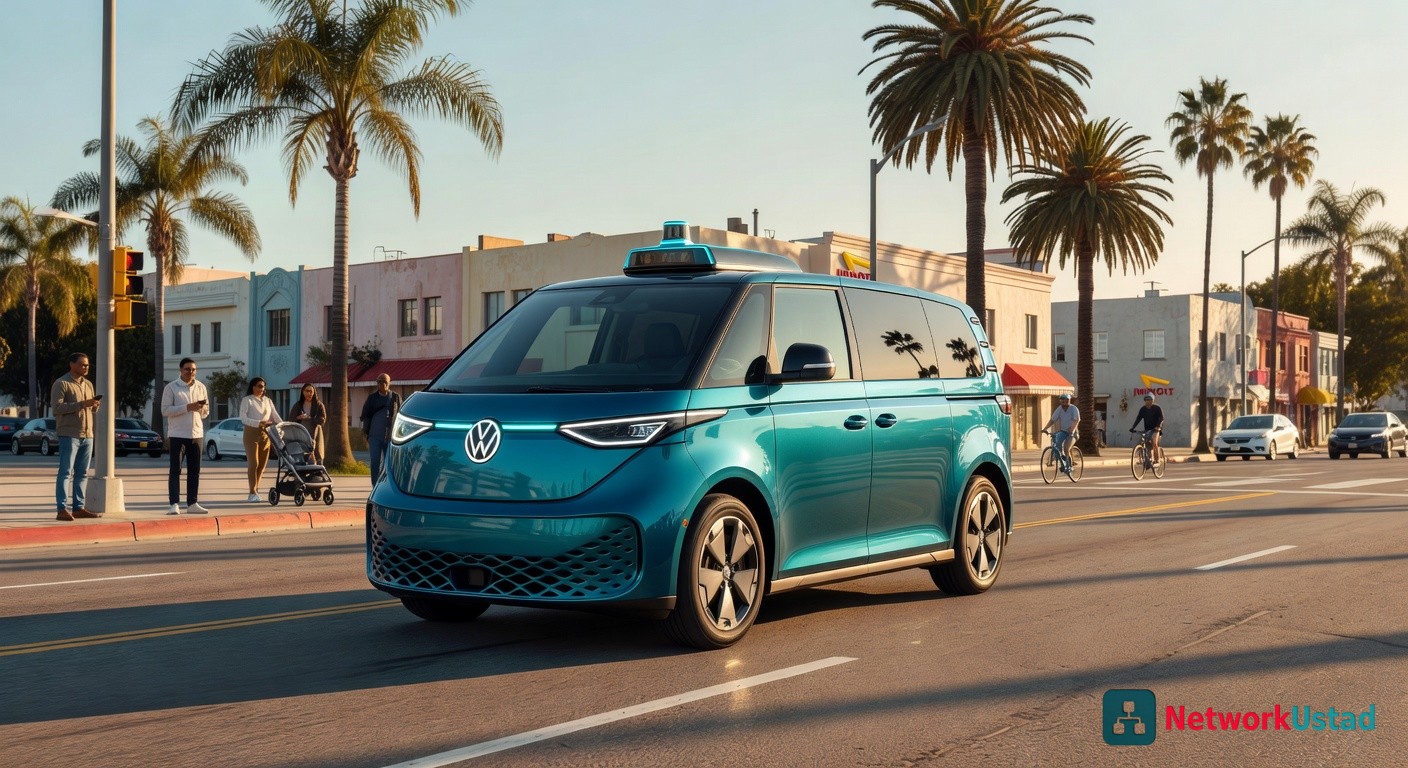
Volkswagen ID.Buzz Autonomous Tests Launch
Volkswagen has initiated real-world testing of its self-driving ID.Buzz microbuses in Los Angeles, California, as a precursor to a commercial launch in collaboration with Uber Technologies Inc. The trials, which began on Monday, involve a fleet of 10 modified electric vehicles navigating urban routes to validate autonomous driving systems.
Key Details
The testing program features Volkswagen’s ID.Buzz, an all-electric microbus equipped with Level 4 autonomy capabilities, allowing operation without human intervention in defined geofenced areas. According to a statement from Volkswagen Group, the vehicles integrate advanced sensors, LiDAR, and AI-driven software developed in partnership with Argo AI, a subsidiary focused on autonomous tech. Testing will span six months, covering approximately 500 miles daily across Los Angeles neighborhoods, including high-traffic zones like downtown and Hollywood.
Safety remains paramount, with each microbus accompanied by a safety driver during initial phases, transitioning to unsupervised runs by mid-2026. Volkswagen spokesperson Elena Martinez emphasized the milestone: “This testing phase ensures our technology meets rigorous safety standards while adapting to diverse urban environments.” Uber, which announced the partnership in late 2025, plans to integrate the microbuses into its ride-hailing network, offering shared autonomous rides to reduce congestion and emissions.
Background and Context
Volkswagen’s push into autonomous vehicles stems from its broader electrification strategy, initiated after the 2015 Dieselgate scandal, which prompted a $30 billion investment in electric and self-driving tech by 2030. The ID.Buzz, a modern revival of the iconic 1960s VW Bus, was first unveiled in 2017 and entered production in 2022 as a non-autonomous model. Autonomy upgrades began in 2024 through collaborations with Uber and Mobileye.
This Los Angeles trial follows similar pilots in Germany and Texas, where Volkswagen tested prototypes under controlled conditions. The partnership with Uber addresses regulatory hurdles in California, where the Department of Motor Vehicles has approved over 50 autonomous testing permits since 2018. Why it matters: As urban populations grow, self-driving shuttles could transform public transit, potentially cutting traffic accidents by 90% according to National Highway Traffic Safety Administration data, while supporting California’s zero-emission goals by 2045.
Expert Perspectives
Bryant Walker Smith, an autonomous vehicle law expert at the University of South Carolina, noted the significance of the trials. “Volkswagen’s entry into LA’s testing ecosystem intensifies competition with leaders like Waymo and Cruise, but their Uber tie-up could accelerate consumer adoption by leveraging an existing app-based platform,” Smith said in an interview. He added that public trust hinges on transparent data sharing, especially after incidents involving other AV firms in 2023.
Industry analysts from McKinsey & Company project the global autonomous mobility market to reach $400 billion by 2035, with ride-hailing integrations driving 60% of growth. Volkswagen’s move positions it against Tesla’s Robotaxi ambitions and GM’s Cruise, which already operates commercial services in San Francisco.
Implications and Future Steps
The testing could pave the way for widespread deployment, with Uber aiming to deploy 1,000 ID.Buzz units across U.S. cities by 2027, starting in Los Angeles and expanding to New York and Austin. Economically, this partnership may create 5,000 jobs in software and maintenance sectors, per Volkswagen estimates, while challenging traditional taxi services.
Regulatory approval from the California Public Utilities Commission is expected by Q3 2026, contingent on zero major incidents during trials. Broader impacts include enhanced accessibility for non-drivers and reduced carbon footprints, aligning with global sustainability targets. Volkswagen plans to release quarterly progress reports, with full commercial operations targeted for early 2027. As the industry evolves, these tests underscore the accelerating shift toward autonomous urban transport.
(Word count: 612)