NeoGeo AES Review: Timeless Retro Gaming Powerhouse
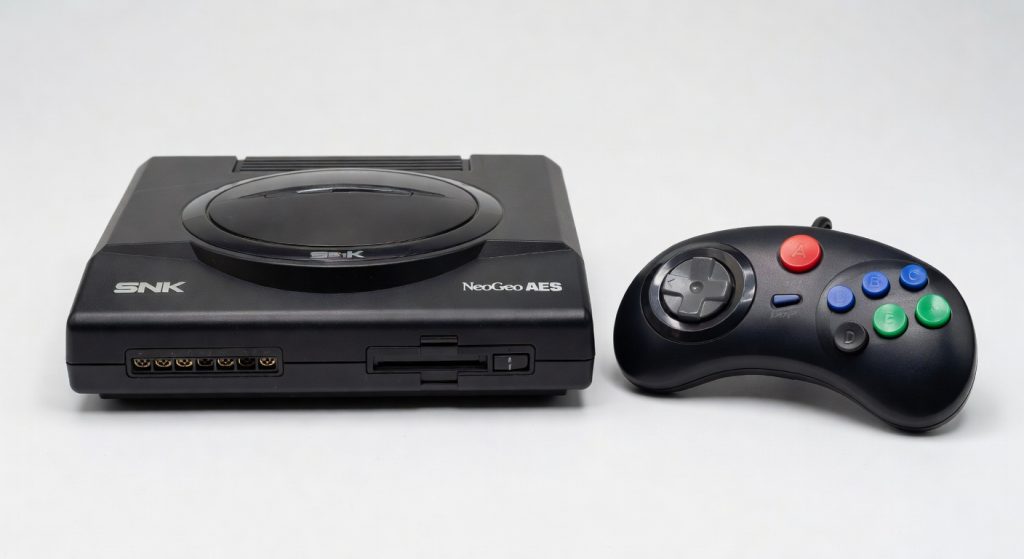
The SNK NeoGeo AES is one of the most uncompromising home consoles ever built: a 1990 system that placed genuine arcade hardware in the living room and asked buyers to pay arcade prices for the privilege. More than three decades later it remains the benchmark for authentic 2D arcade fidelity, and its cult status has only grown. The catch is, and always was, the cost. Cartridges routinely outprice the console, and the hardware skips every modern convenience. For the right owner it is retro royalty; for everyone else it is an expensive way to play games that are now available far more cheaply elsewhere.
Product Details
| Brand | SNK |
| Released | 1990 (Japan: April 26, 1990; North America: August 22, 1990) |
| Launch price | $649.99 (Gold System) / $399.99 (Silver System) |
| Used price today | $400 – $800 (console only); $600 – $1,000 bundled |
| Best for | Retro gaming enthusiasts, competitive fighting-game players, and collectors seeking authentic arcade experiences at home |
A note on this review and the 2026 revival. This is a review of the original 1990 NeoGeo AES, the console most collectors mean when they say “AES.” In April 2026, SNK and publisher Plaion announced a modernized successor, the NeoGeo AES+, launching November 12, 2026 at $249.99 / £179.99 / €199.99. It keeps compatibility with original AES cartridges while adding low-latency 1080p HDMI output, on-device BIOS and DIP-switch controls, lower power draw, and a batteryless memory card. If your goal is to play NeoGeo games on a modern television without hunting down decades-old hardware, the AES+ is worth reading about before you commit to an original unit. Details are in TechSpot’s coverage.
Dropping a NeoGeo AES cartridge into the slot still feels like a small ceremony. The cartridges are enormous, the boot is near-instant, and what appears on screen is not an approximation of an arcade game but the arcade game itself, running on the same silicon that powered the cabinets. In an era crowded with 4K upscalers, FPGA recreations, and emulator front-ends, the original AES holds a peculiar position: technically surpassed in convenience by almost everything, yet still unmatched in what it fundamentally is. This review looks at why that reputation endures, and at the one issue that has defined the platform since day one, its price.
The AES was never a mainstream console. It was a premium product from SNK aimed at players who wanted full arcade fidelity at home and were willing to pay for it. Understanding that framing is essential, because judged as a mass-market machine it makes little sense, and judged as a luxury enthusiast platform it is close to flawless.
Overview
The NeoGeo AES (Advanced Entertainment System) is SNK’s home console, released in Japan on April 26, 1990 and in North America that August. It was engineered to mirror SNK’s MVS (Multi Video System) arcade hardware as closely as possible, and the two platforms are effectively the same machine in different shells. The cartridges are, in practical terms, arcade boards housed in consumer casings.
Under the hood, the AES pairs a Motorola 68000 running at 12 MHz as its main processor with a Zilog Z80A at 4 MHz handling audio, backed by 64 KB of system RAM, 84 KB of video RAM, and 2 KB of sound memory. Graphics run at a native 320×224 resolution, drawing up to 4,096 colors on screen from a palette of 65,536, with the custom SNK chipset able to push around 380 sprites simultaneously. Sound comes from a Yamaha YM2610. SNK marketed the system as “24-bit,” a reference to the graphics data bus rather than the CPU, which is a 16/32-bit design. It is a distinctive architecture, and one built entirely around fast, large 2D sprite work rather than the polygon rendering that would define the generation that followed.
At launch the console cost $649.99 for the Gold System (two controllers, a memory card, and the pack-in game Magician Lord), with a stripped-down $399.99 Silver System also offered. Individual cartridges commonly ran $200 and up. Today, used consoles fetch roughly $400 to $800 on the secondary market, with complete bundles climbing higher. For the full hardware lineage, see the Wikipedia entry on Neo Geo.
Key Features
Large arcade cartridge library. The AES received roughly 148 licensed titles over its lifespan, spanning shooters such as Blazing Star and Pulstar, run-and-gun classics like Metal Slug, and the deep fighting-game catalogue the platform is best known for, including The King of Fighters, Fatal Fury, Samurai Shodown, and World Heroes. Because each game shipped on arcade-grade hardware, ports were not ports at all in the usual sense: they were the arcade code, running directly.
Arcade-identical hardware. The AES shares its architecture with the MVS arcade system, which is the core of its appeal. The two use the same underlying boards and game data. It is worth noting that MVS and AES cartridges use different physical shells and are not directly interchangeable without a converter, a detail sometimes glossed over, but the software and silicon beneath are the same.
Four-button controller. The AES arcade stick uses a four-button layout (A, B, C, D) with a solid microswitched joystick. The build quality of the original controllers is frequently praised, and the taut, arcade-style stick is well suited to the fighting games that dominate the library. Aftermarket replicas rarely match the feel of an original unit.
Memory card save system. The AES was among the first consoles to use a removable memory card for saving progress and high scores, a roughly 2 KB card that could carry data between an AES at home and MVS cabinets in arcades. Capacity is tiny by any modern measure, but for a 1990 console the ability to preserve scores and progress at all was notable.
Region flexibility. With a straightforward hardware modification, the AES can be switched between NTSC and PAL behavior, which historically made importing games from other regions considerably easier for collectors. This is a modification rather than a built-in feature, and should be treated as such.
Performance
Performance is where the AES earns its reputation. The system boots almost immediately, menus and games render crisply at the native 320×224 resolution, and demanding fighters hold a steady frame rate through busy, multi-character scenes. Titles such as The King of Fighters ’98 and Windjammers run smoothly even during their most chaotic moments, and the sprite work, large, detailed, and drawn without the compression artifacts common to disc-based rivals of the era, still looks striking today.
The console is AC-powered with no battery, which for a home unit simply means uninterrupted play. Against the 16-bit competition of its day it was comfortably the more powerful machine; the Super Nintendo and Sega Genesis could not match its sprite counts, color depth, or raw arcade fidelity, which is precisely why it commanded such a premium.
A fair counterpoint: modern emulation and FPGA solutions such as FinalBurn Neo and MiSTer now reproduce NeoGeo games with extremely high accuracy, and in many cases with added conveniences like save states, HDMI output, and shaders. What the original hardware offers over those options is not measurably better performance but authenticity, the exact timing, behavior, and output of the real system. Whether that distinction justifies the price is the central question every prospective buyer has to answer.
Design & Build
The original AES is a solid, purposeful piece of hardware. The console measures roughly 325 × 237 × 60 mm and has a reassuringly sturdy feel, with a matte finish and a top-loading cartridge slot that helps keep the connector clean. The cartridges themselves are famously large, a physical statement as much as a storage format.
Port layout is sensible, and the top-loading design is genuinely more practical than side-loading alternatives that can strain under the weight of the big carts. The main design friction is the 15-pin controller connector, which predates modern standards and means USB or aftermarket controllers require an adapter. For owners who want the authentic experience, the original sticks remain the benchmark, and their weight and switch feel are a large part of why the platform is still enjoyable to use rather than merely collect. For additional hardware reference, see the official Neo Geo documentation.
Compared to Rivals
SNES Classic / Nintendo Classic Mini. The Mini wins decisively on accessibility: it offers HDMI output and a plug-and-play experience for around $100 (at its original retail), with no cartridges to source. What it cannot offer is real arcade hardware. For a buyer who simply wants to play classic games easily, the Mini is the sensible choice; for one who specifically wants arcade-grade NeoGeo fidelity, it is not a substitute.
Sega Genesis Mini. Similar trade-off. The Genesis Mini is inexpensive, convenient, and has a strong curated library, but it is an emulation box and its catalogue does not overlap with the NeoGeo’s arcade fighters and shooters. The AES is the deeper machine for that specific genre focus; the Genesis Mini is the far easier and cheaper entry point to retro gaming generally.
PlayStation Classic. The PlayStation Classic offers HDMI and a varied library at a low price, but its emulation drew criticism at launch and it cannot match native hardware for responsiveness. Against the original AES it loses on authenticity and gains on convenience and breadth, the recurring pattern in every one of these comparisons.
The throughline is consistent: modern mini-consoles and FPGA devices beat the AES comprehensively on price and convenience, while the AES retains a single advantage, being the genuine article. SNK’s own NeoGeo AES+ revival, covered above, is the first option that meaningfully bridges the two by adding HDMI to real cartridge compatibility.
Value for Money
There is no way around the economics. A used original AES runs roughly $400 to $800 for the console alone, and bundles with controllers reach $600 to $1,000. Individual cartridges frequently cost hundreds of dollars, and the sought-after titles cost far more. Buying in means the console is only the beginning of the spend.
Set against a $100 mini-console or a modestly priced FPGA device, the original AES cannot be justified on value in any conventional sense. What it offers is something those alternatives do not: authentic arcade hardware and the collector value that comes with it, which for genuinely rare titles has historically appreciated. For a collector, that combination can make the outlay worthwhile. For a casual player, the value proposition simply does not hold, and that is not a flaw in the console so much as a reflection of what it was always meant to be.
Who Should Buy It
Buy the original AES if you are a serious fighting-game player who wants authentic native inputs, a collector building a genuine arcade setup, or a run-and-gun enthusiast who specifically values original hardware over convenience. For these buyers the AES delivers something no emulator or mini-console can, and the cost is part of the proposition.
Consider the AES+ instead if you want NeoGeo games on a modern television with HDMI and current conveniences while still using real cartridges. At $249.99 it is a fraction of the cost of a complete original setup.
Skip both and choose a mini-console or emulation if you are a casual retro fan on a budget or a modern player who mainly wants easy HDMI plug-and-play. A $100 mini delivers most of the enjoyment at a small fraction of the cost.
Final Verdict
The NeoGeo AES is a genuinely special machine and a genuinely impractical one, and both things have always been true at once. As a piece of hardware it is close to flawless within its purpose: authentic arcade performance, superb original controllers, a deep and revered library, and build quality that has lasted decades. As a purchase it demands a level of commitment, in money and in effort, that only a specific kind of buyer should take on.
If uncompromised 2D arcade fidelity is what you want and the cost does not deter you, a well-serviced original AES is a rewarding thing to own. If you want the games without the financial and logistical weight, the newly announced AES+ or a good emulation setup will serve you far better. The AES earns its 4.5 out of 5 not because it is for everyone, it emphatically is not, but because it does exactly what it set out to do, and after more than thirty years still does it better than anything else built for the same job.
Where to Buy
Original units are found on the secondary market through specialist retro retailers and auction sites, typically $400–$800 for the console. Information on SNK’s current hardware is available via the official product page.
Frequently Asked Questions
Is the original NeoGeo AES worth buying in 2026?
For collectors and dedicated fighting-game players who value authentic arcade hardware, the original AES remains worth owning, though it is a significant financial commitment once cartridge prices are factored in. For casual players, a mini-console or emulation setup delivers most of the experience at a tiny fraction of the cost. The newly announced NeoGeo AES+ also changes the calculation for anyone who mainly wants HDMI output and cartridge compatibility without hunting for decades-old hardware.
What is the difference between the NeoGeo AES and the MVS?
The AES is the home console version and the MVS is the arcade system, but they share the same core hardware and game data, which is central to the platform’s appeal. The main practical differences are the physical cartridge shells and the intended setting, home versus arcade cabinet. Because the shells differ, AES and MVS cartridges are not directly interchangeable without a converter, even though the software beneath is identical.
How many buttons does the NeoGeo AES controller have?
The original NeoGeo AES arcade stick uses a four-button layout, labeled A, B, C, and D, alongside a microswitched joystick. This configuration matches the arcade hardware and suits the fighting games that dominate the library. The build quality of the original controllers is widely regarded as excellent and difficult for aftermarket replicas to match.
Why is the NeoGeo AES so expensive?
The AES was a premium product from the start, launching at $649.99 with cartridges priced at $200 and up, because it delivered genuine arcade hardware at a time when rivals could only approximate it. Its niche appeal meant relatively few units were produced, with fewer than 1.2 million sold, and that scarcity has driven strong collector demand ever since. Rare titles in particular can command very high prices on the secondary market today.
What is the NeoGeo AES+ and how does it differ from the original?
The NeoGeo AES+ is a modernized console from SNK and publisher Plaion, announced in April 2026 and set to launch on November 12, 2026 at $249.99. It retains full compatibility with original AES cartridges while adding low-latency 1080p HDMI output, on-device BIOS and DIP-switch controls, reduced power consumption, and a batteryless memory card. In short, it targets players who want hardware accuracy together with modern connectivity and reliability, rather than the exclusivity of the original.
+Pros
- Deep arcade library of roughly 148 licensed titles, strong in fighters and shooters
- Arcade-identical hardware for authentic, native performance
- Excellent original four-button arcade sticks with responsive microswitched joysticks
- Early removable memory card system for saving scores and progress
- Region can be modified for straightforward game importing
−Cons
- Extremely expensive, both the console and its cartridges, at launch and today
- AC-powered with no battery backup
- No HDMI or other modern conveniences on original hardware
- Original 15-pin controller port requires an adapter for modern replacements