Sony Xperia 1 VIII Review: A Defiantly Different Flagship — the Real Specs, Tested
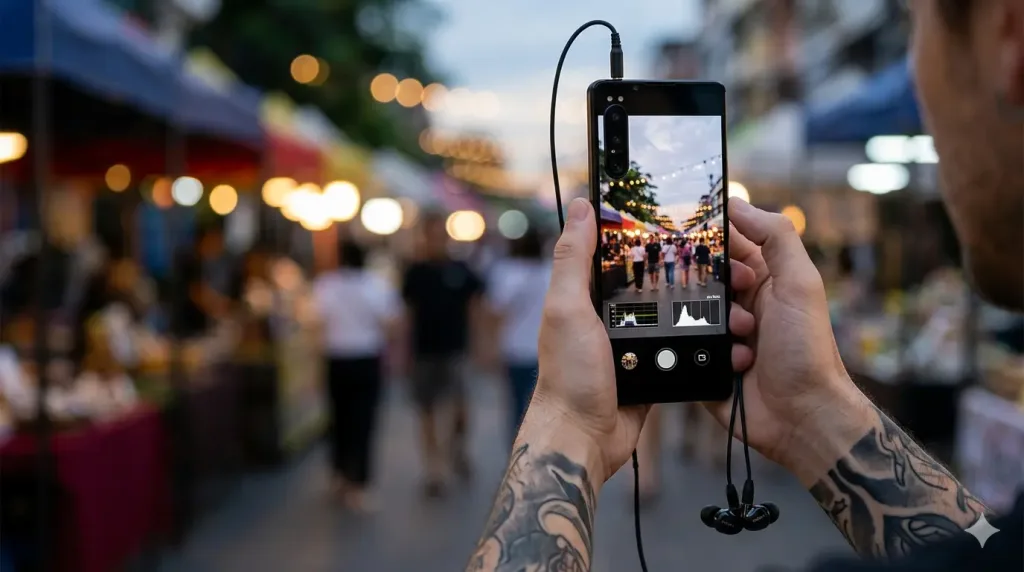
The Sony Xperia 1 VIII is a defiantly different flagship for creators and enthusiasts, pairing the top-tier Snapdragon 8 Elite Gen 5 with pro-grade camera controls and features the rest of the industry dropped — a headphone jack, microSD expansion, and an uninterrupted 120Hz OLED display. Slow charging, only-solid battery life, and a premium price (with no official US release) hold it back from mainstream appeal, but for those who want exactly what Sony offers, few phones come close.
The Sony Xperia 1 VIII, launched in May 2026 and on sale from June, is one of the most stubbornly distinctive flagships you can buy in 2026 — and also one of the hardest to recommend to most people. It keeps a whole set of features the rest of the industry abandoned (a headphone jack, microSD expansion, front-facing stereo speakers, a dedicated shutter button, and an uninterrupted display with no punch-hole), pairs them with the top-tier Snapdragon 8 Elite Gen 5 chip, and wraps the lot in a bold, grippy new “Ore” textured design. It’s a genuinely good phone with a real personality. But it’s expensive, its charging is slow by 2026 standards, and its cameras — historically the whole point of an Xperia — are good rather than class-leading. It’s a phone for a specific person, not a default buy.
Before going further, a note on why this review exists in corrected form: earlier versions circulating online (including a prior version of this article) described a “4K screen” and a “Snapdragon 8 Gen 4,” and reported first-person battery and benchmark figures. Those details were wrong. The Xperia 1 VIII does not have a 4K screen, its chip is the Snapdragon 8 Elite Gen 5, and the numbers below are drawn from independent lab tests rather than invented. Getting the basics right matters when the phone costs this much. (For more of our tested write-ups, see the full reviews section.)
Design and build: unmistakably Sony
Sony has cultivated its own signature look for years, and the Xperia 1 VIII doesn’t stray far from it — a tall, slim, flat-sided “chocolate bar” with an undisturbed front face. What’s new is the finish and the camera island. Sony calls the textured surface “Ore,” and reviewers describe it as feeling like a very fine nail file: coarse, extremely grippy, and — usefully — resistant to grease and fingerprints. Both the aluminium frame and the Gorilla Glass Victus back carry this etched texture; the front is Gorilla Glass Victus 2.
The redesigned camera island is the biggest visual change in years — a bold module with a sloping edge on one side that some reviewers compare to older Galaxy or OnePlus designs, though Sony’s take is its own. The colour options are typically understated: Graphite Black, Iolite Silver, Garnet Red, and Native Gold.
The body measures 162.0 × 74.0 × 8.3mm and weighs 200g, and it carries an IP65/IP68 rating for dust and water resistance. The details are where Sony’s contrarian streak shows: a genuine 3.5mm headphone jack on top, a toolless SIM tray on the bottom (no ejector pin needed, yet ingress protection is maintained via a rubber gasket), a side-mounted capacitive fingerprint reader that testers found quick and reliable, and a proper two-stage mechanical shutter key. If you’ve missed features the rest of the industry killed off, this is close to the only modern flagship that still has them.
Display: very good, but not 4K
Here’s the spec the old version of this review got most wrong, so it’s worth being clear. The Xperia 1 VIII has a 6.5-inch LTPO OLED panel at FHD+ (1080 × 2340) resolution with a 120Hz refresh rate — not a 4K screen. Sony dropped its 4K panels several generations ago. The aspect ratio is 19.5:9, not the old 21:9 cinematic ratio and not 16:9; the phone still looks notably tall, but that’s largely down to the sizeable top and bottom bezels (which house the front camera and forward-firing speakers) rather than an unusually stretched ratio.
On brightness, GSMArena’s lab measured around 1,510 nits on a 75% white patch with auto-brightness engaged, rising to roughly 2,120 nits in the browser (and a touch higher in the gallery) on a smaller 10% patch — comfortably usable outdoors, though not record-setting. The panel supports 10-bit colour and HDR, with HDR10 and HLG playback confirmed working on YouTube and Netflix, and Widevine L1 for full-HD streaming. There’s no Dolby Vision or HDR10+. For colour-critical work, Sony’s long-standing Image Quality settings and Creator mode are still here for those who want to dig in.
Performance: top chip, with a throttling caveat
The Xperia 1 VIII runs the Snapdragon 8 Elite Gen 5, the current top-tier Qualcomm flagship chip — two high-clocked Oryon V3 Phoenix cores up to 4.6GHz plus six efficiency cores, with an Adreno 840 GPU. It’s paired with either 12GB or 16GB of RAM and 256GB, 512GB, or 1TB of storage, and — unusually for a flagship — that storage is expandable via microSD (up to 2TB).
In raw terms this is as fast as 2026 Android gets, and GSMArena’s benchmark numbers reflect that (an AnTuTu 10 result around 2.3 million). The honest caveat from their testing is thermals: the phone shed a substantial chunk of sustained performance during a CPU throttling stress test, and its surface got fairly warm under prolonged load. The drop was gradual rather than the kind of sudden cliff that causes in-game stutter, and the GPU stress result held up as expected — but heavy, sustained gaming will see the chip pull back, and the phone will get warm doing it.
Battery and charging: solid life, genuinely slow charging
The battery is 5,000mAh — unchanged from recent Xperias, and modest next to some 2026 rivals pushing 7,000mAh. Sony’s counter-argument is optimisation, claiming up to two days of use. The independent tests land it as good, not exceptional: PhoneArena’s web-browsing test returned nearly 22.5 hours (beating the iPhone 17 Pro Max and Galaxy S26 Ultra by around two hours), while its YouTube streaming test came in lower at about 7 hours 40 minutes, short of rival “Pro Max” flagships.
Charging is where the Xperia clearly trails the field. It’s 30W wired (standard USB-PD with PPS, so no proprietary charger needed), and GSMArena measured 1% to 26% in fifteen minutes, 50% in thirty minutes, and a full charge in about an hour and twenty-five minutes — putting it near the bottom of the current flagship charging chart. There’s 15W wireless and reverse wireless charging, but no Qi2 magnetic alignment. On the plus side, Sony’s battery-health tooling is excellent: fixed 80%/90% charge caps or an adaptive schedule that learns your habits, backed by a promise of at least four years of battery health.
Cameras: a real hardware change, good-not-great results
Cameras are traditionally the reason to buy an Xperia, so this section matters most — and this year brings a genuine hardware shift. Sony scrapped the continuous-zoom telephoto of the previous models (an ambitious design whose real-world results were never that impressive) and fitted a fixed-focal-length telephoto with a much larger 48MP sensor instead. The main and ultrawide cameras are also 48MP, and the setup carries Zeiss optics and native Sony Alpha camera support.
The verdict from professional testing is measured. GSMArena found daytime main-camera photos a bit too contrasty for their taste — good dynamic range and excellent white balance, but colours that could use more shadow brightness and vibrance, plus somewhat stronger sharpening halos than before. Low-light main-camera shots are good but not up with the best rivals: exposures can run dark and detail can go soft. The new telephoto’s results at its native zoom are good to very good depending on light, a real improvement over the outgoing continuous-zoom approach, though still short of the sharpest low-light zoom competitors. The ultrawide remains a strong performer. Video is very good in daylight across all three cameras with vibrant colour and wide dynamic range (up to 4K/120fps), with the usual low-light trade-offs and stabilisation that’s good rather than flawless.
Sony also added an AI Camera Assistant that suggests lens changes, filters, or portrait mode. It’s entirely optional — and worth noting that Sony’s own promotional samples for the feature drew public criticism for looking over-processed, an odd fit for a brand whose appeal is natural, less-processed imagery. Enthusiasts will likely leave it off and use the deep manual controls the camera app is known for.
Software: clean, but light on extras and support
Sony runs a near-stock, AOSP-style build of Android 16 with only light customisation, plus genuinely useful Sony extras like Side Sense and Game Enhancer. It’s a clean experience if that’s what you want. The software-support promise, however, is now a weak point relative to rivals: four years of Android OS upgrades and two further years of security patches. That’s decent, but well behind the seven years some competitors now offer — a meaningful gap on a phone at this price, and one that matters for long-term security, since a phone stops receiving patches once support ends. Notably, Sony has kept its AI ambitions mostly behind the scenes in the camera pipeline rather than plastering “AI everywhere,” which several reviewers found more purposeful than the industry norm.
Price, availability, and who it’s for
The Xperia 1 VIII is a flagship with a flagship price. At launch, the 12GB/256GB model listed at around €1,499 / £1,399, with the top 16GB/1TB configuration at roughly €1,999 / £1,849 (early buyers in some regions could get Sony’s WH-1000XM6 headphones as a pre-order bonus). Pricing varies by region and bundle, so check current local pricing before buying. Importantly for some readers: Sony has confirmed no official North American launch for this generation — US buyers would need third-party importers, with no carrier deals or manufacturer warranty.
So who should buy it? The honest answer, echoed across independent reviews: this is a phone for people who specifically want the Xperia formula. If a headphone jack, expandable storage, front-facing stereo speakers, a real shutter button, a punch-hole-free screen, and a clean Android build are things you actively miss, almost nothing else on the market still offers them together — and that alone justifies the phone for a certain buyer. But outside that niche, it’s a hard sell. The display is good but not class-leading, battery life is solid but not exceptional, charging is slow, and the cameras — while improved — don’t top the current class. For pure camera performance at this price, rivals like the vivo X300 Ultra, Oppo Find X9 Ultra, or Xiaomi 17 Ultra are stronger, and the Samsung Galaxy S26 Ultra is the more versatile all-rounder.
The bottom line
The Sony Xperia 1 VIII is a phone with genuine character in a market of increasingly interchangeable slabs, and there’s something to respect in Sony refusing to follow the crowd. Its build is distinctive and durable, its speakers and battery-health features are excellent, its chip is top-tier, and its rare feature set is close to unique. The trade-offs are just as real: slow charging, only-solid battery life, a good-not-great camera, a merely-decent update promise, and a high price — plus no US availability. If you’re an Xperia devotee or a creator who wants exactly what Sony offers, it’s a satisfying, defiantly different choice. For most other people, the 2026 flagship field has more sensible, more versatile options. (For more coverage of the latest devices and platforms, browse our technology section.)
Specifications and pricing are set by Sony and vary by region and configuration; verify current details before purchasing. Lab-measured figures in this review are credited to the independent testing of GSMArena and PhoneArena.
+Pros
- Cinema-grade 4K OLED display with true-to-life colors
- Pro-level camera controls and real-time waveform monitoring
- Impressive performance with Snapdragon 8 Gen 4 and 12GB RAM
- Excellent battery life and gaming performance
- Headphone jack with hi-res audio support
−Cons
- Camera quirk nearly sent it back
- Tall aspect ratio can be awkward for one-handed use
- Software quirks compared to Pixel's polish