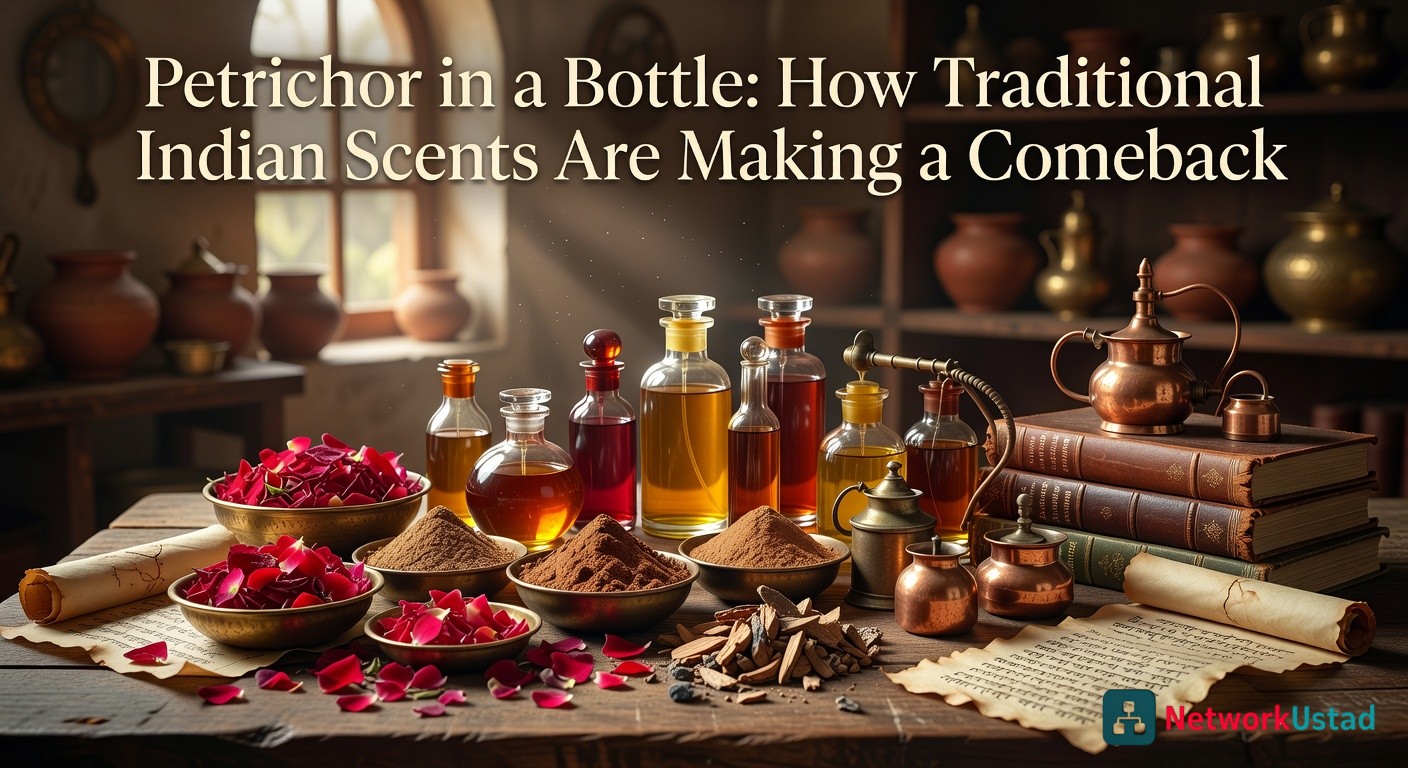
There is a particular smell that is recognised almost universally across the Indian subcontinent — the sharp, earthy exhale of dry soil meeting the first rain of the season. It is called petrichor, and it has been bottled, distilled, and sold as a fragrance from Kannauj for centuries. That this scent — known locally as mitti attar — exists at all as a commercial product says something significant about how deeply fragrance is embedded in Indian sensory culture. That it is now being rediscovered by a new generation of consumers, both domestically and internationally, says something equally significant about where Indian fragrance is headed.
Traditional Indian scents — attars, ittar blends, botanical extracts, and regionally specific aromatic materials — are experiencing a measured but unmistakable revival. This is not a trend driven purely by nostalgia. It is being shaped by a convergence of factors: growing consumer fatigue with synthetic fragrances, increased interest in natural and sustainable ingredients, a broader cultural reclamation of Indian craft traditions, and a global niche perfumery market that has been actively seeking alternatives to the Franco-centric fragrance canon for well over a decade.
The Ingredients That Are Being Rediscovered
India’s aromatic botanical heritage is extraordinarily diverse. The country is home to some of the most prized raw fragrance materials in the world, many of which have been cultivated, harvested, and processed for centuries with a specificity of knowledge that rivals anything produced in Grasse.
Vetiver — known in India as khus — is perhaps the most globally recognised of these. Grown primarily in the Deccan plateau region, Indian vetiver has a distinctly earthy, smoky, rooty quality that differs considerably from vetiver cultivated in Haiti or Java. Its use in traditional cooling systems, in attars, and in regional perfumery is well-documented. In contemporary niche fragrance, it has become one of the most sought-after natural ingredients available.
Sandalwood from Mysore remains the benchmark against which all other sandalwood is measured, though availability has been significantly constrained by decades of over-harvesting and government-controlled cultivation. Its warm, creamy, almost milky quality is irreplaceable in classical Indian perfumery and continues to command extraordinary prices in the international ingredient market.
Beyond these two, a broader palette of traditional Indian materials is being revisited: hina (a complex blend of botanical materials used in attar making), marigold absolute from Tamil Nadu, tuberose from Madurai, rose from Pushkar and Kannauj, jasmine from Mysore and Madurai, and saffron from Kashmir — each of these carries a distinct regional identity that is now being positioned as a point of provenance and authenticity by newer fragrance producers.
Why Synthetic Fatigue Is Driving the Shift
The global fragrance industry has been dominated by synthetic aromatic compounds for the better part of a century. Synthetics made fragrance cheaper, more consistent, and more scalable. They also made it possible to create entirely new aromatic experiences — scents that do not exist in nature. These are not negligible contributions.
However, a growing segment of consumers — particularly those in the 25 to 40 age bracket with higher disposable incomes — has begun to express a clear preference for natural, botanical, and traditionally derived fragrance materials. This preference is not irrational. Natural ingredients tend to have greater olfactory complexity, developing differently on different skin types and evolving in ways that synthetic compounds often do not.
In India, this shift is being felt across multiple product categories. In the perfume for men segment, a visible move away from the generic aquatic and synthetic woody fragrances that dominated the market through the 2000s and early 2010s is being observed. In their place, compositions built around natural Indian materials — vetiver, oud, black pepper, cardamom, sandalwood — are gaining traction among consumers who are actively seeking something with more character and provenance.
The appetite is real, and several Indian fragrance brands have moved quickly to address it.
The Role of Niche Perfumery in the Revival
The global niche perfumery movement — which prioritises artisanal production, rare ingredients, and olfactory complexity over mass-market appeal — has played a significant role in elevating traditional Indian fragrance materials to international visibility.
Houses in Paris, London, New York, and Dubai have been incorporating Indian botanical ingredients into their compositions for years, often at price points that place them firmly in the luxury category. Oud, vetiver, tuberose, and Indian rose have become staples of the niche fragrance vocabulary. In many cases, the raw materials are sourced from India, but the final product is branded and positioned as a Western luxury offering.
What is now changing is that Indian brands are beginning to occupy this space themselves. A new generation of Indian perfumers — trained both in classical attar-making traditions and in contemporary fragrance formulation — is producing work that does not need to defer to a Western reference point. These fragrances are being built from the ground up with Indian materials, Indian olfactory sensibilities, and Indian consumers in mind, while simultaneously finding receptive audiences in export markets.
Traditional Scents Across Gender Categories
The revival of traditional Indian scents is not confined to a single gender category. Both men’s and women’s fragrance segments are being affected, though in somewhat different ways.
In the perfume for men category, the return to traditional Indian materials tends to manifest in heavier, more resinous compositions — oud-forward blends, smoky vetiver bases, spiced amber formulations, and incense-inflected profiles. These are fragrances with considerable presence and longevity, well-suited to the cooler months and evening occasions. They also align with a broader cultural shift among Indian men toward more considered, identity-conscious fragrance choices.
For women, the revival is taking a somewhat different form. Floral attars — rose, jasmine, tuberose — have always been part of the feminine fragrance tradition in India, and their return in contemporary formats is being welcomed. But equally significant is the way in which traditional botanical ingredients are being incorporated into everyday personal care products. The deo for women category, for instance, has seen a meaningful increase in formulations that draw on botanical fragrance materials — jasmine, rose, sandalwood-inflected musks — rather than relying exclusively on synthetic fragrance compositions. This brings the traditional Indian scent vocabulary into daily use, at accessible price points, for a much wider consumer base than fine fragrance alone can reach.
Mitti Attar and the Meaning of Petrichor
It is worth returning to where this examination began — with the smell of rain on dry earth. Mitti attar, produced through the distillation of baked clay into a sandalwood base, is one of the most unusual fragrance products in the world. There is no equivalent tradition in Western perfumery. The deliberate capture of a meteorological sensory experience — the smell of the earth responding to water — reflects a relationship with the natural world that is embedded in Indian culture at a very deep level.
That this product is now being sought out by international fragrance buyers, stocked by niche retailers in London and New York, and rediscovered by urban Indian consumers who grew up with no exposure to attar culture, is a meaningful indicator of something larger. It suggests that the traditional Indian fragrance vocabulary — long undervalued in a market shaped by imported references — is being recognised, on its own terms, as something genuinely distinctive and worth preserving.
The comeback of traditional Indian scents is not a nostalgic exercise. It is a recalibration — a recognition that what was already here, rooted in centuries of botanical knowledge and craft tradition, deserves to be taken seriously as a living, evolving part of contemporary fragrance culture.