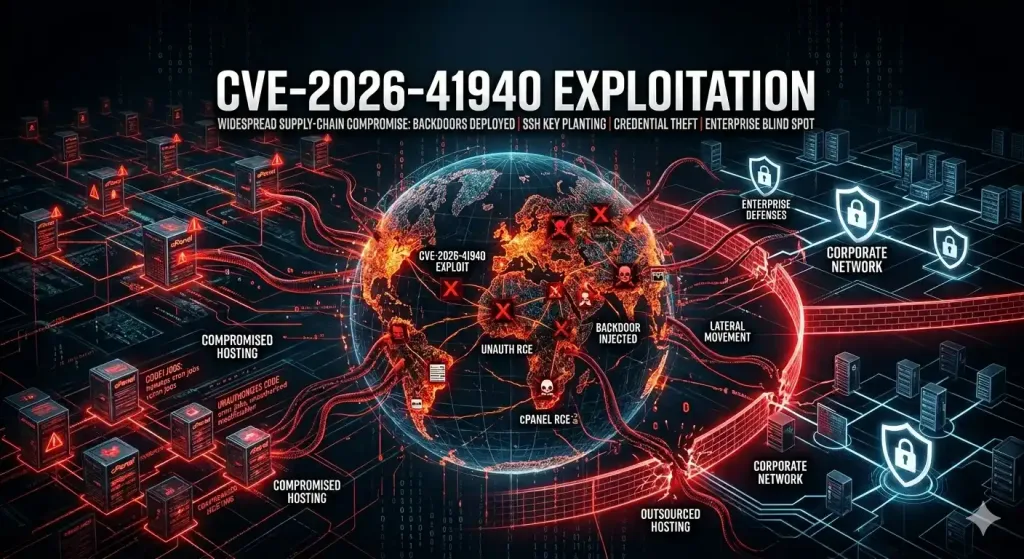
Attackers have deployed backdoors via cPanel flaw CVE-2026-41940 across thousands of web hosting servers, slipping past enterprise defenses that overlook third-party environments. Researchers report widespread exploitation enabling SSH key planting, credential theft, and full system compromise—threats that ripple into corporate networks reliant on outsourced hosting.
This vulnerability underscores hosting supply-chain risks, where enterprises treat hosting providers as black boxes. Without visibility, attackers pivot from compromised cPanel instances to internal assets, exploiting trust in unmonitored vendors. IT leaders now face a stark reality: shared hosting isn’t just a cost-saver; it’s a perimeter blind spot.
Vulnerability Mechanics
The cPanel flaw stems from inadequate input validation in its API endpoints, allowing remote code execution without authentication. Attackers chain this with scripted payloads to:
- Inject persistent backdoors via cron jobs
- Harvest cPanel credentials from config files
- Escalate to root via sudo misconfigurations
- Deploy SSH keys for lateral movement
For details on cPanel’s architecture, see the official cPanel documentation. Unlike isolated SaaS breaches, this hits self-managed and reseller hosting, amplifying scale.
Supply-Chain Blind Spots
Enterprises often delegate web apps to hosts like those using cPanel, assuming vendor responsibility ends at the firewall. Yet hosting supply-chain risks expose gaps: 80% of firms lack endpoint detection on partner infrastructure, per NIST guidelines on supply chain security.
Compromised hosts serve as jump servers. Attackers exfiltrate staging site data, then target linked DNS records or API keys. This mirrors SolarWinds but in hosting: low-visibility vectors evade tools like CrowdStrike, which prioritize endpoints over cloud-adjacent services.
To counter, integrate hosting into threat modeling workflows, treating providers as extensions of your attack surface.
Detection Challenges
Standard SIEM rules miss cPanel exploits due to noisy web traffic. Indicators include anomalous API calls to `/execute` endpoints and sudden SSH authorized_keys modifications. Network engineers should baseline hosting traffic with tools like Zeek or Suricata, flagging outbound C2 to known IOCs.
Script kiddies automate scans via Shodan, targeting exposed cPanel ports (2082/2083). Enterprises with legacy sites on shared plans face highest exposure—migrate to containerized alternatives like isolated PaaS environments for better segmentation.
Mitigation Strategies
IT pros must act decisively:
- Audit providers: Demand SOC 2 reports and cPanel patch status—CVE-2026-41940 patches rolled out in late 2026.
- Deploy agentless monitoring via AWS GuardDuty or Azure Defender for host visibility.
- Enforce least-privilege API keys; rotate on anomaly detection.
- Segment apps with Kubernetes namespaces or VPS isolation.
Run custom scans: `grep -r “backdoor” /var/cpanel/` and monitor `/usr/local/cpanel/logs/error_log`. Forward logs to central SIEM for correlation.
Enterprise Implications
Hosting supply-chain risks demand zero-trust for vendors. Boards should budget for managed detection on third-party infra, as unpatched flaws like this erode customer trust—think leaked PII from e-commerce sites.
Conclusion
The cPanel exploitation wave reveals hosting as the weak link in digital supply chains. IT teams ignoring it risk cascading breaches. Prioritize visibility: inventory all hosting assets, enforce patching SLAs, and simulate attacks quarterly.
Looking ahead, standards like NIST SP 800-218 will mandate supply-chain observability, pushing hosts toward zero-trust models. Act now—patch, monitor, segment—to turn this flaw into a resilience catalyst.