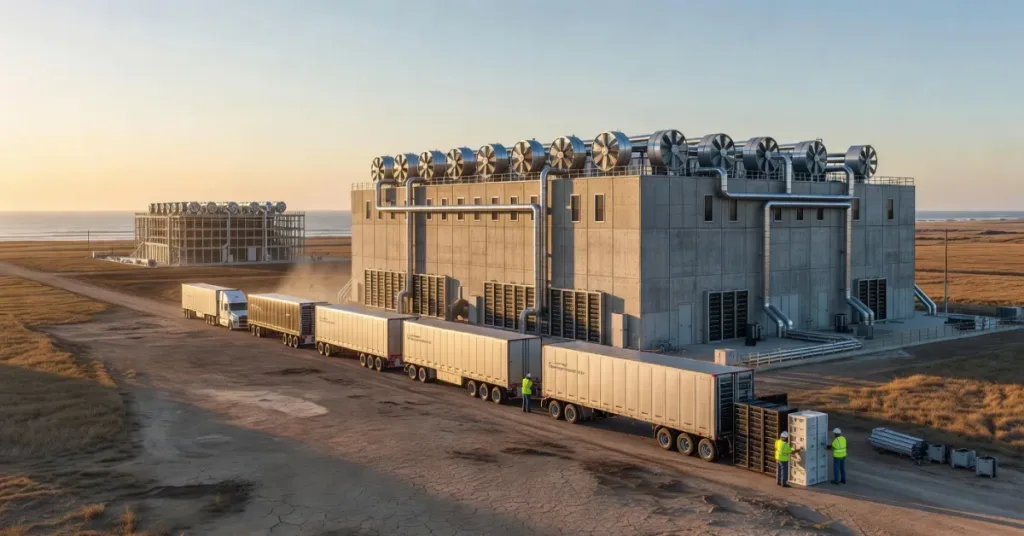
Synergy Research Group reports pinpoint the data centers moving inland trend, with construction plans shifting from coastal hubs to central regions driven by land availability and lower costs. This realignment challenges network architects to rethink latency profiles and bandwidth allocation in edge computing deployments, as inland sites alter traditional traffic patterns.
A second analysis echoes this, highlighting how coastal constraints—high real estate prices and power limitations—are pushing hyperscalers toward Midwest and inland Southwest locations. For IT professionals, this means recalibrating throughput expectations in multi-region cloud computing architectures, where sub-10ms latency thresholds now demand hybrid fiber-optic backbones paired with 5G mmWave extensions.
Inland Innovation Drivers
Inland data centers leverage abundant land for sprawling campuses optimized for liquid-cooled processors like AMD EPYC Genoa-X or Intel Xeon 6, enabling denser rack configurations with 100kW+ per cabinet. Innovations in architecture include modular prefabricated units from vendors like Schneider Electric, reducing deployment time by integrating encryption-accelerated NICs compliant with TLS 1.3 protocols.
- Power efficiency: Inland grids support 1.5 PUE ratios via geothermal cooling, slashing operational costs versus coastal seawater systems.
- Framework adaptability: Open Rack V3 standards facilitate seamless upgrades to NVMe-oF storage fabrics, boosting IOPS by integrating machine learning-driven predictive caching.
These shifts incorporate Synergy Research Group insights on regional buildouts, emphasizing cost-driven scalability.
Networking Market Impact
Data centers moving inland disrupts coastal peering points, forcing enterprises to optimize BGP anycast routing for balanced latency. Bandwidth demands surge inland, with Zscaler’s zero-trust frameworks now prioritizing inland PoPs to maintain <50ms global averages. Throughput gains emerge from inland fiber rings, like those expanding via IEEE 802.3bs 400G Ethernet specs.
Market players adapt: AWS retools Ohio facilities for AI workloads, while Google’s Midwest expansions integrate custom TPUs with encryption at rest via KMS APIs. Network engineers must audit how data flows influence application performance, as inland latency spikes could degrade real-time services like AR/VR streaming.
Costs drop significantly inland, per reports, enabling reinvestment in NIST-compliant encryption protocols for sovereign data mandates.
Architecture Overhaul Needs
Inland migration demands framework redesigns, blending on-premises with cloud computing via Kubernetes-orchestrated meshes. Processor advancements like Arm Neoverse V2 cut power draw by 30% in edge nodes, vital for inland sites distant from urban 5G density.
IT teams should prioritize:
- Latency mapping with tools like ThousandEyes for inland-to-coast paths.
- Throughput scaling via EVPN VXLAN overlays, ensuring 100G+ inter-rack speeds.
This evolution ties into broader infrastructure resilience strategies, mitigating seismic risks absent on stable central plains.
Looking Ahead
As data centers pivot inland, network pros gain from cheaper expansions but face latency trade-offs—expect 20-50ms increases for coastal users unless mitigated by CDN prefetching. Enterprises should pilot inland colos now, stress-testing protocol stacks like QUIC for bandwidth efficiency.
By 2026, this trend could redefine Networking hierarchies, with inland hubs powering AI inference at scale. Forward-thinking teams will embed inland redundancy in SD-WAN fabrics, securing future-proof throughput.