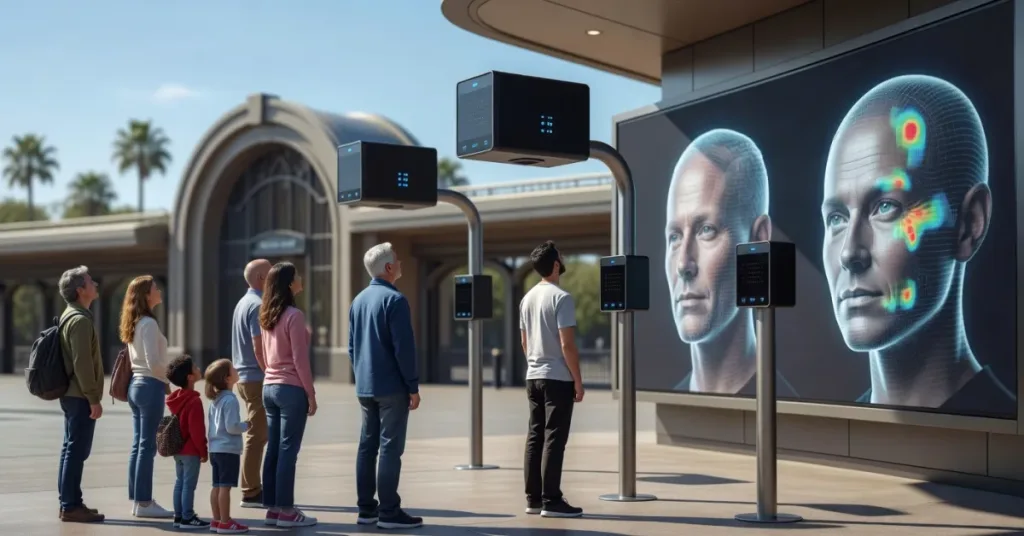
Disneyland has deployed face recognition systems across its California parks, scanning millions of visitors annually to streamline entry, payments, and ride access. Cameras at turnstiles capture facial data, matching it against pre-submitted photos via biometric algorithms that process features like eye spacing and jawline contours in under 2 seconds. This shift from MagicBands to passive scanning reduces queue times by enabling contactless verification, but it exposes visitors’ biometric templates to potential breaches.
Network engineers managing high-traffic venues must recognize this as a preview of face recognition ubiquity in public spaces. The system integrates with IP-based camera networks using ONVIF standards for interoperability, feeding data into centralized servers running real-time facial matching via libraries like OpenCV or proprietary Disney tech. For IT pros, the real challenge lies in the edge-to-cloud pipeline: cameras stream H.265 video at 1080p, compressing data before upload to minimize latency under 100ms, critical for 50,000+ daily peak users.
Face Recognition Network Demands
Face recognition thrives on robust network infrastructure. Disney’s setup likely employs PoE++ switches (IEEE 802.3bt) to power 4K PTZ cameras, ensuring 90W delivery over Cat6a cabling for AI-accelerated endpoints. Key demands include:
- Bandwidth scaling: 10Gbps uplinks handle 500Mbps aggregate from 100+ cameras per zone, with QoS policies prioritizing biometric packets over guest Wi-Fi.
- Low-latency protocols: RTSP over UDP for video feeds, paired with MQTT for metadata syncing to avoid TCP retransmissions in crowded RF environments.
- Encryption mandates: TLS 1.3 end-to-end, plus FIPS 140-2 modules for biometric hash storage, as mandated by NIST facial recognition guidelines.
Failure here risks template spoofing, where attackers replay captured liveness signals. IT teams should deploy intrusion detection tuned for anomalous camera traffic, mirroring enterprise zero-trust models.
Privacy and Security Risks
Biometric data permanence amplifies threats. Unlike revocable passwords, stolen face prints enable indefinite impersonation. Disney’s system uses liveness detection—analyzing micro-movements via 3D depth sensors—but vulnerabilities persist, as seen in past DeepFace exploits. Regulators like the FTC scrutinize consent flows, requiring opt-out QR codes at gates.
For cybersecurity pros, audit API gateways exposing facial APIs; misconfigurations have leaked data in 20% of tested systems per NIST benchmarks. Integrate behavioral analytics to flag anomalies, like repeated failed matches from a single IP.
Enterprise Adoption Strategies
Venues adopting face recognition must prioritize federated learning to train models without centralizing raw biometrics, reducing breach surfaces. Network admins: segment camera VLANs with EVPN-VXLAN for isolation, enforcing ACLs at 10G edges. Test failover with 99.99% uptime via redundant SD-WAN overlays.
Beyond Disney, this accelerates perimeterless authentication in stadiums and offices. Learn from user data handling best practices to balance frictionless access with compliance.
The Big Picture
Face recognition redefines venue network security, demanding IT pros evolve from reactive firewalls to proactive biometric governance. Enterprises face mandates like GDPR’s “right to be forgotten”—impossible for faces—pushing hashed template rotation every 90 days. Forward, integrate with 5G private networks for sub-20ms inference, but only after penetration testing exposes weak links.
Audit your camera feeds today: deploy Wireshark on mirrors for unencrypted RTP, and simulate DDoS at 1Gbps to benchmark resilience. This isn’t amusement park tech—it’s the blueprint for secure, scalable public authentication.