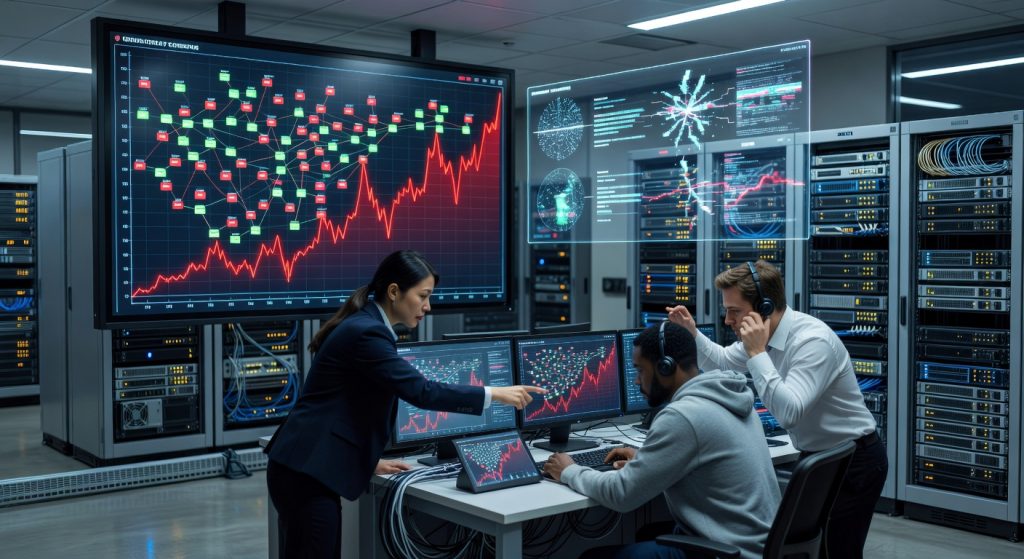
Enterprises running AI-centric network operations now face latency spikes exceeding 50ms across hybrid clouds, crippling real-time inference for models like those powering generative AI. Equinix’s latest Fabric Intelligence platform directly tackles this by automating connectivity orchestration, bridging the divide between dynamic AI demands and rigid legacy networks. This move signals a pivotal shift in how networking pros provision bandwidth for distributed AI workloads spanning data centers, clouds, and edges.
Legacy setups rely on manual ticket queues and fixed schedules, which bottleneck AI scaling. Fabric Intelligence introduces intent-based automation, dynamically adjusting virtual connections based on workload telemetry. Network engineers can define policies once—say, guaranteeing 99.99% uptime for GPU clusters—and the system handles provisioning via APIs integrated with tools like Kubernetes and Terraform.
Legacy Network Limitations
Traditional architectures falter under AI’s voracious data flows. Static VLANs and scheduled change windows can’t match the bursty patterns of large language models (LLMs) syncing across regions. For instance, training a single LLM iteration might pull 10TB+ from edge nodes to central DCs, yet manual configs introduce hours of downtime.
- Ticket-driven workflows delay responses to 24-48 hours, per industry benchmarks from Gartner networking reports.
- Edge-to-cloud latency averages 100ms in unoptimized setups, per Cisco’s AI networking analysis, throttling inference speeds.
This gap widens as AI deployments multiply, forcing IT teams to overprovision capacity by 2-3x, inflating costs.
Fabric Intelligence Core Features
Equinix’s offering embeds AI-driven analytics into its Fabric network, a global interconnection platform spanning 260+ data centers. Key capabilities include:
- Real-time telemetry fusion: Aggregates metrics from NetFlow, sFlow, and cloud APIs to predict congestion before it hits.
- Automated remediation: Self-heals via SD-WAN overlays, rerouting traffic in under 5 seconds without human intervention.
- Multi-cloud orchestration: Seamlessly links AWS Outposts, Azure Edge Zones, and on-prem racks, optimizing for AI-specific protocols like RDMA over Converged Ethernet (RoCE).
As explored in securing distributed IoT infrastructures, similar automation principles apply to AI fabrics, reducing exposure in edge-heavy setups.
Benefits for AI Workloads
For IT professionals, automated AI-centric network operations mean slashing mean time to resolution (MTTR) from days to minutes. AI apps gain consistent low-latency paths, vital for federated learning where models train across silos. Enterprises avoid the “AI tax”—wasted cycles from poor interconnects—enabling 24/7 scaling.
Consider a telco deploying computer vision at cell towers: Fabric Intelligence auto-scales bandwidth during peak inference, integrating with 5G core elements. This aligns with IEEE studies on AI-network convergence, emphasizing programmable fabrics.
Implementation Roadmap
Network teams should start with pilot integrations:
- Audit current BGP peering and EVPN fabrics for AI bottlenecks.
- Deploy Fabric Intelligence via Equinix Metal APIs, testing with synthetic workloads from tools like Locust.
- Monitor via Prometheus dashboards, tuning policies for service level objectives (SLOs).
Pair this with zero-trust overlays, as detailed in NIST frameworks, to secure automated flows. Early adopters report streamlined ops, per Equinix demos.
The Bottom Line
Automated AI-centric network operations via Fabric Intelligence redefines enterprise networking, empowering IT pros to focus on innovation over firefighting. As AI permeates industries—from autonomous logistics to predictive maintenance—networks must evolve from reactive pipes to proactive intelligence layers.
Professionals: Inventory your interconnect latency today and prototype Fabric integrations. This isn’t optional; it’s the new baseline for competitive AI deployment. Forward, expect hybrid fabrics to standardize, blending Equinix-like automation with open standards like BMS for universal AI orchestration.