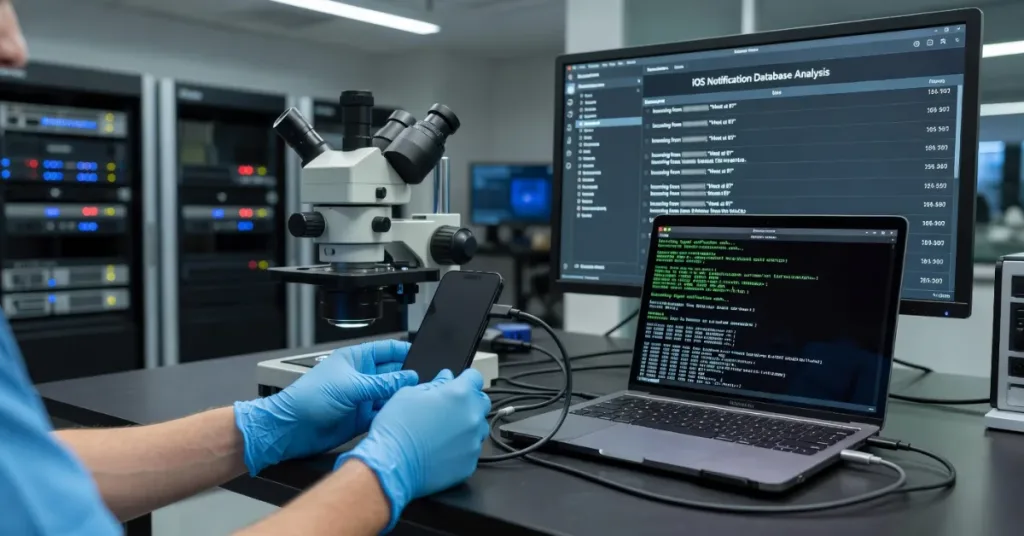
FBI forensic tools pulled deleted Signal messages from an iPhone’s push notification database, exposing content long after the app vanished. Investigators accessed a defendant’s device with physical possession, running specialized extraction software to recover incoming message copies stored in iOS’s notification logs. This technique bypassed Signal’s end-to-end encryption and auto-delete features, revealing plaintext previews pushed via Apple’s APNs (Apple Push Notification service).
The case, detailed in investigative reporting, underscores how iPhone notification database persistence creates hidden data troves. Even unencrypted message snippets—typically 100-200 characters—linger in SQLite databases like com.apple.pushnotificationd.db, immune to app uninstalls. Forensic firms like Magnet Forensics or Cellebrite exploit this via advanced logical extraction, dumping the database without full jailbreak.
Notification Data Mechanics
iOS caches push notifications in a protected notification database to enable quick previews on the lock screen. When Signal receives a message, APNs delivers a payload including title, body, and app identifier. This data hits the device’s pushd service, writing to persistent storage under /private/var/mobile/Library/Preferences/com.apple.pushnotificationd.db.
- SQLite structure: Tables like `notification` store `payload` blobs with JSON-decoded message text.
- Retention policy: Entries persist until storage pressure triggers pruning, often weeks or longer.
- Access method: Tools query the DB directly post-extraction, filtering by bundle ID (e.g., `org.whispersystems.signal`).
Deleting the app removes user data from its sandbox but leaves system-wide caches intact. As NIST guidelines note, mobile forensics prioritizes these artifacts for high-value evidence.
Cybersecurity Implications
This exposes forensic extraction risks in end-to-end encrypted apps. IT pros managing BYOD fleets face amplified threats: adversaries with brief device access—say, via theft or insider action—can harvest sensitive comms. Enterprises using Signal for secure channels must recalibrate assumptions about data ephemerality.
Consider lateral movement in breaches: a compromised executive’s iPhone yields partner names, deal terms, or ops intel from notification ghosts. Network teams should integrate this into threat modeling for mobile endpoints, prioritizing zero-trust device posture.
Mitigation Strategies for IT
Secure your ecosystem against iPhone notification database leaks with targeted controls:
- Disable previews: Enforce MDM policies via Apple Business Manager to suppress message previews in Settings > Notifications > Signal > Show Previews (set to Never).
- Regular wipes: Script push notification cache clears using `killall -9 pushnotificationd` in supervised devices, tested in lab environments.
- Forensic hardening: Deploy containerization with apps like Cisco Secure Endpoint, isolating notifications; audit via osquery for DB anomalies.
Integrate into SIEM workflows: monitor APNs traffic spikes on firewalls, flagging unusual push volumes. For deeper defense, explore advanced endpoint visibility tools. Pair with APNs proxying in enterprise proxies to strip payloads.
Final Thoughts
Signal messages from deleted apps redefine mobile forensics, compelling IT leaders to treat notifications as quasi-permanent logs. This shifts paradigms from app-centric security to system-layer persistence hunting. Forward, expect vendors like Apple to tighten DB scoping—perhaps with ephemeral storage in iOS 20—but pros can’t wait.
Action now: Audit iPhone fleets for notification exposure, simulate extractions with open-source tools like iLEAPP, and train teams on these vectors. In high-stakes sectors, this knowledge prevents intel leaks that erode trust overnight.