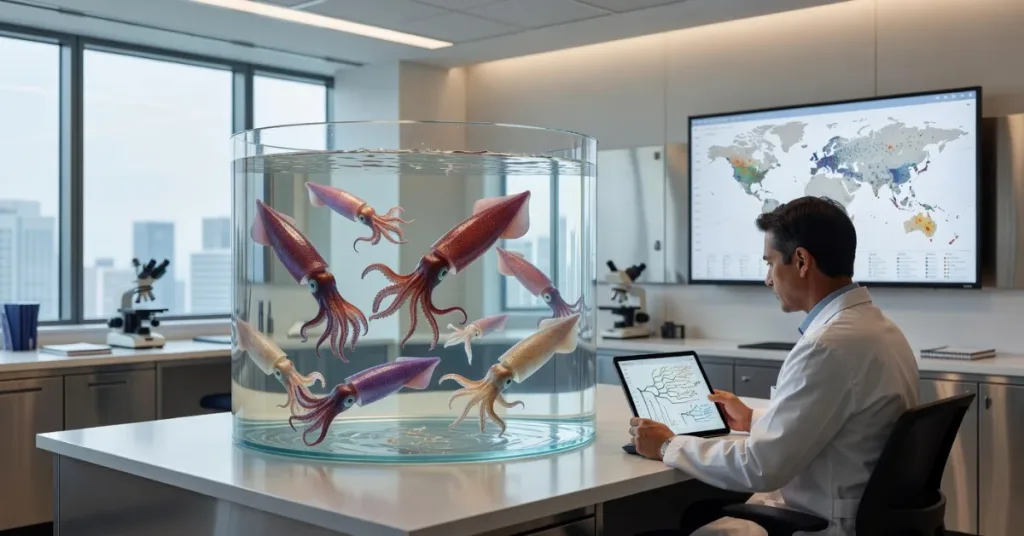
Squid and cuttlefish genomes, newly sequenced and cross-referenced with global oceanographic data, reveal these cephalopods emerged over 100 million years ago in the deep ocean. Unlike shallow-water species wiped out in mass extinctions, they endured by exploiting oxygen-rich abyssal zones, maintaining genetic stability for eons before recent evolutionary bursts.
This breakthrough, detailed in peer-reviewed analyses from marine genomics labs, upends assumptions about resilient life forms. Deep-sea refuges—thermoclines with elevated dissolved oxygen—shielded them from anoxic surface die-offs during events like the Cretaceous-Paleogene impact. Their stasis evolution, with minimal genomic drift, mirrors strategies in extremophile microbes, offering blueprints for engineering durable biological systems.
For IT professionals modeling resilient networks, squid survival parallels fault-tolerant architectures. Just as these creatures retreated to stable depths, enterprises must design underwater data centers—like Microsoft’s Project Natick, submerged off Scotland since 2020—to evade terrestrial threats such as floods or cyberattacks. Learn more about resilient infrastructure designs in ocean-inspired computing.
Genomic Stability Lessons
Squid genomes show negligible change over millions of years, a trait enabled by low predation and abundant resources in the bathypelagic zone (1,000-4,000 meters). This evolutionary stasis relied on:
- High oxygen niches: Mesopelagic oxygen minimum zones (OMZs) spared them, unlike surface plankton decimated 66 million years ago.
- Camouflage mastery: Chromatophore cells for instant adaptation, akin to polymorphic encryption in cybersecurity.
- RNA editing prowess: Over 60% of neural transcripts editable, per Doryteuthis pealeii studies, enabling rapid behavioral tweaks without DNA mutations.
Network engineers can apply this to self-healing networks: Implement RNA-like dynamic reconfiguration using SDN controllers like OpenDaylight, where protocols auto-edit routes during DDoS floods, mimicking squid neural plasticity.
Deep-Sea Tech Parallels
Ocean refuges prefigure edge computing in harsh environments. Squid thrived in high-pressure, cold waters; similarly, NIST-guided subsea nodes withstand 300 atm pressures for seismic monitoring. In 2026, firms like Subsea Valley deploy fiber-optic squid-inspired sensors for real-time abyssal data relay.
IT teams should prioritize:
- Oxygen analogs: Redundant power via microbial fuel cells, harvesting seafloor methane like squid harvest krill.
- Extinction-proof redundancy: Multi-homed undersea cables, echoing cephalopod distributed nervous systems (500 million neurons across arms).
This informs adaptive network strategies for climate-vulnerable data centers.
Engineering Resilience Now
Bio-mimicry from squid drives neuromorphic computing: Intel’s Loihi chips emulate their decentralized brains for low-latency inference, cutting energy 10x versus GPUs. For cybersecurity pros, their escape-jet propulsion inspires zero-trust packet ejection—discard anomalous traffic via eBPF hooks in Linux kernels.
Actionable steps for IT leaders:
- Audit OMZ equivalents: Map network “dead zones” with traceroute and iperf3; reinforce with MPLS fast-reroute.
- Prototype stasis protocols: Use gene-drive analogs in simulation tools like NS-3 to test invariant core functions amid disruptions.
- Invest in abyssal analogs: Pilot cold-tolerant NVMe storage in refrigerated edge nodes, per IEEE ocean tech standards.
Final Verdict
Squid survival—rooted in deep-sea retreats and genomic thrift—illuminates paths for extinction-resistant IT infrastructures. Enterprises facing rising sea levels and cyber Armageddon gain from cephalopod tactics: decentralize, adapt via editing, endure in refuges. Forward, expect squid genomics to seed quantum-secure bio-networks, blending wetware with silicon for perpetual uptime.
Prioritize pilots now: Sequence your network’s “genome” with Wireshark baselines, then embed squid-like redundancy. This isn’t whimsy—it’s the next evolution in tech endurance.