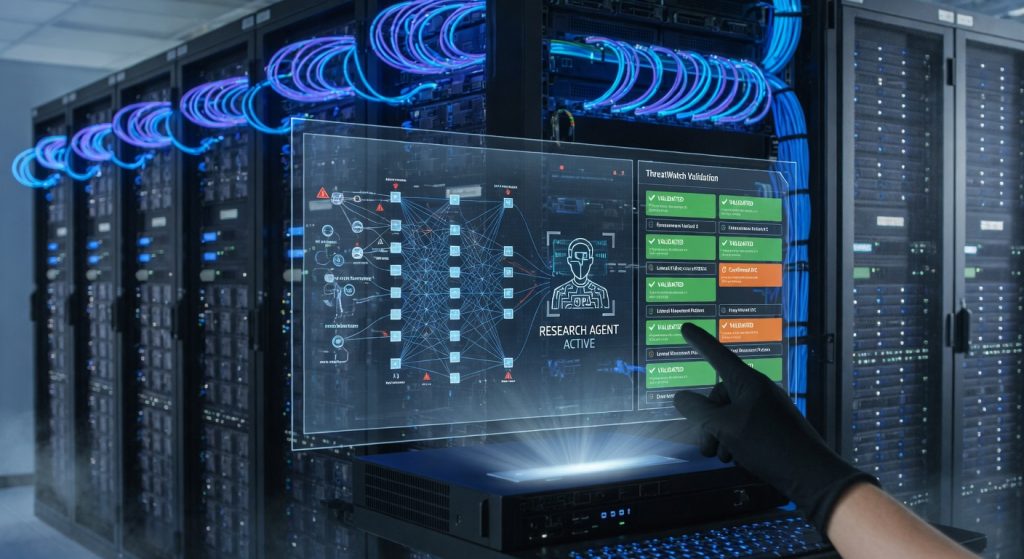
Security teams waste hours manually cross-referencing threat feeds against internal logs, often missing critical exposure windows that let attackers dwell undetected for weeks. Securonix Threat Research Agent and ThreatWatch change this dynamic by automating intelligence validation directly within ThreatQ workflows, turning raw data into actionable, documented defenses.
These tools integrate seamlessly with Securonix security operations, enabling analysts to query emerging threats against historical telemetry. For IT professionals, this means generating tailored reports for SOC leaders or field engineers without switching platforms. Built on ThreatQ‘s open platform, they bridge the gap between threat hunting and response, reducing manual validation from days to minutes.
Agent Automates Research
The Securonix Threat Research Agent acts as an AI-driven query engine, pulling role-specific intelligence from vast datasets. SOC analysts input IOCs like malicious IPs or hash values; the agent correlates them with enterprise telemetry, flagging anomalies with explainable reasoning.
- Telemetry validation: Cross-checks threats against logs from endpoints, networks, and cloud environments.
- Role-based outputs: Delivers summaries for executives (risk scores) versus engineers (technical mitigations).
- Workflow integration: Feeds directly into Securonix SIEM for automated playbook execution.
This addresses a core pain point: 70% of threats evade initial detection due to unvalidated intelligence, per NIST guidelines on threat modeling. Network engineers can now prioritize patches based on proven exposure, not hypotheticals.
ThreatWatch Validates Exposure
ThreatWatch for ThreatQ specializes in exposure assessment, scanning historical data for signs of active compromise. It simulates attack paths, validating if a new TTP—like Cobalt Strike beaconing—matches past behaviors in your environment.
Key capabilities include:
- Historical replay: Replays telemetry against new threat profiles to confirm dwell time.
- Explainable AI: Outputs chain-of-evidence reports, citing log entries and MITRE ATT&CK mappings.
- Actionable documentation: Auto-generates tickets with remediation steps.
For cybersecurity teams, this means defensible audits. As enterprises adopt zero-trust architectures, tools like ThreatWatch ensure compliance with frameworks such as NIST SP 800-53. IT pros should integrate it with existing EDR stacks to baseline normalcy.
Workflow Transformations
Connecting Securonix to ThreatQ creates closed-loop operations: detect, validate, document, respond. Analysts query in natural language—”Does this ransomware strain hit our Active Directory?”—and receive prioritized actions.
This shifts SOCs from reactive firefighting to proactive hunting. Consider multi-cloud setups; the agent unifies logs from AWS GuardDuty and Azure Sentinel, exposing blind spots. Advanced threat teams gain efficiency, freeing bandwidth for custom YARA rules or Sigma detections.
Practical steps for implementation:
- Map IOC feeds to ThreatQ actors.
- Train on explainable outputs to build trust in AI decisions.
- Audit integrations quarterly for data drift.
Looking Ahead
These capabilities signal a broader shift: AI agents as force multipliers in overcrowded SOCs. By 2026, expect 80% of enterprises to embed similar tools, per industry forecasts, compressing mean-time-to-respond.
IT leaders must pilot Securonix Threat Research Agent in air-gapped labs first, validating against synthetic attacks via Atomic Red Team. Network engineers: prioritize ThreatWatch for NDR validation, ensuring it ingests NetFlow and Zeek logs. This isn’t just automation—it’s a blueprint for resilient defenses amid escalating threats.