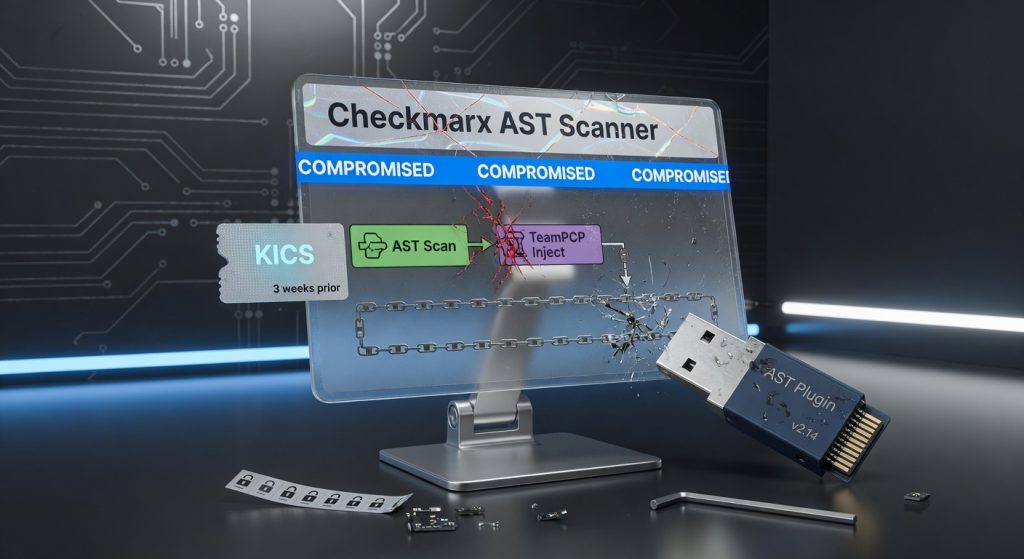
Security researchers discovered that threat actors operating under the TeamPCP banner compromised a widely used Jenkins plugin for Checkmarx’s AST platform within weeks of the notorious KICS supply chain incident. The breach exposed build pipelines at organizations that rely on automated static analysis to meet compliance mandates and catch vulnerabilities before code reaches production.
Timeline of Recent Supply Chain Incidents Involving Security Tools
The compromise unfolded rapidly after the KICS attack surfaced in March. Attackers leveraged stolen maintainer credentials to upload a trojanized version of the Checkmarx Jenkins AST Plugin. Organizations that updated the plugin between late March and early April pulled down malware capable of exfiltrating scan results and credential material.
Checkmarx issued an emergency advisory after independent researchers at a major financial services firm noticed anomalous network traffic leaving their Jenkins controllers. The incident forced the vendor to revoke plugin signing certificates and reset maintainer access across its open-source repositories.
Similar patterns emerged in other toolchains. A parallel campaign targeted Gradle plugins used for secret scanning, highlighting how attackers now prioritize developer tooling over traditional endpoints. Industry analysts recorded at least twelve high-profile supply chain compromises involving security and DevOps utilities in the first quarter of 2026 alone.
Role of the Checkmarx Jenkins AST Plugin in Modern DevSecOps Pipelines
The Checkmarx Jenkins AST Plugin integrates directly into continuous integration workflows to run static application security testing against every code commit. Teams depend on its ability to flag injection flaws, insecure deserialization issues, and hardcoded credentials before merges occur.
Many large enterprises embed the plugin in hundreds of Jenkins jobs. When the trojanized build executed, it captured scan output containing sensitive findings and forwarded the data to attacker-controlled domains. The malware also harvested Jenkins credentials stored in the controller’s secrets vault.
Organizations that adopted the plugin for regulatory compliance suddenly faced new exposure. Auditors began questioning whether previous scan results remained trustworthy after learning that the reporting mechanism itself had been subverted.
Technical Breakdown of the TeamPCP Compromise
TeamPCP operators gained initial access through a phishing campaign aimed at open-source maintainers. Once inside one maintainer’s account, they waited until a scheduled release window before pushing a malicious JAR containing the legitimate Checkmarx functionality plus a secondary loader.
The loader established persistence by writing a native library into the Jenkins home directory and scheduling a cron job that survived controller restarts. Encrypted command-and-control traffic used domain fronting techniques to blend with legitimate traffic.
Researchers who reversed the sample found hardcoded domains that matched infrastructure previously attributed to the TeamPCP campaign. The malware’s modular design allowed attackers to swap exfiltration targets based on victim environment size.
Security Controls Bypassed During the Attack
Many organizations rely on plugin signature verification, yet the attackers signed the malicious update with valid certificates before revocation took effect. Jenkins administrators who had disabled automatic plugin updates still received the bad version through scripted pipeline jobs.
Network segmentation proved insufficient when the malware phoned home over HTTPS on port 443. Behavioral detection tools flagged unusual file writes but often classified them as legitimate diagnostic dumps from the AST engine.
Zero-trust principles applied to application code did not extend to the tooling layer, leaving the supply chain vector wide open. Organizations learned that even signed artifacts require reproducible builds and reproducible build attestations to limit damage.
Comparison with the Earlier KICS Supply Chain Attack
The KICS incident targeted a popular open-source infrastructure-as-code scanner distributed through official package managers. Attackers replaced the legitimate binary with a version that leaked AWS keys and Azure service principal credentials.
TeamPCP’s approach differed because it focused on an AST integration point rather than a standalone scanner. Both attacks shared the supply chain entry method—compromised maintainer accounts—but the Jenkins plugin compromise reached deeper into runtime environments.
Lessons from KICS prompted many teams to adopt software bill of materials. Yet those same teams still accepted plugin binaries without SBOMs or reproducible build verification, leaving them vulnerable to the subsequent TeamPCP operation.
Industry Reactions and Resulting Best Practices
After the doppelganger events, the Jenkins project updated its Jenkins security advisories to require two-person review for every plugin release. Vendors that previously relied on single maintainer sign-offs now implement multi-party approval workflows.
Security teams began running differential analysis between downloaded plugin versions and previously trusted baselines. Some organizations adopted reproducible builds for internal tooling just as they do for application code.
Industry conferences in 2026 devoted entire tracks to supply chain hardening, with speakers emphasizing that security tools themselves require the same scrutiny applied to production applications.
Broader Implications for Supply Chain Security in DevSecOps
The back-to-back incidents demonstrate that attackers treat security tooling as high-value targets because breach notifications often bypass normal SOC triage. Organizations that trust their scanners implicitly create blind spots when the scanners themselves become compromised.
Market research from Gartner indicates that 68% of enterprises now require SBOMs for every third-party component, up from 42% the previous year. Yet many still exclude developer tooling from those requirements.
Future Predictions and Emerging Trends
Analysts expect more attacks targeting integration points rather than core products. Reproducible build pipelines and signed attestations will become standard procurement criteria for security vendors by late 2026.
Artificial intelligence models trained on historical build logs may soon detect anomalous plugin behavior before human analysts notice. Organizations will likely adopt policy-as-code frameworks that enforce minimum security levels for every component entering the build system.
Regulators are already drafting rules that hold software vendors accountable for downstream harm caused by compromised updates. Those rules will likely require mandatory incident reporting within 72 hours of discovery.
Expert Perspectives on Preventing Similar Breaches
Dr. Elena Vargas, principal security researcher at a leading threat intelligence firm, stated: “The TeamPCP incident proves that supply chain attacks have matured beyond random malware drops. They now aim for measurement tools that organizations treat as trusted oracles.”
Mark Thompson, director of DevSecOps at a Fortune 100 healthcare provider, noted that his team responded by implementing runtime attestation for every plugin loaded into Jenkins. “We learned that identifying deceptive software threats requires continuous monitoring rather than point-in-time verification.”
According to a 2026 report issued by the Cloud Security Alliance, organizations that adopted multi-party plugin reviews experienced 47% fewer supply chain incidents compared with peers who maintained single-approver models.
Real-World Case Study: Financial Services Firm’s Response
One global bank discovered the malicious plugin after correlating unusual DNS queries from its Jenkins cluster with threat intelligence feeds. The firm isolated 340 Jenkins controllers within six hours and rebuilt them from trusted images.
Scan results generated during the compromise window underwent manual review by a red team. No production vulnerabilities were missed, yet the incident delayed a regulatory audit by three weeks.
The bank now maintains an internal plugin registry with cryptographic hashes updated daily. Every new release undergoes automated behavioral analysis before deployment across its 1,200 development teams.
Practical Steps Organizations Can Take Immediately
Security leaders should audit every Jenkins plugin that touches sensitive data or secrets. Replace automatic update channels with pinned versions validated through reproducible build processes.
Teams can benefit from observing how similar campaigns spread across cloud environments to inform their own containment strategies.
Implement the NIST Secure Software Development Framework across both application code and tooling stacks. Organizations that apply the framework consistently report measurable reductions in time-to-detect for malicious updates.
Comparison of Mitigation Approaches
The following table summarizes common approaches and their observed effectiveness after the recent incidents:
| Mitigation | Observed Effectiveness | Implementation Cost | Complexity |
|---|---|---|---|
| Multi-party plugin approval | High | Medium | Low |
| Reproducible builds | High | High | High |
| Runtime attestation | Medium-High | Medium | Medium |
| Network segmentation | Low | Low | Low |
Conclusion
The TeamPCP Compromises Checkmarx Jenkins AST Plugin Weeks After KICS Supply Chain Attack revealed critical gaps in how organizations protect the tools that protect their code. Moving forward, every component in the build pipeline—from IDE plugins to scanner binaries—must undergo the same rigorous verification once reserved for production software.
Organizations that act now by adopting reproducible builds, multi-party approvals, and runtime attestation position themselves to weather the next wave of supply chain campaigns. Those who continue treating security tooling as inherently trustworthy will likely face repeated compromises.
Security teams should begin auditing their Jenkins environments this week and establish formal processes for validating every plugin update before it reaches developer workstations. identifying deceptive software threats