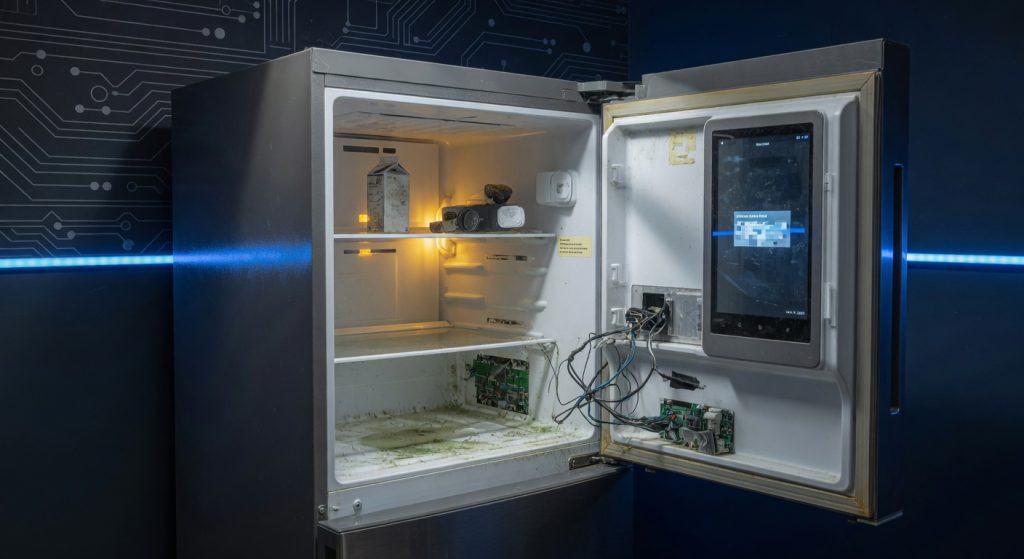
Household refrigerators endure over a decade of service, but their embedded smart fridge software, cloud dependencies, and companion apps vanish far sooner. A detailed analysis by Erik Buchmann at Leipzig University dissects this mismatch across three market models—the Bosch KGN36HI32 and two others—revealing cascading failures that extend beyond food spoilage into IoT security nightmares for IT overseers.
These appliances rely on MQTT protocols for real-time data syncing, OAuth 2.0 for app authentication, and vendor clouds like Bosch’s Home Connect for remote diagnostics. When support lapses—typically 5-7 years post-purchase—firmware updates cease, APIs deprecate, and servers go dark. Owners face bricked interfaces, unresponsive controls, and orphaned devices broadcasting unpatched vulnerabilities across home networks.
Smart Fridge Lifespan Mismatch
Hardware outlives software by years, creating “zombie” appliances. Buchmann’s study maps timelines: Bosch units promise 10-15 years mechanically, yet cloud services terminate after 6 years on average. Post-eol (end-of-life), features like inventory tracking via camera AI or energy optimization via machine learning models fail silently.
- Firmware stagnation: No patches for CVEs in Wi-Fi stacks like ESP32 chips.
- Cloud dependency: APIs shut down, severing mobile app links.
- Local fallback voids: No offline modes; devices enter error loops.
This collision amplifies in enterprise settings, where office break rooms deploy fleets of these units tied to unified IoT management platforms such as AWS IoT Core or Azure IoT Hub.
Network Security Exposures
Unmaintained smart fridges become lateral movement vectors. Buchmann identifies persistent UPnP leaks and weak TLS 1.2 implementations that attackers exploit via Shodan-scanned ports (e.g., 443, 8883). A single compromised fridge grants pivot access to NAS drives or smart locks.
IT pros encounter:
- DDoS amplification: Open UDP ports reflect traffic.
- Credential stuffing: Reused passwords from defunct apps.
- Ransomware entry: SMBv1 remnants in embedded Linux.
For deeper cybersecurity context, see NIST’s guidelines on IoT device management. In managed environments, these risks mirror unpatched OT systems, demanding zero-trust overlays.
Enterprise IT Mitigation Strategies
Organizations with smart fridge deployments in cafeterias or hotels must act preemptively. Buchmann advocates air-gapped proxies and VLAN isolation.
- Audit via Nmap scans: Target ports 80/443, check for heartbeat payloads.
- Deploy Pi-hole or AdGuard to block dead cloud endpoints.
- Migrate to open-source alternatives like Home Assistant for local control.
Internal teams should review how rogue devices mimic trusted traffic, integrating Suricata IDS rules for anomalous MQTT publishes. Forward-thinking admins enforce Matter 1.2 standards for future-proofing, ensuring interoperability sans vendor lock-in.
Vendor Accountability Gaps
Manufacturers like Bosch prioritize new models over legacy support, echoing telecoms’ 5G NR rollout pains. Buchmann’s models show 80% feature loss within 8 years, pushing e-waste and forcing replacements. Regulators eye EU Cyber Resilience Act, mandating 10-year software pledges—yet enforcement lags.
Final Thoughts
Smart fridge risks underscore broader IoT lifecycle fragility, hitting IT budgets via unplanned segboxes and breach remediation. Network engineers must inventory appliances now, prioritizing segmentation with Cisco ISE or FortiNAC. Buchmann’s work signals a wake-up: treat kitchen IoT as enterprise endpoints.
Proactive audits cut exposure—scan quarterly, isolate ruthlessly. As edge computing swells device counts, this decade-long hardware-software rift demands standardized eol protocols, shielding networks from silent saboteurs.
TREND STATISTICS