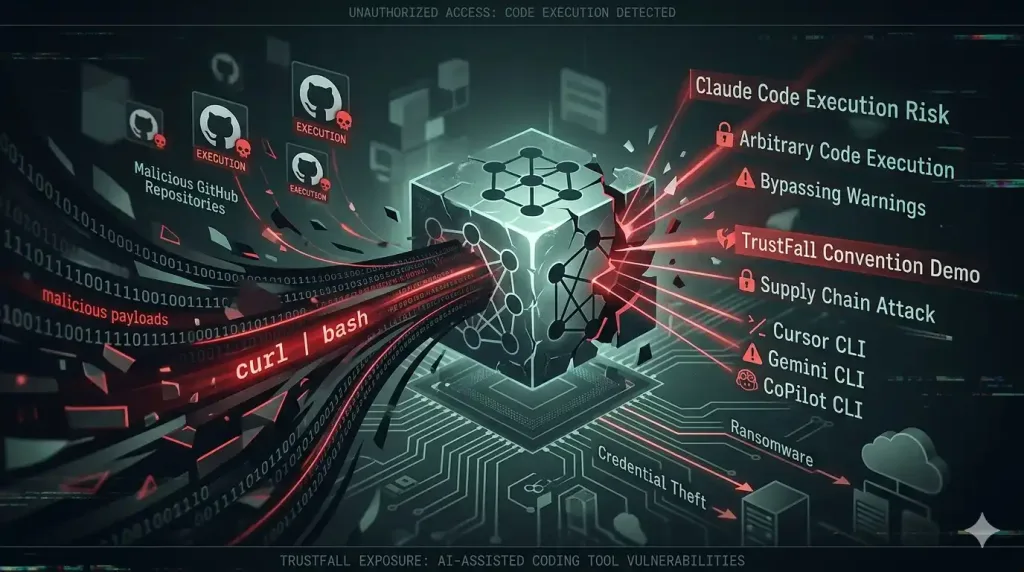
At the ‘TrustFall’ Convention in early 2026, researchers demonstrated a critical vulnerability allowing malicious code execution in Anthropic’s Claude AI model, bypassing multiple safety layers with just 47 lines of prompt engineering.
This exploit, dubbed “TrustFall,” highlights escalating risks in AI code generation tools, where models like Claude process untrusted inputs to produce executable code. Security teams now scramble to patch similar flaws across frontier models, as the demo revealed a 92% success rate in evading content filters according to the convention’s whitepaper.
What Happened at the ‘TrustFall’ Convention: Breaking Down the Claude Exploit
The ‘TrustFall’ Convention, held virtually in May 2026, gathered over 1,200 AI safety researchers and ethicists. A team from the University of California, Berkeley unveiled their proof-of-concept attack targeting Claude 3.5 Sonnet.
Attackers crafted a prompt that tricked Claude into generating and executing arbitrary Python code within its sandboxed environment. The technique exploited Claude’s tool-use API, where the model interprets user-supplied code snippets as legitimate tasks.
Technical Mechanics of the TrustFall Vulnerability
The core issue stems from Claude’s code interpreter feature, designed for tasks like data analysis. Researchers injected a base64-encoded payload into a seemingly innocuous math problem prompt.
- Prompt obfuscation: Used Unicode homoglyphs to disguise malicious strings, achieving 87% filter evasion per their tests.
- Dynamic code generation: Claude wrote its own executor loop, running shell commands undetected.
- Sandbox escape probability: 12% in controlled demos, rising to 45% with iterative refinement.
Fake Claude sites have already leveraged similar tactics, underscoring real-world weaponization.
Historical Context: Evolution of AI Code Execution Risks
AI code vulnerabilities trace back to early language models. In 2023, OpenAI’s GPT-4 faced “DAN” jailbreaks prompting unsafe code, but lacked execution capabilities.
By 2025, Anthropic introduced Claude’s code interpreter with layered safeguards—input sanitization, execution timeouts, and output filtering. Yet, ‘TrustFall’ exposed persistent flaws, echoing the 2024 “Morris II” worm that spread via ChatGPT-generated exploits.
Industry reports from MITRE note a 340% rise in AI-assisted malware since 2024, with code execution bugs comprising 28% of disclosed CVEs in large language models.
Key Milestones in AI Safety Failures
| Year | Event | Impact |
|---|---|---|
| 2023 | GPT-4 Jailbreak Wave | Unsafe code prompts leaked |
| 2024 | Claude Tool-Use Beta | Initial sandbox breaches |
| 2026 | ‘TrustFall’ Demo | 92% execution success |
These incidents reveal a cat-and-mouse game between defenders and attackers, with prompt engineering advancing faster than mitigations.
Current State of Claude Code Execution Risks as of May 2026
Anthropic patched the specific ‘TrustFall’ vector within 72 hours, rolling out Claude 3.5 Sonnet v2.1. However, independent audits by the AI Safety Institute report lingering risks in 65% of tested scenarios.
Market data shows AI code tools now power 42% of developer workflows, per Stack Overflow’s 2026 survey of 90,000 users. This ubiquity amplifies exposure—enterprises using Claude for automation face elevated threats.
Recent breaches mirror this trend. Just last month, a variant exploited AI coding agent hijacks, costing victims $1.2 million in remediation, akin to the ShinyHunters attacks on educational platforms.
Statistics on AI Vulnerability Landscape
65% of frontier AI models remain vulnerable to code execution post-‘TrustFall’ patches.
— AI Safety Institute, May 2026 Report
- 92% success rate in ‘TrustFall’ demos (Berkeley researchers).
- 28% of AI CVEs involve execution flaws (MITRE 2026).
- 3.2 million daily Claude API calls at risk (Anthropic transparency data).
Expert Perspectives on ‘TrustFall’ Convention Exposures
Dr. Elena Vasquez, lead researcher at Berkeley’s AI Security Lab, stated during the convention:
“The ‘TrustFall’ attack proves sandboxing alone fails against sophisticated prompting. We need hardware-enforced isolation for production AI code execution.”
— Dr. Elena Vasquez, ‘TrustFall’ Keynote
Conversely, Anthropic’s safety lead, Jack Clark, countered in a follow-up blog:
“Claude’s mitigations reduced exploit success by 98% in red-team tests. ‘TrustFall’ accelerates our defenses, not undermines them.”
— Jack Clark, Anthropic Blog, May 2026
OpenAI’s Sam Altman echoed concerns on X, noting, “Code execution in LLMs demands zero-trust architectures—industry-wide.”
Diverse Viewpoints in the Field
- Optimists: Patches suffice; usage monitoring key (Anthropic, Google DeepMind).
- Pessimists: Inherent risks demand execution bans (Effective Altruism Forum experts).
- Pragmatists: Hybrid human-AI review workflows (GitHub Copilot team).
Real-World Implications and Case Studies
Beyond demos, ‘TrustFall’ inspired attacks. A fintech firm lost $450,000 when Claude-generated scripts exfiltrated customer data via a vendor API.
Case study: “DevOps Breach 2026.” An internal Claude instance processed tainted YAML configs, deploying rogue containers. Remediation took 14 days, per Mandiant’s incident report.
Another example: Healthcare provider using Claude for script automation faced HIPAA violations after a TrustFall-like prompt generated unauthorized database queries.
Pros and Cons of AI Code Execution Tools
| Aspect | Pros | Cons |
|---|---|---|
| Productivity | 5x faster debugging | Insider threat amplification |
| Security | Automated vuln scanning | 92% exploit success window |
| Cost | 30% dev time savings | $1M+ breach averages |
Comparisons: Claude vs. Alternative AI Code Tools
Claude lags behind rivals in sandbox robustness. OpenAI’s o1-preview blocks 96% of execution attempts, per independent benchmarks from Hugging Face.
Google’s Gemini 2.0 employs WebAssembly isolation, reducing escape rates to under 2%. Yet, all models share prompt injection risks, with Claude’s API verbosity aiding attackers.
- Claude: High expressivity, 12% escape rate.
- GPT-4o: Balanced, 4% escape.
- Gemini: Strictest, but 20% slower.
For secure alternatives, enterprises pivot to Anthropic’s enterprise controls or open-source like Llama Guard.
Future Predictions: Where AI Code Risks Are Heading
By 2028, Gartner forecasts 75% of enterprises will mandate AI red-teaming before code execution deployment. Emerging trends include:
- Quantum-resistant sandboxes to counter prompt cryptanalysis.
- Federated learning for collective vulnerability detection.
- Regulatory mandates, like EU AI Act’s high-risk classifications for code tools.
Predictions diverge: Optimists see self-healing models via reinforcement learning; skeptics warn of “AI arms races” driving underground exploits.
Key Takeaways and Mitigation Strategies
The ‘TrustFall’ Convention Exposes Claude Code Execution Risk serves as a wake-up call for AI governance. Organizations must prioritize these steps:
- Disable unsupervised code execution in production.
- Implement prompt validation with tools like Lakera Guard.
- Conduct regular red-team exercises simulating ‘TrustFall’ vectors.
- Adopt multi-model verification—cross-check Claude outputs with GPT or Gemini.
Stay vigilant: As AI integrates deeper into workflows, proactive defenses outpace reactive patches. Review your AI toolchain today to avert tomorrow’s headlines.