When you hear the word “hacker,” what comes to mind? A hooded figure in a dark room, typing furiously on a keyboard, trying to steal your data?
That’s only part of the story. The hacking world is far more complex and colorful than Hollywood portrays.
Not all hackers are criminals. In fact, many work to protect us. Understanding the different types of hackers helps you recognize threats, appreciate ethical security work, and make informed decisions about cybersecurity.
Let’s explore the hacker spectrum—from heroes to villains and everyone in between.
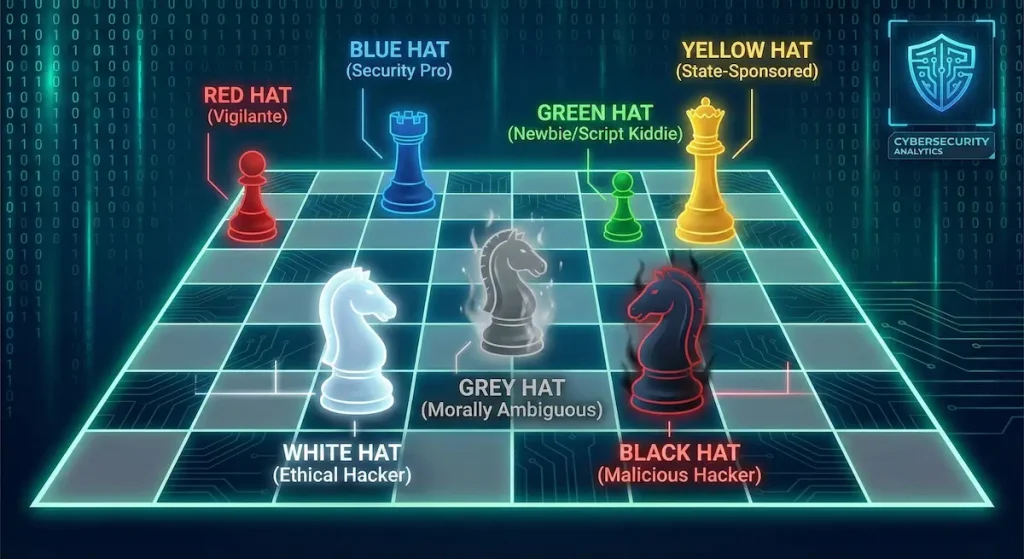
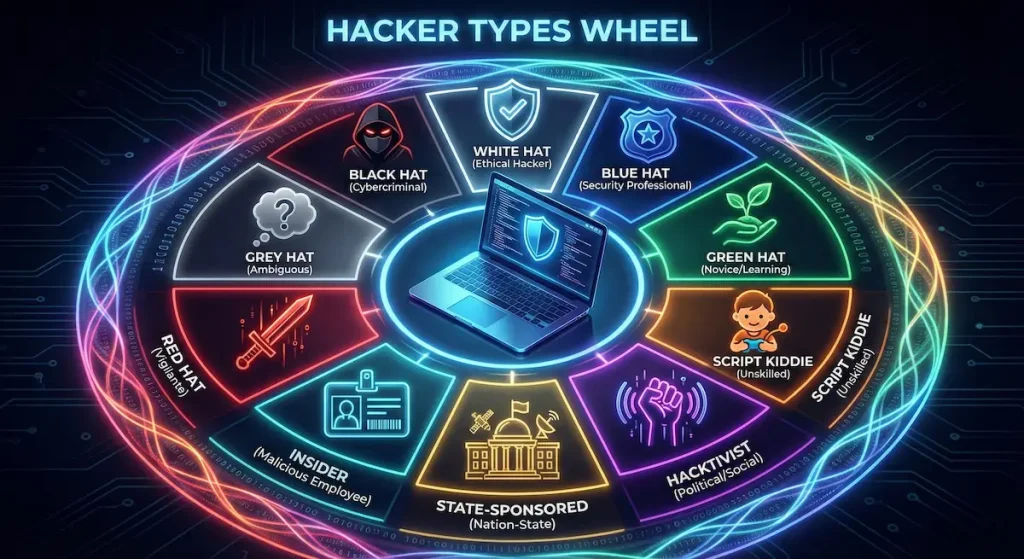
The Hacker Hat Colors Explained
The hacker community uses “hat colors” borrowed from old Western movies where good guys wore white hats and bad guys wore black hats.
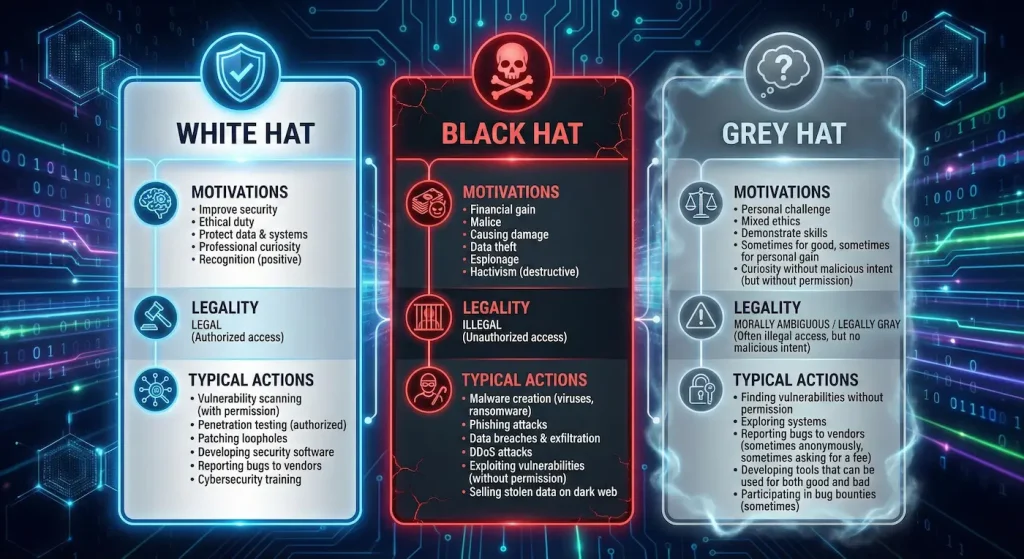
White Hat Hackers (Ethical Hackers)
Who They Are: The good guys. White hat hackers use their skills to find and fix security vulnerabilities before criminals can exploit them.
What They Do:
- Conduct authorized penetration testing
- Perform security audits and assessments
- Report vulnerabilities responsibly
- Work for security companies or as consultants
- Help organizations strengthen defenses
Motivation: Protecting systems and helping organizations improve security. They work within legal boundaries with explicit permission.
Real-World Example: A company hires a white hat hacker to test their network security. The hacker attempts to break in, documents all vulnerabilities found, and provides a detailed report on how to fix them.
Black Hat Hackers (Malicious Hackers)
Who They Are: The criminals. Black hat hackers break into systems without permission for personal gain, causing harm, or other malicious purposes.
What They Do:
- Steal sensitive data and financial information
- Deploy ransomware and malware
- Sell stolen data on the dark web
- Conduct corporate espionage
- Launch DDoS attacks
- Create and distribute viruses
Motivation: Financial gain, revenge, political ideology, or causing chaos. They operate illegally and face criminal prosecution if caught.
Real-World Example: Black hat hackers breach a retail company’s database, steal millions of credit card numbers, and sell them on underground markets for profit.
Grey Hat Hackers (The In-Between)
Who They Are: Hackers who operate in the moral and legal grey area. They may break into systems without permission but claim good intentions.
What They Do:
- Find vulnerabilities without authorization
- Publicly disclose security flaws
- Sometimes demand payment for vulnerability information
- May expose security issues to embarrass organizations
- Hack for curiosity without malicious intent
Motivation: Curiosity, desire for recognition, or belief they’re doing good—even if their methods are questionable.
Real-World Example: A grey hat hacker discovers a serious vulnerability in a company’s website. Without asking permission, they exploit it to prove it exists, then contact the company demanding a “finder’s fee” to reveal details.
Beyond the Basic Three: Specialized Hacker Types
The hacker world has evolved beyond simple color classifications. Here are other important categories:
Red Hat Hackers (Vigilante Hackers)
Who They Are: Aggressive security professionals who actively hunt down and attack black hat hackers.
What They Do:
- Track and counter-attack cybercriminals
- Use extreme methods to stop malicious hackers
- Often take down entire criminal networks
- May use illegal methods to fight illegal activity
Key Difference: Unlike white hats who report threats, red hats wage war against black hats using any means necessary.
Blue Hat Hackers (External Security Testers)
Who They Are: External security professionals specifically invited to test systems before launch.
What They Do:
- Test software before public release
- Participate in bug bounty programs
- Conduct pre-launch security audits
- Help companies find vulnerabilities during development
Key Difference: They’re not employees but are officially authorized, unlike grey hats who test without permission.
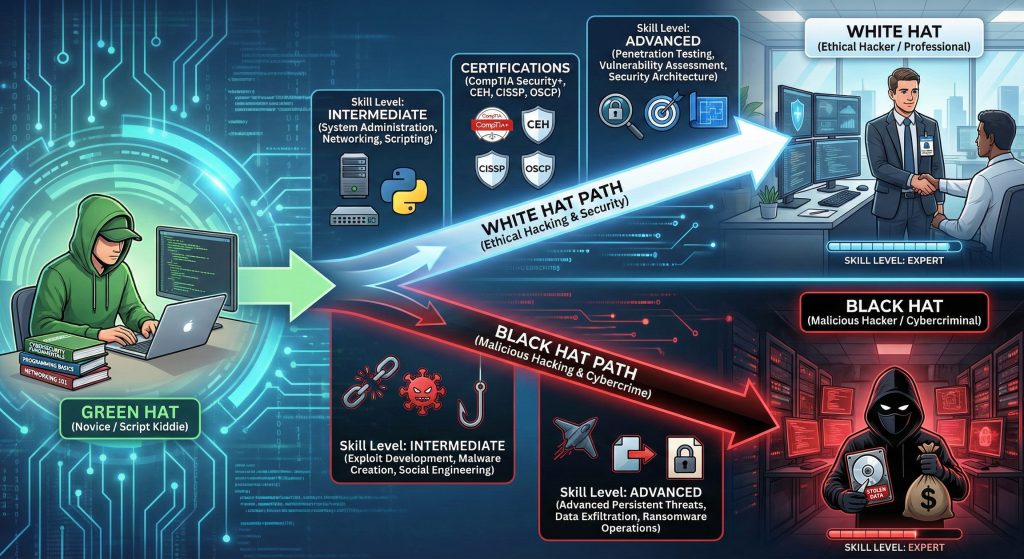
Green Hat Hackers (Newbies/Learners)
Who They Are: Beginners in the hacking world who are learning and developing their skills.
What They Do:
- Study hacking techniques and tools
- Practice in learning environments
- Ask questions in hacking forums
- May accidentally cause damage while learning
- Often later become white or black hats
Key Difference: They’re defined by their skill level rather than intentions—they could go either direction ethically.
Script Kiddies (Unskilled Attackers)
Who They Are: Inexperienced individuals who use pre-made hacking tools without understanding how they work.tt4
What They Do:
- Download and run automated hacking scripts
- Launch attacks using tools created by others
- Cause disruption without sophisticated knowledge
- Often get caught due to poor operational security
- Motivated by showing off or causing mischief
Why They’re Dangerous: Despite limited skills, they can still cause significant damage using powerful tools developed by more skilled hackers.
Hacktivists (Political/Social Hackers)
Who They Are: Hackers motivated by political, social, or ideological causes rather than personal gain.
What They Do:
- Deface websites with political messages
- Leak confidential information to expose wrongdoing
- Launch DDoS attacks against organizations they oppose
- Support social movements through cyber operations
- Target government and corporate entities
Famous Example: Anonymous, the decentralized hacktivist collective, has targeted governments, corporations, and organizations worldwide to promote various causes.

State-Sponsored Hackers (Nation-State Actors)
Who They Are: Government-employed or contracted hackers who conduct cyber operations for national interests.
What They Do:
- Conduct cyber espionage and intelligence gathering
- Launch cyber warfare operations
- Steal intellectual property and state secrets
- Sabotage critical infrastructure
- Target foreign governments and corporations
Why They’re Significant: They have enormous resources, advanced skills, and government protection. They’re among the most sophisticated threat actors.
Real-World Example: The SolarWinds attack was attributed to Russian state-sponsored hackers who compromised thousands of organizations globally.
Insider Threats (The Enemy Within)
Who They Are: Current or former employees, contractors, or partners who misuse their authorized access.
What They Do:
- Steal proprietary information
- Sabotage systems out of revenge
- Sell access credentials to external attackers
- Accidentally expose data through negligence
- Help external hackers bypass security
Why They’re Dangerous: They already have legitimate access, know system weaknesses, and can evade many security controls.
Suicide Hackers (Kamikaze Hackers)
Who They Are: Hackers who don’t care about getting caught and aim to cause maximum damage.
What They Do:
- Launch destructive attacks knowing they’ll be identified
- Target critical infrastructure for maximum disruption
- Often motivated by extreme ideology or personal grievances
- Accept imprisonment or other consequences
Key Characteristic: Unlike most hackers who try to remain anonymous, suicide hackers prioritize impact over self-preservation.
Cyber Terrorists
Who They Are: Hackers who use cyber attacks to create fear, panic, or advance terrorist objectives.
What They Do:
- Target critical infrastructure (power grids, water systems)
- Attempt to cause physical harm through cyber means
- Spread propaganda and recruit through online channels
- Coordinate physical and cyber attacks simultaneously
Distinction: Their goal is terror and ideological impact rather than financial gain.
What Motivates Hackers?
Understanding motivations helps predict behavior and defend against attacks.
Financial Gain
The most common motivation. Hackers steal data, deploy ransomware, commit fraud, or sell access for money.
Intellectual Challenge
Some hack simply because they can. The puzzle-solving aspect appeals to their technical curiosity.
Recognition and Fame
Many hackers want respect from peers. Pulling off a high-profile hack brings status in hacker communities.
Political or Social Beliefs
Hacktivists attack to promote causes, expose corruption, or fight perceived injustice.
Revenge or Spite
Disgruntled employees or individuals with grievances may attack for personal satisfaction.
National Security
State-sponsored hackers serve their country’s intelligence and military objectives.
Thrill and Excitement
Some simply enjoy the adrenaline rush of breaking into systems and evading detection.
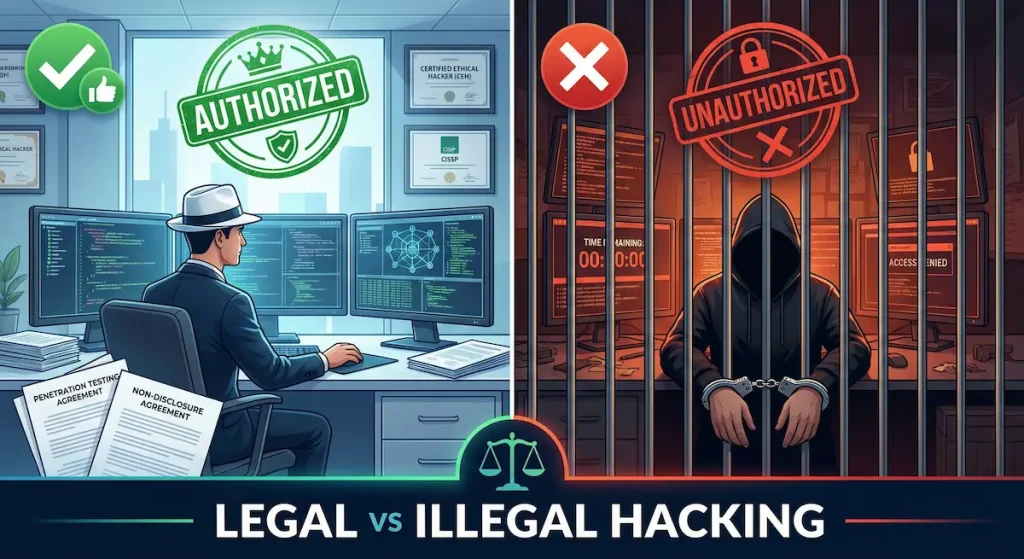
The Legal Landscape
Legal Hacking requires:
- Explicit written authorization
- Clear scope definition
- Proper contracts and agreements
- Compliance with regulations
- Responsible disclosure practices
Illegal Hacking includes:
- Unauthorized system access
- Data theft or destruction
- Creating or distributing malware
- Launching denial-of-service attacks
- Selling exploits to criminals
Even well-intentioned hacking without permission is illegal in most jurisdictions. The Computer Fraud and Abuse Act (CFAA) in the US and similar laws worldwide criminalize unauthorized access.
How to Become an Ethical Hacker
Interested in the white hat path? Here’s how to get started:
Education and Training
Formal Education: Computer science, information security, or cybersecurity degrees provide foundational knowledge.
Online Courses: Platforms like Cybrary, Udemy, and Coursera offer specialized hacking courses.
Hands-On Practice: Use legal practice environments like HackTheBox, TryHackMe, and OWASP WebGoat.
Certifications
Entry Level:
- CompTIA Security+
- Certified Ethical Hacker (CEH)
Advanced Level:
- Offensive Security Certified Professional (OSCP)
- GIAC Penetration Tester (GPEN)
- Certified Information Systems Security Professional (CISSP)
Skills to Develop
- Programming (Python, JavaScript, C++)
- Networking fundamentals
- Operating systems (Windows, Linux, macOS)
- Web application security
- Cryptography basics
- Social engineering awareness
Career Paths
- Penetration Tester
- Security Analyst
- Vulnerability Researcher
- Security Consultant
- Bug Bounty Hunter
- Red Team Member
Protecting Against Different Hacker Types
Different hackers require different defenses:
Against Black Hats
- Strong access controls and authentication
- Regular security updates and patches
- Network monitoring and intrusion detection
- Employee security awareness training
- Data encryption and backups
Against Insiders
- Principle of least privilege
- Activity monitoring and logging
- Background checks for sensitive positions
- Clear security policies and enforcement
- Exit procedures for departing employees
Against State-Sponsored Actors
- Advanced threat detection systems
- Network segmentation
- Zero-trust architecture
- Threat intelligence sharing
- Incident response planning
Against Script Kiddies
- Basic security hygiene (updated software, strong passwords)
- Rate limiting and anti-automation measures
- Firewall rules
- Monitoring for common attack patterns
The Ethics Debate
The hacking community continues debating ethical boundaries:
Grey Hat Defenders Argue:
- They expose vulnerabilities companies ignore
- Public disclosure motivates faster fixes
- They don’t cause intentional harm
- Many security improvements resulted from grey hat activities
Critics Counter:
- Unauthorized access is illegal regardless of intent
- They risk causing unintended damage
- Extortion (demanding payment for vulnerability info) is wrong
- Proper disclosure channels exist for responsible reporting
Bug Bounty Programs have helped bridge this gap by providing legal pathways for security researchers to report vulnerabilities and receive compensation.
Common Hacking Misconceptions
Myth 1: All hackers are young males in hoodies. Reality: Hackers come from all ages, genders, backgrounds, and professions. Many are professionals in suits working for corporations.
Myth 2: Hacking is always technical. Reality: Social engineering (manipulating people) is often more effective than technical exploits.
Myth 3: You need to be a genius to hack. Reality: Many attacks use readily available tools and exploit basic security oversights.
Myth 4: Antivirus software provides complete protection. Reality: Layered security is necessary. No single tool stops all attacks.
Myth 5: Small businesses aren’t targets. Reality: Cybercriminals often target smaller organizations with weaker security.
The Future of Hacking
Emerging trends shaping the hacker landscape:
AI-Powered Attacks: Machine learning enables more sophisticated, adaptive attacks that evolve to bypass defenses.
IoT Exploitation: Billions of poorly secured smart devices create massive attack surfaces.
Cloud Targeting: As businesses move to cloud platforms, hackers follow with cloud-specific attack techniques.
Quantum Computing Threats: Future quantum computers may break current encryption methods.
Automated Hacking: AI-driven tools will enable script kiddies to launch attacks requiring advanced skills today.
Defensive AI: White hats increasingly use AI for threat detection and automated response.
Conclusion
The hacker world is diverse and complex, extending far beyond the simple criminal stereotype.
White hat hackers protect us, using their skills to find and fix vulnerabilities. Black hat hackers exploit weaknesses for personal gain or malicious purposes. Grey hats operate in between, with questionable methods but sometimes good intentions.
Beyond these basics, specialized categories include hacktivists fighting for causes, state-sponsored actors conducting cyber warfare, insiders abusing trusted access, and script kiddies causing chaos with borrowed tools.
Understanding these different types helps you:
- Recognize the threats your organization faces
- Appreciate ethical security professionals
- Make informed security decisions
- Understand hacker motivations and tactics
- Build appropriate defenses
Remember: hacking is a tool. Like any tool, it can build or destroy. The person wielding it determines whether it protects or harms.
Whether you’re considering an ethical hacking career or simply want to understand cybersecurity threats, recognizing these distinctions is your first step toward digital literacy in an increasingly connected world.
Key Takeaways:
- Hackers are categorized by motivations and methods, not just skill level
- White hat hackers are ethical professionals who improve security legally
- Black hat hackers are criminals who exploit systems for malicious purposes
- Grey hat hackers operate in ethical and legal grey areas
- Specialized types include hacktivists, state-sponsored actors, and insider threats
- Understanding hacker types helps build appropriate defenses
- Ethical hacking offers legitimate career opportunities with proper training
Related Articles:
- Cybersecurity Fundamentals 2026: Build Strong Defense
- How Do I Get Certified in Cyber Security?
- Information Security vs Cybersecurity: Key Differences
- Corporate Security: Home Office Weakest Link
Next Article Preview:
In the next article, we’ll dive into “Understanding Security Domains: A Complete Guide to the 8 CISSP Domains” to explore the comprehensive framework that security professionals use to organize and manage cybersecurity!