The digital world is expanding rapidly, and with it comes a growing number of cyber threats. From data breaches to ransomware attacks, organizations face constant risks that can disrupt operations and damage reputations. As a result, companies are actively seeking skilled professionals who can protect their systems and sensitive data. This is where Cyber Security Training and Certification becomes essential.
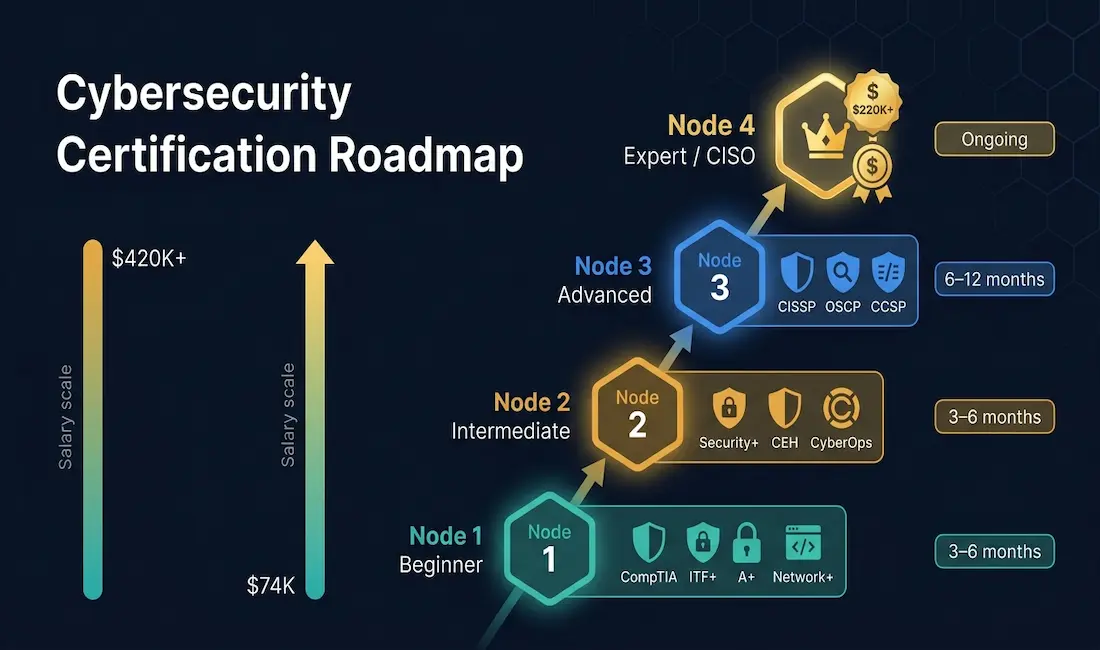
<cite index=”28-1″>The median cybersecurity salary in the US is $120,360 per year (BLS 2024), with entry-level positions starting at $74,000–$110,000 and CISOs earning $220,000–$420,000+.</cite> <cite index=”28-1″>With 87% of cybersecurity positions globally unfilled and a 33% job growth outlook, salaries remain strong across every experience level and specialization.</cite>
A structured learning roadmap helps aspiring professionals move from beginner to expert while gaining the practical skills needed to succeed. This guide outlines a clear progression through four stages — with certification costs, salary benchmarks, study timeline estimates, and both free and paid training options at each level.
Why Cyber Security Training and Certification Matters
Cybersecurity is no longer limited to IT departments — it has become a core business priority for organizations worldwide. Governments, financial institutions, healthcare providers, and tech companies all require trained professionals who can defend their digital infrastructure.
Completing a Cyber Security Training and Certification program offers several advantages:
- Builds strong technical and analytical skills
- Enhances credibility and demonstrated competence in the job market
- Provides hands-on experience with real security tools and environments
- Significantly improves salary potential — <cite index=”34-1″>CompTIA Security+ adds $15,000–$20,000 over uncertified candidates and is required for many government contracts</cite>
- Keeps professionals updated with the latest cyber threats and defense strategies
Cybersecurity Career Salaries at a Glance (2026)
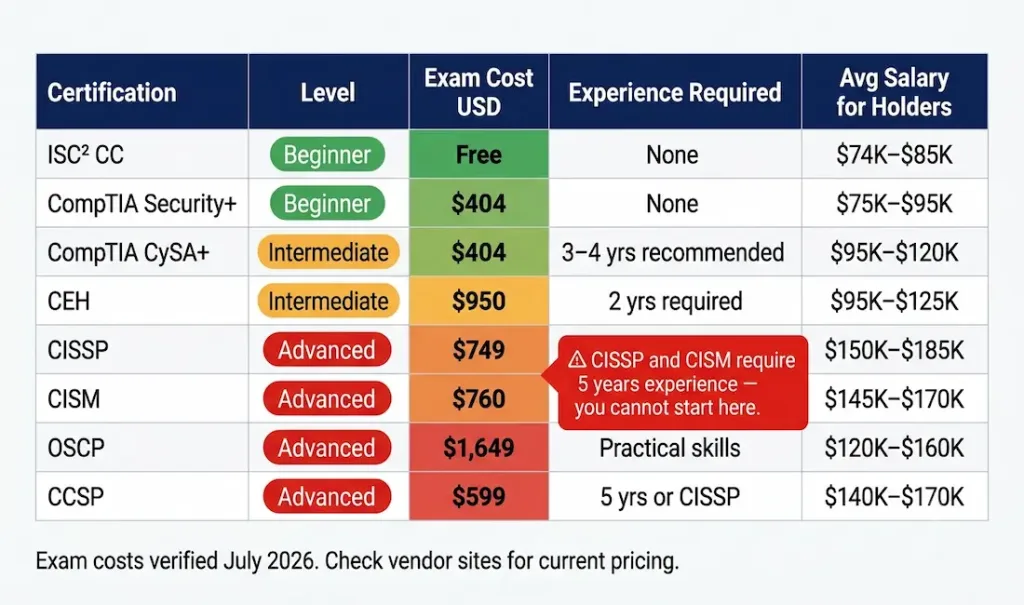
Before committing to a certification path, it helps to understand what each career level pays. <cite index=”29-1″>According to the BLS, information security analysts earned a median salary of $124,910 in 2024.</cite>
| Role / Level | Typical Salary (US) | Common Certifications |
|---|---|---|
| SOC Analyst (Entry) | $74,000–$95,000 | CompTIA Security+, Network+ |
| GRC Analyst (Entry) | $85,000–$100,000 | CompTIA Security+, CISA |
| Security Engineer (Mid) | $100,000–$140,000 | CySA+, CISSP, CEH |
| Penetration Tester (Mid) | $100,000–$145,000 | OSCP, CEH, eJPT |
| Cloud Security Specialist | $120,000–$170,000 | CCSP, AWS Security Specialty |
| Security Architect (Senior) | $140,000–$185,000 | CISSP, CISM, TOGAF |
| CISO | $220,000–$420,000+ | CISSP, CISM |
<cite index=”36-1″>CISSP tops the salary ranking at $150,000–$185,000 US median for holders, followed by CCSP ($140,000–$170,000) and CISM ($145,000–$170,000).</cite>
Stage 1: Beginner Level — Building the Foundation
What to Learn
The first step is understanding fundamental IT and networking concepts. Before diving into advanced security techniques, learners must build a base in how systems actually work — because you cannot defend what you do not understand.
Key topics at the beginner level:
- Basic computer hardware and software
- Networking concepts and protocols (TCP/IP, DNS, HTTP/S, subnetting)
- Introduction to operating systems — Linux and Windows administration basics
- Fundamentals of information security (CIA triad, threat actors, attack types)
- Basic scripting and command-line tools (Bash, PowerShell)
Recommended Timeline
3–6 months of consistent study (1–2 hours per day) to build a foundation strong enough to begin pursuing entry-level certifications.
Entry-Level Certifications and Costs
| Certification | Exam Cost | Prerequisites | Target Role |
|---|---|---|---|
| CompTIA ITF+ | ~$155 | None | Pre-IT baseline |
| CompTIA A+ | ~$253 per exam (2 exams) | None | IT support roles |
| CompTIA Network+ | ~$369 | None recommended | Network technician |
| ISC² CC (Certified in Cybersecurity) | Free | None | Entry cybersecurity roles |
<cite index=”32-1″>The ISC² CC and Fortinet NSE credentials build foundational knowledge at zero cost and add credible lines to your resume</cite> — an excellent starting point for budget-conscious learners before investing in paid certification exams.
Free Training Resources
- TryHackMe (tryhackme.com) — interactive browser-based cybersecurity labs; free tier available
- Cybrary (cybrary.it) — free foundational cybersecurity courses
- NIST Cybersecurity Framework (nist.gov) — free reference framework used industry-wide
- Professor Messer (professormesser.com) — free CompTIA study guides and videos
Paid Training
For learners who want structured, instructor-led learning with hands-on labs, JanBask Training offers beginner-friendly cybersecurity courses that introduce networking, security fundamentals, and essential tools. Their programs are designed to make complex concepts accessible while providing practical learning experiences for students at every starting point.
Stage 2: Intermediate Level — Core Cyber Security Skills
What to Learn
Once learners understand the basics, the focus shifts to practical defensive skills:
- Threat detection and vulnerability assessment
- Network security monitoring and log analysis
- Security tools: firewalls and intrusion detection systems
- Risk management and compliance frameworks (NIST, ISO 27001, SOC 2)
- Incident response and threat analysis workflows
Recommended Timeline
3–6 months of study on top of Stage 1, with at least 6–12 months of IT or help-desk work experience as parallel context.
Intermediate Certifications and Costs
| Certification | Exam Cost | Prerequisites | Target Role |
|---|---|---|---|
| CompTIA Security+ | ~$404 | None required (Network+ recommended) | SOC Analyst, security generalist |
| CompTIA CySA+ | ~$404 | Security+ or equivalent + 3–4 years experience | Security analyst, threat hunter |
| Certified Ethical Hacker (CEH) | ~$950 | 2 years IT security experience | Ethical hacker, pen tester |
| Cisco CyberOps Associate | ~$330 | None required | SOC analyst (Cisco environments) |
<cite index=”34-1″>CompTIA Security+ costs $404, has no experience prerequisite, and is approved for US Department of Defense IT roles. It unlocks first security jobs paying $75,000–$95,000 and is the foundation every other security certification builds on.</cite>
Free Training Resources
- HackTheBox (hackthebox.com) — free tier with practical penetration testing labs
- OWASP (owasp.org) — free web application security resources and Top 10 reference
- Blue Team Labs Online — free defensive security challenges
- Cisco NetAcad (netacad.com) — free CyberOps Associate study materials
Paid Training
JanBask Training‘s intermediate cybersecurity programs provide practical labs, real-world case studies, and mentorship from industry professionals. This approach helps learners apply theoretical knowledge to real security challenges in a structured environment with instructor support.
Stage 3: Advanced Level — Specialization and Expertise
What to Learn
After gaining intermediate knowledge and 2–5 years of work experience, professionals can move toward advanced roles. Specialization becomes the primary differentiator at this stage.
Popular cybersecurity specializations:
- Ethical hacking and penetration testing
- Cloud security (AWS, Azure, GCP security architecture)
- Security architecture and engineering
- Digital forensics and incident response (DFIR)
- Governance, risk, and compliance (GRC)
- Threat intelligence and hunting
Recommended Timeline
6–12 months of dedicated study per certification, alongside active professional experience in the field.
Advanced Certifications and Costs
| Certification | Exam Cost | Prerequisites | Target Role | Avg. Salary Impact |
|---|---|---|---|---|
| CISSP | $749 | 5 years experience in 2+ domains | Security architect, manager | <cite index=”28-1″>+$25,000–$35,000 vs non-certified peers</cite> |
| CISM | $760 | 5 years IS management experience | Security manager, director | $145,000–$170,000 median |
| OSCP | ~$1,649 (includes lab access) | Security+ or equivalent practical skills | Penetration tester | $120,000–$160,000 |
| CCSP | ~$599 | CISSP or 5 years experience | Cloud security architect | $140,000–$170,000 |
| CISA | ~$760 | 5 years IS audit/control experience | IT auditor, GRC analyst | $115,000–$145,000 |
<cite index=”35-1″>A core Security+ ($425) + CySA+ ($425) path costs $850 in exam fees. CISSP adds $749 but is a long-term credential for 5+ year career progression.</cite>
Important: <cite index=”34-1″>You cannot start with CISSP or CISM — both require 4–5 years of verified experience. Beginners must start with Security+ and build up.</cite>
Free Training Resources
- SANS Reading Room (sans.org) — free research papers and whitepapers
- Exploit-DB (exploit-db.com) — free exploit database for penetration testing research
- MITRE ATT&CK Framework (attack.mitre.org) — free adversary tactics and techniques reference
Paid Training
JanBask Training‘s advanced Cyber Security Training and Certification programs provide advanced modules focused on penetration testing, threat intelligence, and security architecture. These programs are designed to help professionals move into senior roles with the confidence of guided, lab-intensive learning.
Stage 4: Professional Growth and Career Advancement
Becoming an expert requires continuous learning. Cyber threats evolve constantly, so professionals must stay updated with emerging attack methods and defensive technologies.
Ways to Gain Real-World Experience
Cybersecurity professionals can sharpen skills and build a public portfolio by:
- Participating in capture-the-flag (CTF) competitions (CTFtime.org lists hundreds of free events)
- Practicing penetration testing in virtual labs (HackTheBox, TryHackMe, VulnHub)
- Joining bug bounty programs on HackerOne or Bugcrowd — paid real-world vulnerability hunting
- Building a personal cybersecurity home lab with virtual machines
- Contributing to open-source security projects on GitHub
- Writing technical blog posts or publishing CTF writeups — builds a visible professional brand
Which Certification Path Is Right for You?
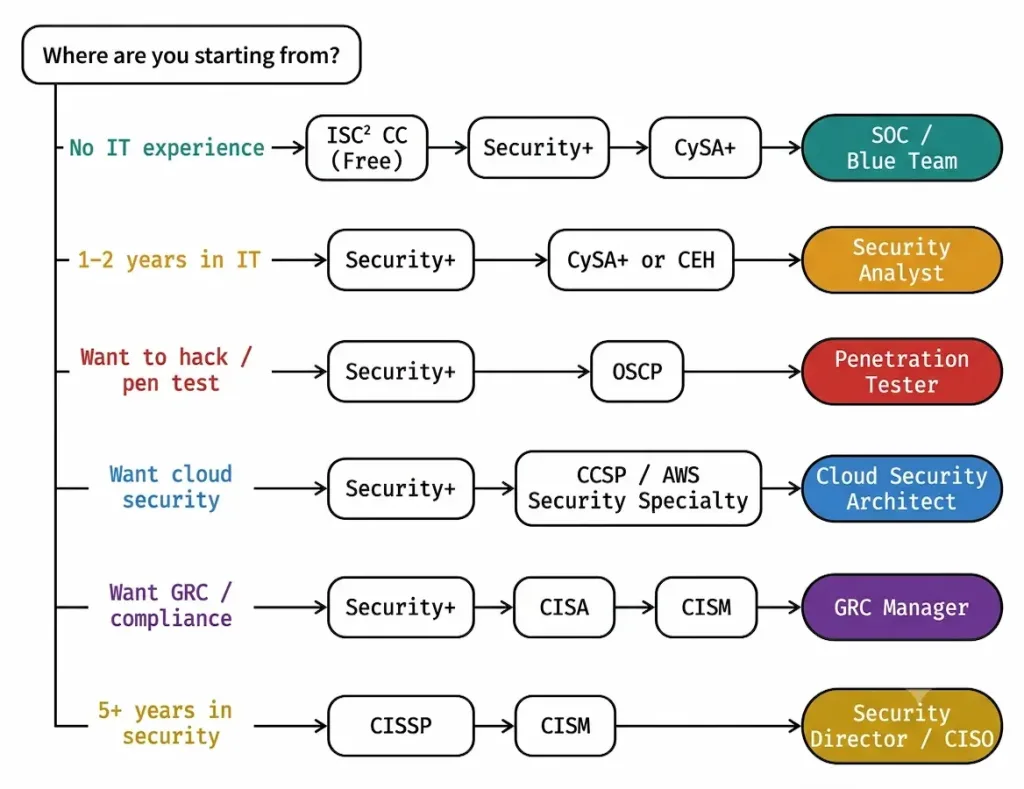
| Your Situation | Recommended Path |
|---|---|
| No IT or security experience | ISC² CC (free) → CompTIA Security+ → CySA+ |
| 1–2 years in IT, moving into security | CompTIA Security+ → CySA+ or CEH |
| Want offensive security / pen testing | Security+ → OSCP (skip CEH unless a job requires it) |
| Want cloud security | Security+ → CCSP or AWS Security Specialty |
| Want GRC / compliance track | Security+ → CISA → CISM |
| 5+ years in security, targeting leadership | CISSP → CISM |
Why Choose JanBask Training for Cyber Security Training and Certification
Selecting the right training provider matters. A good program should offer practical training, industry-relevant curriculum, and career support. JanBask Training stands out for its:
- Comprehensive curriculum from beginner to advanced levels
- Hands-on labs and real-world cybersecurity projects
- Training from experienced industry professionals
- Career guidance and job assistance
- Flexible learning options for working professionals
Other reputable training options to consider alongside JanBask Training:
- TryHackMe and HackTheBox — strongest for hands-on practical skills at any level
- SANS Institute — most respected for advanced and specialist training (premium pricing)
- Cybrary — strong free-to-paid progression for foundational and intermediate content
- (ISC)² Official Training — purpose-built for CISSP and CCSP preparation
Conclusion
Cybersecurity is one of the most promising and rapidly growing career fields in the technology industry. By following a clear Cyber Security Training and Certification roadmap, learners can gradually build their knowledge, develop practical skills, and achieve expert-level proficiency.
Starting with foundational IT concepts, progressing through intermediate security skills, and specializing in advanced cybersecurity domains ensures a strong career trajectory. The investment is modest relative to the return: <cite index=”35-1″>against $850–$1,200 in certification costs, the salary-to-investment ratio is one of the strongest in all of IT.</cite> With the right training — whether through JanBask Training or the free and paid alternatives listed above — individuals can confidently move from beginner to expert in the ever-evolving world of cybersecurity.
Frequently Asked Questions
How long does it take to break into cybersecurity from scratch?
Most people entering cybersecurity without prior IT experience can reach an entry-level position in 12–18 months with consistent dedicated study. The typical path involves 3–6 months building foundational IT and networking knowledge, followed by 2–3 months of focused CompTIA Security+ exam preparation and passing the exam, then 3–6 months of job searching and interview preparation while building a home lab or completing CTF challenges. People with existing IT experience in helpdesk, networking, or system administration can typically accelerate this timeline significantly — often reaching a first security role within 6–9 months of beginning targeted cybersecurity study.
What is the best first cybersecurity certification for beginners?
CompTIA Security+ is the most widely recommended first cybersecurity certification for most learners. It has no formal prerequisites, costs approximately $404, is approved for US Department of Defense IT positions, and directly unlocks entry-level roles paying $74,000–$95,000. For learners who want to build confidence before investing in the Security+ exam, the ISC² Certified in Cybersecurity (CC) credential is free and provides a credible introductory certification with no experience requirement. Network+ is also worth considering for learners who need to strengthen their networking foundations before Security+.
How much do cybersecurity certifications cost and is the investment worth it?
Entry-level certifications like CompTIA Security+ cost approximately $370–$450 for the exam. Mid-level certifications like CySA+ and CEH range from $400–$950. Advanced certifications like CISSP cost $749 (exam only) and OSCP costs approximately $1,649 including lab access. The total investment for a Security+ and CySA+ certification path is approximately $850–$1,000 in exam fees — a small fraction of the $25,000–$35,000 salary increase that CISSP certification alone has been documented to add. CompTIA Security+ typically pays back its cost within the first month of a new security role, making it one of the strongest ROI certifications in any technology field.
What is the difference between CompTIA Security+, CEH, and CISSP?
These three certifications target different career stages and roles. CompTIA Security+ is an entry-level certification with no prerequisites, covering broad security fundamentals and required by many government and DoD positions. CEH (Certified Ethical Hacker) is an intermediate certification focused specifically on offensive security techniques and penetration testing methodology, typically requiring 2 years of IT security experience. CISSP is an advanced, management-oriented certification requiring 5 years of verified professional experience in two or more security domains — it validates security leadership and architecture capability rather than hands-on technical skills, and commands the highest salary premium of the three at $150,000–$185,000 median for holders. Most professionals pursue them in roughly this order as their experience grows.
=Do I need a degree to work in cybersecurity?
No. Cybersecurity is one of the most accessible fields in technology for career changers without traditional degrees, because hiring managers place very high weight on demonstrated skills and industry certifications. CompTIA Security+ and hands-on lab experience documented through a GitHub portfolio or CTF writeups can substitute for a degree in many hiring processes. That said, a degree in computer science, information technology, or cybersecurity does accelerate progression into management and senior architecture roles, and some government positions explicitly require a degree. The practical path for most people without a degree is: earn CompTIA Security+, build a lab portfolio, get a first SOC analyst role, then evaluate whether a degree makes sense for the specific career trajectory they want.