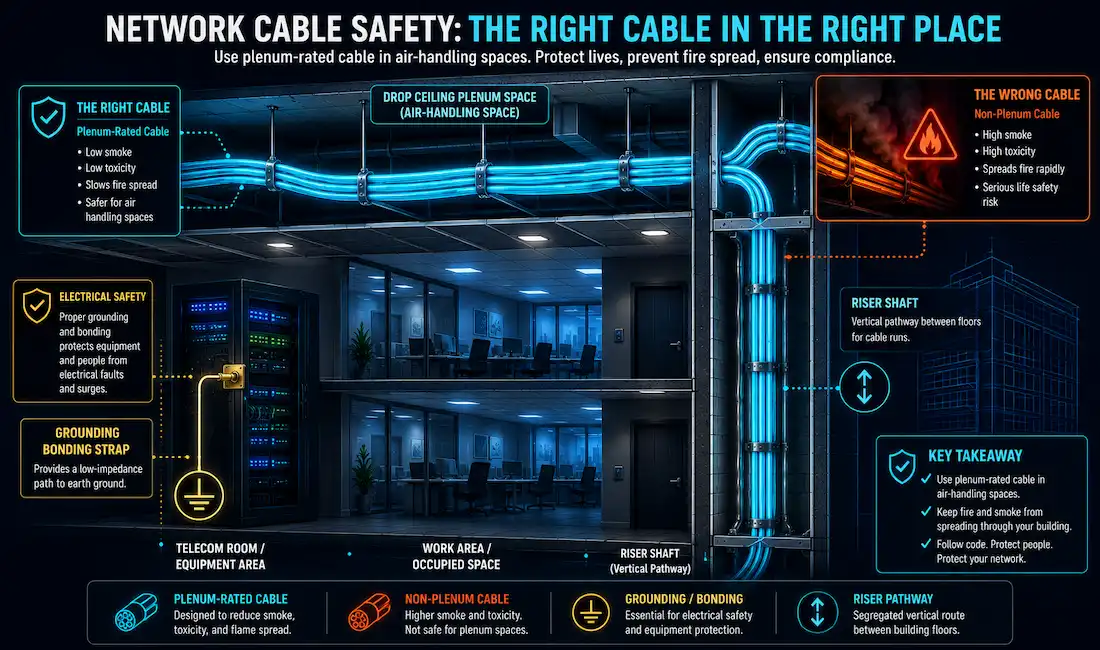
Copper cabling carries real risk. Not catastrophic, day-to-day risk, but real enough that building codes, safety standards, and installation practices all exist specifically to manage it. Every type of copper cable is vulnerable to two categories of hazard: fire and electrical. Understanding both, and the specific standards built around them, is genuinely useful knowledge for anyone installing or inspecting network cabling.
Fire Hazards: Why Cable Insulation Matters
Cable insulation and sheaths can be flammable. Some produce toxic fumes when heated or burned. This isn’t a theoretical concern. It’s exactly why building codes specify what kind of cable jacket is allowed in different parts of a building.
PVC, Riser, and Plenum Cable
Most standard network cable uses a PVC (polyvinyl chloride) jacket. PVC is cheap and durable. It’s also a real fire risk. When PVC burns, it releases dense smoke and toxic gases, including hydrogen chloride. In a fire, that smoke can spread through a building’s air-handling system faster than the fire itself.
That’s exactly the problem plenum spaces create. A plenum is the space above a drop ceiling, or below a raised floor, used to circulate air for heating and cooling. Cable often gets run through this same space. If a fire starts, and PVC cable is sitting in the airflow path, burning cable can pump toxic smoke through the entire building’s ventilation system in minutes.
Plenum-rated cable solves this. It uses fire-resistant, low-smoke jacket materials, commonly FEP (fluorinated ethylene propylene), instead of standard PVC. Building codes in the US, under the National Electrical Code (NEC), require plenum-rated cable in any space used for environmental air handling. Using standard PVC cable in a plenum space isn’t just risky. In most jurisdictions, it’s a code violation.
Riser-rated cable sits in between. It’s used for vertical runs between floors, through risers, where fire can spread from floor to floor if the cable isn’t adequately fire-resistant. Riser cable doesn’t need to meet plenum’s smoke standards, since it’s not sitting directly in air-handling space, but it still needs better fire resistance than basic PVC.
As a rule of thumb: plenum-rated cable in air-handling spaces, riser-rated cable in vertical shafts between floors, standard PVC only where neither of those conditions applies. Getting this wrong isn’t just a compliance problem. It’s a genuine life-safety issue.
Electrical Hazards
Copper conducts electricity. That’s the entire point of using it for signaling. It’s also the source of every electrical hazard on this list.
Unwanted current paths. A defective network device can conduct current to its own chassis, and from there to anything else the chassis touches, including other network devices connected by copper. This can put personnel and equipment at risk of electrical exposure, in ways that aren’t always obvious until something actually fails.
Ground potential differences. Buildings, and even different floors of the same building, don’t always share a single, unified electrical ground. When copper cabling connects two points with different ground potentials, voltage can flow across that cable that was never intended to be there. This is a genuinely common issue when copper runs between buildings on separate power systems, and it’s a major reason fiber-optic cable, which doesn’t conduct electricity at all, is often preferred for inter-building links specifically.
Lightning. A lightning strike near, or on, a building can induce dangerous voltage onto copper cabling, even cabling that’s fully indoors. Outdoor copper runs are especially exposed. Surge protection at building entry points exists specifically to catch this before it reaches sensitive equipment, or a person.
Unwanted voltage and current can damage network devices, damage connected computers, and injure the people working near them. Correct installation, following relevant specifications and building codes, is what actually prevents this.
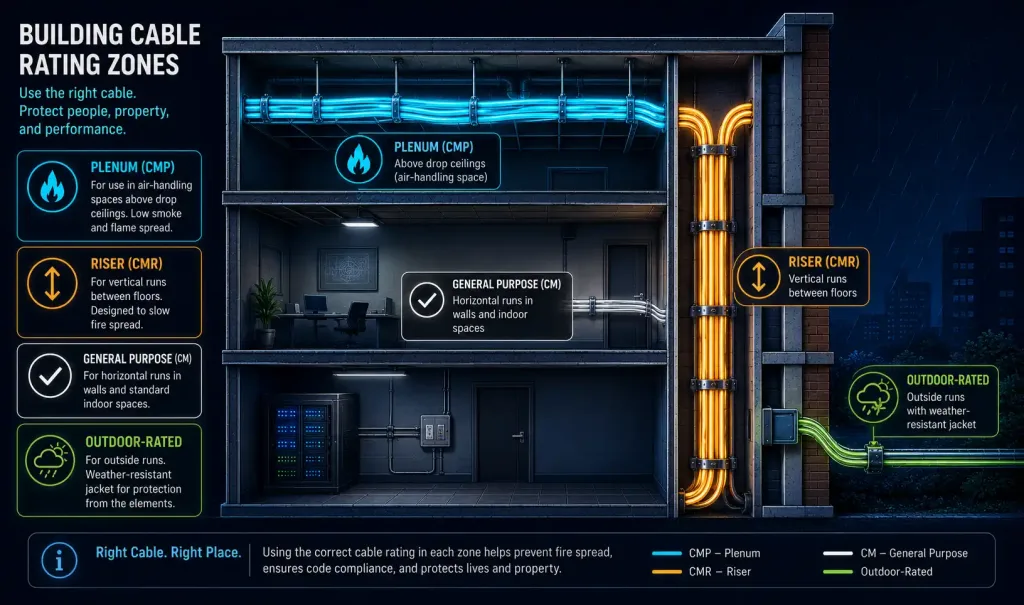
Cable Rating Quick Reference
| Rating | Where It’s Used | Why |
|---|---|---|
| Plenum (CMP) | Air-handling spaces: above drop ceilings, below raised floors, HVAC return paths | Low-smoke, fire-resistant jacket prevents toxic fumes from spreading through ventilation |
| Riser (CMR) | Vertical runs between floors, through risers and shafts | Prevents fire from spreading floor to floor through the cable pathway |
| General Purpose / PVC (CM) | Standard indoor runs, not in plenum or riser spaces | Adequate for typical horizontal runs where fire-spread risk is lower |
| Outdoor-rated | Direct burial, aerial, or exterior exposed runs | Weather resistance, UV resistance, and often gel-filled construction against moisture |
Mixing these up is one of the most common, and most consequential, mistakes in a cabling installation. A cable pulled through a plenum space with only a general-purpose PVC rating can fail inspection outright, and worse, represents a genuine fire-safety gap that won’t be obvious until it actually matters.
Grounding and Bonding Basics
Proper grounding is one of the most effective, and most commonly skipped, defenses against copper’s electrical hazards.
Grounding connects equipment to the earth, giving unwanted current somewhere safe to go instead of through a person or a sensitive device. Bonding connects separate metal components together electrically, so they all sit at the same potential, eliminating the voltage differences that cause shock and equipment damage in the first place.
For network cabling specifically, this means: patch panels, racks, and cable trays should be properly bonded to the building’s grounding system, not left electrically floating. Skipping this step is a common shortcut in rushed installations, and it’s exactly the kind of shortcut that turns a minor fault into a real hazard.
Safety Precautions During Installation
Use these precautions to avoid injury and equipment damage during copper cable installation:
- Wear safety glasses. Cutting, stripping, and terminating cable throws small debris. Eye protection is not optional.
- Use common sense with ladders. Don’t overreach. Don’t climb a ladder that’s rated below your combined weight plus tools.
- Wear protective clothing. Long sleeves and gloves protect against sharp cable ends, insulation debris, and rough surfaces in ceiling and wall spaces.
- Don’t be careless when lifting. Cable reels and spools are heavier than they look. Lift with your legs, not your back.
- Don’t use power tools you’re not trained on. An unfamiliar tool in a tight space is how injuries happen.
- Treat every cable as potentially energized until you’ve confirmed otherwise. Don’t assume a cable is safe just because it looks like a standard network cable.
- Know local building codes. Codes may prohibit drilling holes through firewalls, fire-rated ceilings, or other fire-separation barriers without specific fire-stopping procedures afterward.
- Be deliberate about what you touch. In an unfamiliar space, assume any exposed metal could be energized until you’ve verified it isn’t.
- Use the right tools for the job, not whatever’s closest at hand.
- Use the right cable rating for the space, plenum, riser, or standard, based on where it’s actually being installed.
- Mark junction box locations carefully, both for your own reference and for whoever works on this installation after you.
- Protect cable from sharp edges when pulling it through drop ceilings or wall cavities. A nicked jacket today is a fire or electrical hazard later.
- Don’t rush. A rushed installation is far more likely to have something wrong with it, and cable installation mistakes are expensive and disruptive to find and fix later.
Relevant Standards
A few standards bodies define the requirements referenced above:
- NEC (National Electrical Code). Sets US requirements for plenum and riser cable ratings, along with broader electrical safety requirements relevant to any cabling installation.
- NFPA (National Fire Protection Association). Publishes fire safety standards that inform, and often get referenced by, local building codes.
- TIA/EIA-568. The primary structured cabling standard, covering performance requirements for the cable itself, separate from fire and electrical safety specifically, but relevant to overall installation quality.
Local building codes take precedence over any of these when they’re more restrictive. Always check local requirements before assuming a national standard is sufficient on its own, since requirements can vary meaningfully between jurisdictions.
Fiber as an Alternative for High-Risk Runs
For inter-building links specifically, where ground potential differences and lightning exposure are both real concerns, fiber-optic cable sidesteps the problem entirely. Fiber carries light, not electricity. It can’t conduct current between buildings, can’t create a ground loop, and isn’t a path for induced lightning voltage the way copper is.
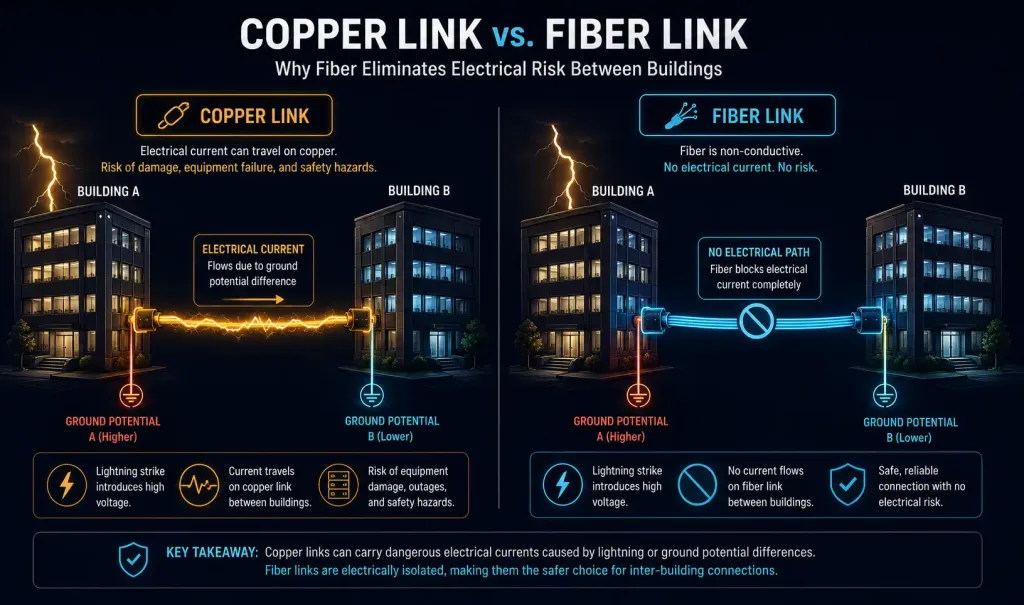
This is exactly why many organizations default to fiber for any run leaving a building, even when copper would technically work over the distance involved. The extra cost of fiber and its transceivers is often smaller than the cost of dealing with even one electrical incident caused by a copper run between buildings on separate grounds.
Conclusion
Copper cabling’s hazards, fire and electrical, are well understood and well documented, which means they’re also entirely preventable with the right precautions. Using the correct cable rating for the space (plenum, riser, or standard PVC), maintaining proper grounding and bonding, and following basic installation safety practices covers the overwhelming majority of real-world risk. None of this is exotic. It just requires actually following it, rather than treating it as optional.
FAQs
What is the difference between plenum-rated and riser-rated cable?
Plenum-rated cable uses fire-resistant, low-smoke jacket materials, required by code in air-handling spaces like the area above a drop ceiling, since burning cable there could pump toxic smoke through a building’s ventilation system. Riser-rated cable is used for vertical runs between floors, needing better fire resistance than standard PVC to prevent fire from spreading floor to floor, but without needing to meet plenum’s stricter smoke requirements. Using the wrong rating for a given space isn’t just a safety risk. It’s typically a direct building code violation.
Why is copper cabling an electrical hazard?
Because copper conducts electricity, and that conductivity can carry unwanted current in situations it was never designed for, a defective device conducting current to its chassis, a ground potential difference between two connected buildings, or induced voltage from a nearby lightning strike. Any of these can damage equipment or injure someone working near the cabling. Proper grounding, bonding, and correct installation practices are what prevent these unwanted paths from becoming dangerous.
Why does grounding matter for network cabling?
Grounding gives unwanted electrical current a safe path to the earth instead of through equipment or a person, while bonding keeps connected metal components at the same electrical potential, eliminating dangerous voltage differences between them. Racks, patch panels, and cable trays that aren’t properly bonded to the building’s grounding system are a common, often-overlooked source of real electrical risk. This is an easy step to skip during a rushed installation, and exactly the kind of shortcut that turns a minor fault into a real hazard later.
What building codes apply to network cable installation?
In the US, the National Electrical Code (NEC) sets requirements for plenum and riser cable ratings, along with broader electrical safety rules relevant to any cabling work. The National Fire Protection Association (NFPA) publishes fire safety standards that often inform local building codes directly. Local codes always take precedence when they’re stricter than the national standard, so checking local requirements before starting any installation is essential, not optional.
What safety precautions matter most during copper cable installation?
Using the correct cable rating for the space (plenum-rated in air-handling areas, riser-rated in vertical shafts) prevents the most serious fire-related risk, while proper grounding and bonding prevent most electrical hazards. Beyond that, basic physical safety practices matter just as much in practice: eye protection, safe ladder use, careful lifting, and simply not rushing the job. Most real-world cabling injuries and installation failures come from skipping one of these basics, not from anything exotic or unpredictable.