Day: August 27, 2019
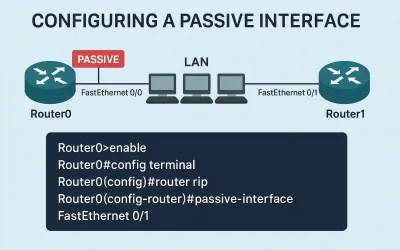
How to Configure RIP Passive Interface
By default, the Routing Information Protocol (RIP) sends routing table updates every 30 seconds on all enabled interfaces. In RIP version 1 (RIPv1), these are broadcasts to 255.255.255.255, while RIP version 2 (RIPv2) uses multicasts to 224.0.0.9. However, updates should only be sent on interfaces connected to other RIP-enabled routers to avoid unnecessary traffic. This...
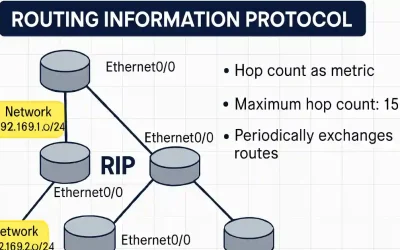
How to Configure Routing Information Protocol (RIP)
Routing Information Protocol (RIP) is a dynamic routing protocol that defines a way for routers to connect different networks using the Internet Protocol (IP) to share information about how to route traffic among these other networks. The Routing Information Protocol (RIP) uses hop count as a routing metric to determine the best path between the source and...
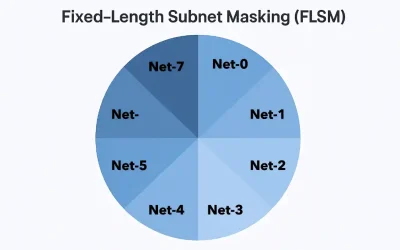
Fixed-Length Subnet Masking (FLSM) Exclusive Explanation
Fixed-Length Subnet Masking (FLSM), also known as traditional or classful subnetting, is a foundational concept in IP addressing that CCNA students must master before advancing to more efficient techniques like VLSM in CCNP. In FLSM, an equal number of addresses is allocated to each subnet using a uniform mask length, which simplifies routing in internal...
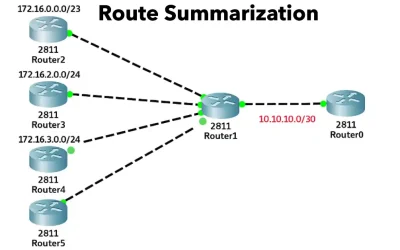
What is Classless Inter-Domain Routing (CIDR)
The IETF introduced RFC 1517 in 1993, introducing classless inter-domain routing (CIDR). The CIDR replaced the old classful network assignments. The classful address has now become obsolete due to the CIDR scheme. The CIDR network address is determined by the subnet mask instead of the value of the address’s first octet. The network and host...
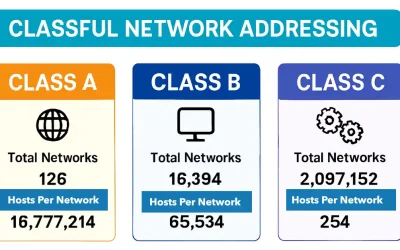
IPv4 Classful Network Exclusive Explanation
A classful network is a network addressing architecture used in networks since 1981. RFCs 790 and 791, released in 1981, describe how IPv4 network addresses were primarily allocated based on a classification system. The authors of IPv4 addresses set up three classes of network addresses: class A, B, and C for different network sizes. Classful...

Configure a Directly Connected Static IPv6 Route
The directly connected static IPv6 route is the best routing solution when CEF is not working on the router. In the old Cisco IOs before 12.0 versions, this is the best solution to avoid recursive routing. It is also the best in point-to-point networks. It is also the best alternative to using the next-hop IPv6...
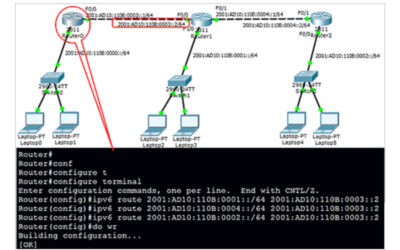
Static IPv6 Route Using Next-Hop IPv6 Address
Only the IP address of the next-hop IPv6 is specified in the next-hop static IPv6 route. The exit interface is derived from the next hop. For example, in Figure 1, three next-hop static routes are configured on Router 0. Before forwarding any packet, the router must resolve the route to determine the exit interface to...
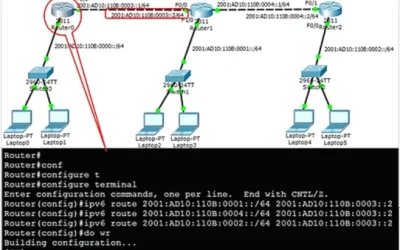
Master IPv6 Route Next-Hop Option? – Eliminate Routing Blind Spots for Superior Connectivity
As we already discussed, what is a Next-Hop in the Network? The article is a routing term for the next neighboring router that a data packet can go through. The IPv6 route next-hop is along with a series of routers connected simultaneously in a network, and is the next possible destination for a data packet....