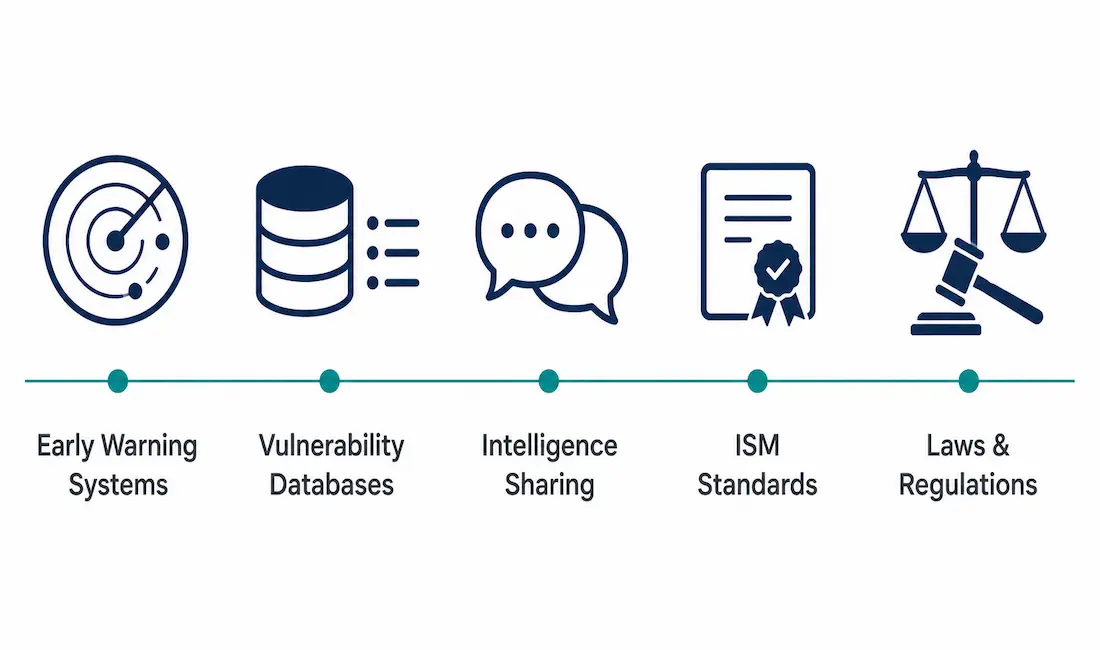
No single defense stops every attacker, but a combination of technology, collaboration, and policy — applied consistently — makes an organization a meaningfully harder target. This guide covers five pillars of that combined approach: early warning systems, vulnerability databases, cyber intelligence sharing, information security management standards, and the legal and regulatory landscape that shapes how organizations are expected to respond.
Early Warning Systems
Early warning systems use sensors and alerting infrastructure to detect attacks in their earliest stages, before they escalate into a full breach. Comprehensive monitoring across every network segment can be genuinely costly, which is why organizations typically prioritize high-value targets — the systems most likely to face sophisticated, targeted attacks — rather than spreading monitoring resources evenly across everything.
Designing and implementing effective Cyber Early Warning Systems (CEWS) involves real research challenges: distinguishing genuine attack patterns from normal traffic noise, minimizing false positives without missing real threats, and scaling detection across increasingly large and complex networks. Despite these challenges, early detection remains one of the highest-leverage investments in proactive defense, since the cost of catching an intrusion in its early stages is consistently far lower than the cost of a full breach.
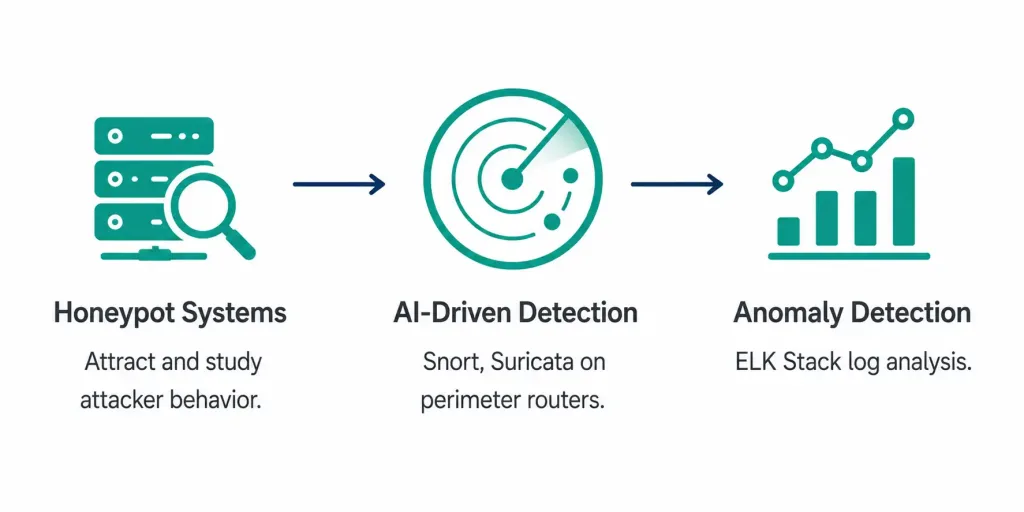
The Honeynet Project is a well-known, long-running international security research organization that investigates active attacks, develops open-source security tools, and studies attacker behavior by deploying deliberately vulnerable “honeypot” systems designed to attract and observe malicious activity. Its HoneyMap visualizes detected attacks in real time, making it a useful reference point for understanding current attack patterns even outside a formal research context.
AI-Enhanced Detection
Modern early warning systems increasingly incorporate AI-driven predictive analytics, aiming to spot anomalies in network traffic before they escalate into confirmed incidents. Open-source intrusion detection systems like Snort or Suricata, deployed on perimeter routers, remain a practical and widely-used starting point for organizations building this capability — configured to monitor for patterns like sudden spikes in outbound traffic, which can indicate data exfiltration in progress.
For hands-on learning, the ELK Stack (Elasticsearch, Logstash, Kibana) is a genuinely accessible way to experiment with building custom anomaly detection in a home lab environment, without needing enterprise-scale infrastructure to get meaningful, practical experience.
Vulnerability Databases
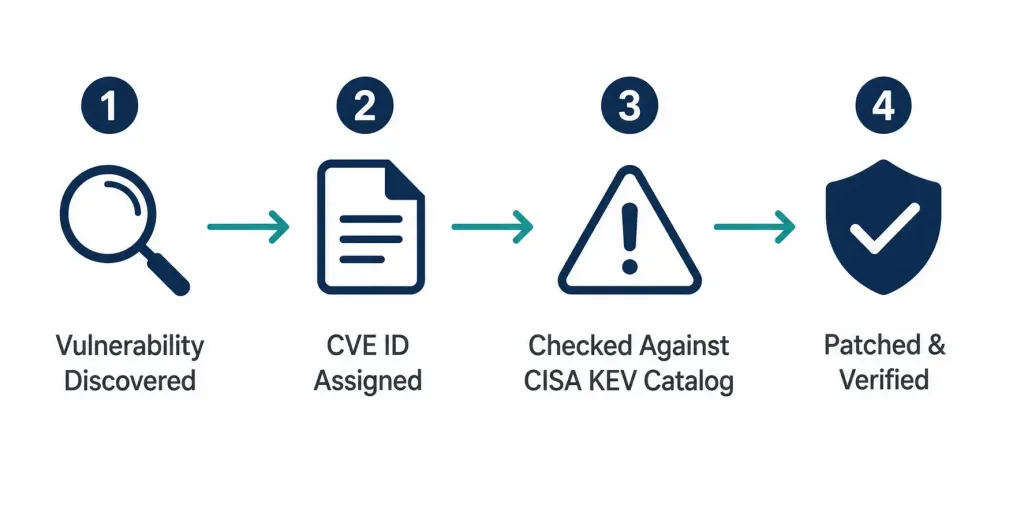
The Common Vulnerabilities and Exposures (CVE) system provides a publicly available, standardized catalog of known security vulnerabilities. Each CVE entry includes a unique identification number, a description of the vulnerability, and at least one public reference — giving security teams a shared, unambiguous way to discuss and track specific flaws across different tools and organizations.
A concrete, verified recent example: Microsoft’s October 2025 Patch Tuesday addressed 167 CVEs, including three actively-exploited zero-days — among them CVE-2025-24990 (a Windows Agere Modem Driver elevation-of-privilege flaw) and CVE-2025-59230 (a Windows Remote Access Connection Manager flaw). Both were confirmed under active exploitation and added to CISA’s Known Exploited Vulnerabilities catalog, illustrating exactly why prioritizing patches based on that catalog — rather than treating every CVE as equally urgent — is a practical, high-value strategy.
Practical integration: vulnerability scanners like Nessus or OpenVAS can automatically cross-reference CVE data during network sweeps, and prioritizing remediation based on CISA’s Known Exploited Vulnerabilities Catalog focuses limited patching resources on flaws with confirmed real-world exploitation, rather than the full, much larger universe of theoretical vulnerabilities.
Sharing Cyber Intelligence
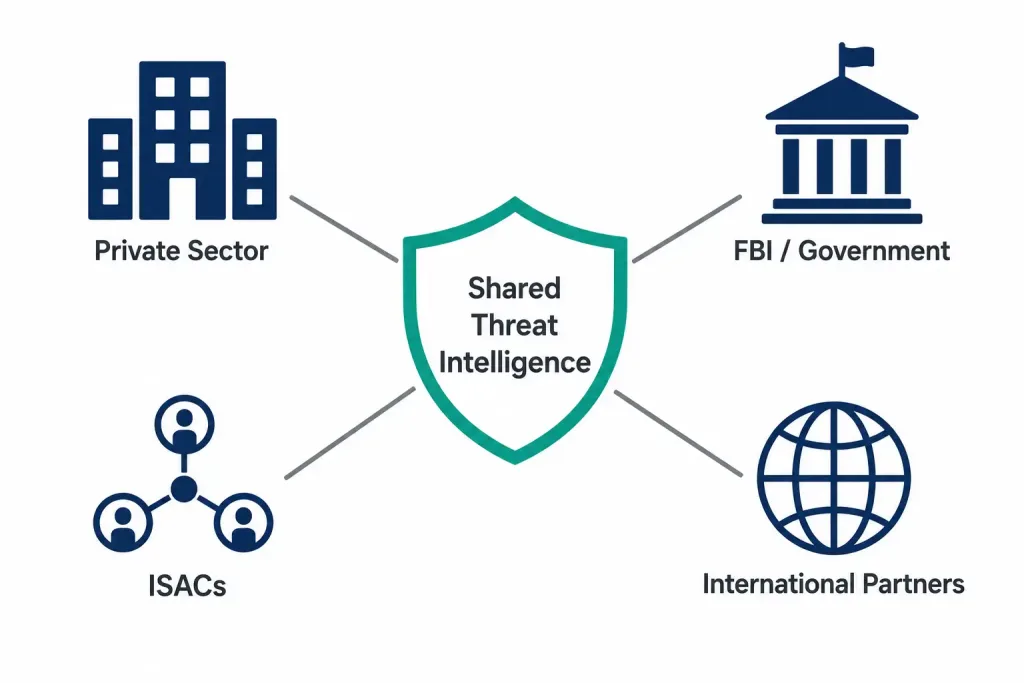
Sharing threat intelligence between organizations, and between the private sector and government, is a genuinely important defense multiplier — a single organization’s incident response, shared appropriately, can help many other organizations avoid falling victim to the same attack pattern.
InfraGard, a partnership between the FBI and the private sector, is a well-established example of this kind of collaboration in the United States, giving members access to shared threat intelligence that can directly inform firewall configuration and incident response planning. Beyond InfraGard, many countries maintain their own national cyber intelligence sharing bodies, reflecting how central this kind of collaboration has become to modern cyber defense generally.
A Note on U.S. Legal Framework Status
The Cybersecurity Information Sharing Act of 2015 (CISA 2015) — the primary U.S. legal framework providing liability protections for private-sector threat intelligence sharing — expired on September 30, 2025, after Congress missed its reauthorization deadline amid a government shutdown. This is worth knowing accurately: the law was subsequently reauthorized on a short-term basis through January 30, 2026, and then extended further through September 30, 2026 as part of the FY2026 Consolidated Appropriations Act. Organizations relying on CISA 2015’s protections should track its status directly, since the law has already lapsed and been renewed multiple times within a single year — a pattern worth building into information-sharing risk planning rather than assuming permanence either way.
Information Security Management (ISM) Standards
The ISO/IEC 27000 family of standards helps organizations systematically protect information assets — financial data, intellectual property, employee records, and third-party information alike. ISO/IEC 27001 is the best-known standard in the family, defining requirements for a formal Information Security Management System (ISMS).
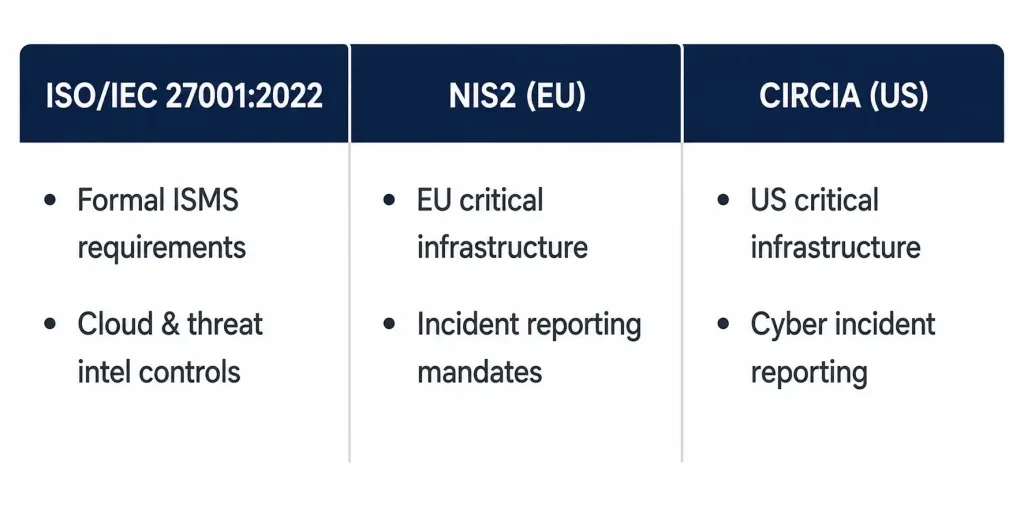
The 2022 revision transition: organizations certified against the earlier ISO/IEC 27001:2013 standard were required to transition to the 2022 version by October 31, 2025, which introduced updated controls addressing cloud security and threat intelligence more directly than the previous revision. Practical implementation commonly involves applying the standard’s Annex A controls — for example, control 8.1 on secure network services — through concrete measures like VLAN segmentation and adopting zero-trust access principles, translating the standard’s requirements into actual network configuration rather than treating it as a purely paperwork exercise.
New Laws and Regulations
Governments continue to develop legislation aimed at discouraging cyberattacks and data breaches, generally through a combination of mandatory reporting requirements and financial penalties for non-compliance. ISACA (formerly the Information Systems Audit and Control Association), an independent global nonprofit, tracks developments in this space and regularly surveys the field’s biggest operational challenges — persistent staffing shortages and social engineering consistently rank among the top-cited concerns in industry survey data.
Beyond the U.S., the EU’s NIS2 directive and the U.S. CIRCIA (Cyber Incident Reporting for Critical Infrastructure Act) both impose meaningful incident reporting obligations on covered organizations. Practically, this means enabling comprehensive logging on network infrastructure — switches, routers, and security appliances — well before an incident occurs, since reconstructing an accurate timeline after the fact from inadequate logs is far harder than logging comprehensively from the start.
Network-Level Best Practices
Translating these strategic pillars into concrete network configuration is where the theory becomes practice:
- Deploy firewalls with deep packet inspection to scrutinize traffic content, not just headers — this is standard capability on modern next-generation firewall platforms.
- Use network segmentation, whether through traditional VLANs or Software-Defined Networking (SDN), to isolate critical assets so a compromise in one segment doesn’t automatically grant access to everything else.
- Monitor actively with packet capture tools like Wireshark to investigate anomalies, rather than relying purely on automated alerting to catch everything.
- Enforce strong passwords and deploy multi-factor authentication (MFA) specifically to counter credential-stuffing attacks, which exploit exactly the weak point that MFA is designed to close.
- Adopt zero-trust architecture principles, verifying every access request explicitly rather than trusting anything already inside the network perimeter by default — a meaningful shift from older perimeter-based security models.
Staying Current: The Threat Landscape Keeps Moving
The specific threats organizations face continue to evolve, and a few durable trends are worth tracking regardless of the exact year: ransomware remains a persistent, high-impact threat category; AI is increasingly used by attackers to make phishing and social engineering more convincing (including deepfake audio and video); and supply chain risk — whether from a genuine attack or, as with the CrowdStrike incident covered elsewhere in this series, an accidental vendor-caused outage — continues to demonstrate how concentrated dependency on a small number of vendors creates systemic risk.
Rather than trying to memorize a specific year’s threat statistics, which age quickly, building the habit of checking current threat intelligence sources — CISA advisories, vendor threat reports, and industry surveys — as an ongoing practice is the more durable skill.
A Practical Starting Checklist
Pulling the five pillars above into something actionable, a reasonable starting sequence for an organization building out these capabilities looks like:
- Establish baseline visibility first. Before layering on advanced detection, confirm you actually have logging enabled on critical infrastructure — switches, routers, firewalls, and key servers. Detection tools are only as good as the data they can see.
- Integrate CVE tracking into routine operations, not as a one-time project. A vulnerability scanner cross-referencing CVE data automatically, checked against CISA’s Known Exploited Vulnerabilities catalog, turns patch management from reactive firefighting into a manageable, prioritized queue.
- Join at least one intelligence-sharing community relevant to your sector. InfraGard is a reasonable starting point in the U.S., but sector-specific ISACs (Information Sharing and Analysis Centers) often provide more directly relevant threat intelligence for a given industry.
- Map your compliance obligations explicitly, rather than assuming they’re covered. NIS2, CIRCIA, and sector-specific frameworks like HIPAA or PCI-DSS all carry distinct reporting requirements, and the overlap between them isn’t always obvious without deliberately mapping it out.
- Build a home lab or sandboxed test environment for hands-on practice with detection tools before deploying anything to production. Understanding how Snort or Suricata actually behaves against real traffic patterns, in a low-stakes environment, builds genuine operational confidence that reading documentation alone doesn’t provide.
None of these steps requires enterprise-scale budget to start — the honest starting point for most of them is time and consistency rather than expensive tooling, which is worth remembering for smaller organizations or individual learners who might otherwise assume this kind of defense is out of reach without a large security budget.
FAQs
What are early warning systems in cybersecurity?
Early warning systems use sensors, honeypots, and increasingly AI-driven anomaly detection to identify attacks in their earliest stages, before they escalate into confirmed breaches. The Honeynet Project is a well-established example, using deliberately vulnerable systems to observe and study attacker behavior in a controlled way.
How do vulnerability databases help thwart cybercriminals?
Databases like CVE provide a standardized, publicly available catalog of known vulnerabilities, each with a unique identifier and description, letting security teams communicate about and prioritize specific flaws consistently. Integrating CVE data into automated scanners, and prioritizing patches based on CISA’s Known Exploited Vulnerabilities Catalog, focuses limited remediation resources on the vulnerabilities attackers are actually using right now.
Why is sharing cyber intelligence important?
Threat intelligence sharing, through partnerships like InfraGard or national cyber intelligence agencies, lets one organization’s incident response inform and protect many others facing similar threats. In the U.S., the legal framework supporting this kind of sharing (CISA 2015) has recently lapsed and been reauthorized multiple times, which is worth tracking directly given how central these liability protections are to organizations’ willingness to share sensitive threat data.
What are ISM standards and why do they matter?
Information Security Management standards like ISO/IEC 27001 define formal requirements for protecting an organization’s information assets through a structured Information Security Management System. The 2022 revision specifically strengthened controls around cloud security and threat intelligence, and organizations previously certified against the 2013 version were required to transition by October 31, 2025.
What new laws and regulations discourage cybercrime?
Regulations like the EU’s NIS2 directive and the U.S. CIRCIA impose meaningful incident reporting requirements on covered organizations, generally backed by real financial penalties for non-compliance. Comprehensive logging infrastructure, established before an incident occurs rather than scrambled together afterward, is what actually makes compliance with these reporting requirements practical.
How can someone new to cybersecurity start building these skills hands-on?
Open-source tools provide genuinely accessible starting points: Snort or Suricata for intrusion detection, the ELK Stack for building custom anomaly detection and log analysis, and a home lab environment for experimenting safely without risking production systems. Following CISA advisories and major vendor threat reports as an ongoing habit builds the kind of current threat awareness that no single course or certification fully covers on its own.