Starting vlogging has never required less upfront investment, and it’s never been more competitive. The creator economy is now a genuinely massive market — valued at roughly $255.66 billion in 2025 and projected to reach about $323.48 billion in 2026, growing at a 26.5% compound annual rate, according to Research and Markets. That growth cuts both ways: more opportunity, and more competition for attention. Here’s what actually matters when starting out, organized honestly by what you genuinely need versus what’s optional.
1. Plan Before You Film
The biggest reason new vlogs stall isn’t bad gear — it’s starting without a plan and running out of ideas by video three. Before filming anything, decide on a few basics: what topic or niche you’re covering, how often you’ll realistically post, roughly how long each video will run, and who you’re actually making it for. Sketching out your first four or five video ideas before you film the first one gives you momentum instead of staring at a blank page every week, and it forces you to confirm you actually have enough to say about your chosen topic before committing to it publicly.
2. You Can Genuinely Start With Just a Smartphone
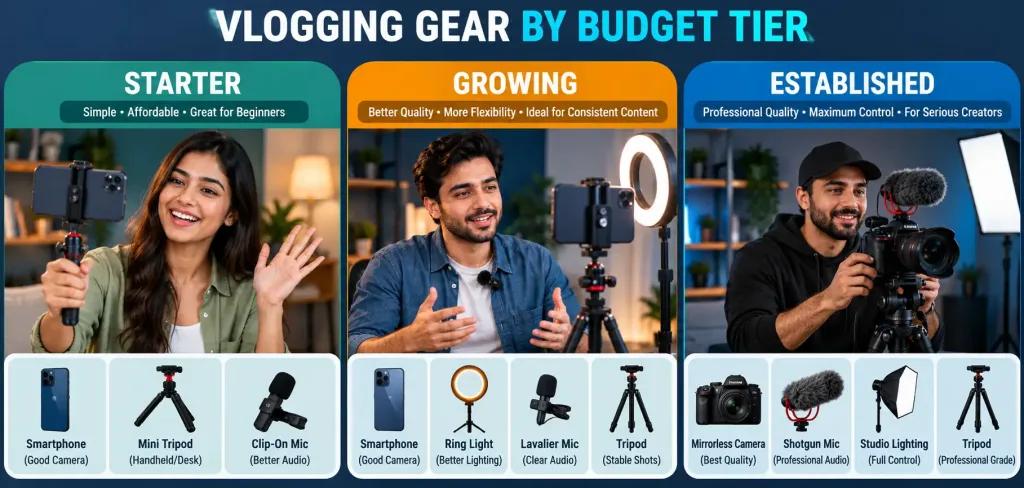
Here’s the honest answer to a question most vlogging guides dodge: modern smartphone cameras are genuinely capable of producing publishable video, and plenty of successful channels are still shot entirely on a phone. If you’re testing whether vlogging is something you’ll stick with, start with the phone you already own rather than buying a camera first. A dedicated camera becomes worth the investment once you have a clearer sense of your style and are ready to invest in production quality that a phone genuinely can’t match — better low-light performance, more control over depth of field, and interchangeable lenses.
If and when you do upgrade, a mirrorless camera with a flip-out screen (so you can see yourself while filming) and reliable face or eye autofocus is the most useful upgrade path, since it directly solves the two biggest frustrations of filming yourself: not knowing if you’re in frame, and footage that drifts out of focus.
3. Lighting Matters More Than Camera Quality
This is genuinely the highest-impact, lowest-cost improvement available: good, consistent lighting makes footage from a phone look dramatically better, while bad lighting makes even expensive camera footage look amateur. Film facing a window during the day for free, soft, even light — direct sunlight creates harsh shadows, so position yourself facing the light source rather than with it behind you. If you’re filming indoors regularly or at inconsistent times of day, a basic LED ring light is a genuinely worthwhile low-cost upgrade, since it gives you consistent, repeatable lighting regardless of what’s happening outside.
4. Audio Quality Is Where Most Beginners Get Caught Out
A built-in camera or phone microphone is omnidirectional — it picks up sound from every direction equally, including room echo, background noise, and anything happening behind you, not just your voice. This is one of the fastest ways a video reads as “amateur” even when the visuals look fine, because viewers tolerate mediocre video quality far better than they tolerate bad audio. A basic external microphone — a clip-on lavalier mic or a simple shotgun mic mounted on your camera or phone — solves most of this problem for a relatively small cost, and it’s worth prioritizing over a camera upgrade if you have to choose one or the other.
5. Editing Software You Already Have Is Genuinely Enough to Start
The free editing software that comes bundled with most computers (iMovie on Mac, the built-in Photos app’s video editor on Windows) is entirely capable of handling basic cuts, trimming, and simple transitions — enough to post a clean, watchable video. Don’t let “I need professional editing software” become a reason to delay publishing. Once you have a consistent posting habit and a clearer sense of what effects or transitions you actually want, software like Adobe Premiere Pro or DaVinci Resolve (which has a genuinely capable free tier) becomes worth the learning curve for more advanced color grading, multi-track audio, and motion graphics.
6. Distribution Is Part of the Work, Not an Afterthought
Posting a video and hoping it finds an audience rarely works on its own. Upload to the platforms where your actual audience spends time — YouTube remains the default for long-form vlogs, but don’t ignore where your specific audience already is. Share clips or trailers for the full video on your other social channels to drive traffic back to the main platform, and if you have your own website, embedding your videos there gives you a piece of owned, searchable content that isn’t entirely dependent on a platform’s algorithm.
The Bottom Line
The honest version of vlogging advice, stripped of gear-upsell pressure: start with the phone you already have, prioritize lighting and audio over camera quality (they matter more and cost less to fix), use free editing software until you actually need more, and plan your first several videos before you film any of them. Upgrade gear incrementally as you figure out what you’re actually making and what limitations you’re genuinely running into — not because a guide told you a camera upgrade is step one.
Frequently Asked Questions
Do I need a DSLR or mirrorless camera to start vlogging? No. Modern smartphone cameras are genuinely capable of producing publishable video, and many successful vlogs are shot entirely on a phone. A dedicated camera becomes worth the investment once you have a clearer sense of your style and want production quality a phone can’t match.
What single upgrade makes the biggest visible difference? Lighting, not camera quality. Good, consistent lighting makes phone footage look dramatically better, while poor lighting makes even expensive camera footage look amateur — it’s the highest-impact, lowest-cost improvement available.
Why does audio matter so much in vlogging? Built-in microphones are omnidirectional, picking up background noise and room echo along with your voice. Viewers tolerate mediocre video quality far better than bad audio, which is why a basic external microphone is one of the most worthwhile early purchases.
How big is the creator economy right now? The global creator economy was valued at roughly $255.66 billion in 2025 and is projected to reach about $323.48 billion in 2026, growing at a 26.5% compound annual rate, according to Research and Markets — reflecting both real opportunity and genuinely increasing competition for attention.