
Memorizing a list of fifty vocabulary words rarely sticks. Using five of those words in an actual sentence, in an actual conversation or game, almost always does. That gap between knowing a word and being able to reach for it in the moment is exactly what practice-based learning closes, and it’s why games built around active use tend to outperform flashcard drilling for a lot of learners — especially once the basics of grammar are already in place.
This guide covers four genuinely verifiable, currently-live games and tools for practicing English, each linked directly so you can start using it today, plus guidance on which level and situation each one actually suits. Unlike a lot of roundups of online games to practice English, every pick here was checked directly before being included, rather than repeated from an older list without confirming it still exists.
How This List of Online Games to Practice English Was Chosen
Every tool below was confirmed to be real, currently live, and directly linkable at the time of writing — a lower bar than it should be, but one a surprising number of “best games” roundups skip. Two commonly mentioned names from older lists, including an earlier version of this one, turned out to be either unverifiable as specific products or no longer live, so they were dropped entirely rather than carried forward on faith.
Why Practice Beats Pure Memorization
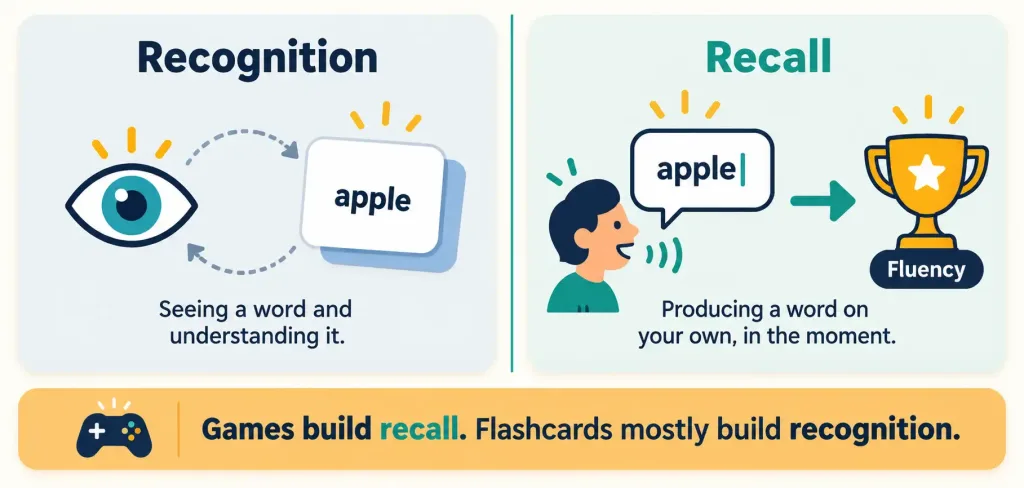
Language researchers generally describe two related but distinct skills: recognition (seeing a word and understanding it) and recall (producing that word on demand, in conversation or writing). Passive memorization — reading a list repeatedly — builds recognition faster than recall. Games and active-use exercises force recall, because you have to produce the word or sentence yourself rather than just identifying it among options. That’s the practical reason games tend to feel more effective than flashcards for actually speaking or writing more fluently, even when the two methods cover identical vocabulary.
Multiplayer or group-based games add a second benefit beyond vocabulary: real-time listening and speaking practice under light social pressure, which is closer to an actual conversation than any solo app can simulate.
1. FluentU — Best for Structured, Video-Based Practice
FluentU turns authentic, real-world video clips — news segments, music videos, movie trailers, talk-show moments — into interactive language lessons. Every clip comes with clickable subtitles: tap an unfamiliar word mid-video and get an instant definition, example sentences, and the option to save it to a personal vocabulary list for spaced-repetition review later.
Best for: Learners at any level who want listening comprehension and real spoken English, rather than textbook dialogue, and who like having their progress tracked automatically rather than managing their own study schedule. FluentU offers a free trial period before requiring a paid subscription, so it’s worth testing with a few videos in your target difficulty level before committing.
How to use it well: Pick a topic you’d actually watch for fun — the clip library spans entertainment, news, and everyday vlogging — rather than defaulting to whatever the homepage suggests first. Motivation holds up much better when the content itself is something you’d choose anyway.
2. Wordshake (British Council LearnEnglish) — Best Free Vocabulary Game
Wordshake is a free timed word game from the British Council’s LearnEnglish site: you’re given a grid of letters and a set time limit, and the goal is to build as many valid English words as possible before time runs out, with longer words scoring more points.
Best for: Intermediate and advanced learners who already have a decent vocabulary base and want a fast, repeatable way to practice spelling and word recall under light time pressure. It’s genuinely replayable — a new letter grid each round means no two sessions feel identical.
How to use it well: Play a few short rounds daily rather than one long session occasionally. The time pressure is the point; it trains quick word recall rather than careful, unhurried thinking, which maps better onto real conversation than a leisurely vocabulary quiz does.
3. Sushi Spell (British Council LearnEnglish) — Best for Beginners and Spelling Practice
Sushi Spell is a free, lighter British Council game built around a moving sushi-conveyor-belt theme: letters pass by on the belt, and you grab the right ones in order to spell a target word before it moves out of reach.
Best for: Beginner and lower-intermediate learners, especially younger learners or anyone who wants a gentler entry point than a full timed word-grid game. The visual, game-like format makes spelling practice feel less like a test.
How to use it well: Treat early rounds as untimed exploration if the pace feels too fast at first — getting comfortable with the letter-grabbing mechanic matters more initially than beating a specific score.
4. Freerice — Best for Practicing With a Real-World Purpose
Freerice is a long-running vocabulary quiz site with a genuinely unusual hook: for every correct multiple-choice vocabulary answer, the platform contributes toward rice donations through the World Food Programme. You pick the closest synonym for a given word from several options, and the difficulty adjusts automatically based on how consistently you’re answering correctly.
Best for: Learners who want quick, low-pressure vocabulary reps without a game-like setting, and who appreciate that the time spent studying also does something concrete beyond their own progress. It’s worth double-checking the current donation mechanics directly on the site before relying on any older description of exactly how the rice-for-answers system works, since charitable platforms like this do periodically update their specific program details.
How to use it well: Freerice’s adaptive difficulty means wrong answers aren’t actually a setback — they’re how the system finds your real working level. Answering honestly, rather than guessing to avoid getting something wrong, gets you to a useful practice difficulty faster.
Best Online Games to Practice English, Compared
| Tool | Cost | Best Skill Practiced | Best Level |
|---|---|---|---|
| FluentU | Free trial, then paid | Listening, vocabulary in context | All levels |
| Wordshake | Free | Spelling, fast word recall | Intermediate–Advanced |
| Sushi Spell | Free | Spelling, letter recognition | Beginner–Lower Intermediate |
| Freerice | Free | Vocabulary, synonym recognition | Adaptive to any level |
Beyond Solo Games: Why Multiplayer and Group Practice Still Matters
Every tool above can be used alone, which is genuinely convenient — but solo vocabulary games only train half of real language use. Speaking and listening in real time, responding to someone else’s actual sentence rather than a pre-written multiple-choice option, is a different skill that a vocabulary app can’t fully substitute for.
If you have a study partner, a language-exchange contact, or even a patient native-speaking friend, pairing one of the games above with a short spoken conversation afterward — describing what you just practiced, or using three of the words you just reviewed in a sentence out loud — closes that gap more effectively than extending the solo game session would. Many language-exchange communities and conversation-practice apps exist specifically to pair learners for this kind of real-time practice, and it’s worth seeking one out once the vocabulary basics from solo games feel solid.
How to Build a Realistic Weekly Practice Routine
A short, consistent routine beats an occasional long session for actually retaining vocabulary. A reasonable starting point: ten to fifteen minutes of a vocabulary game like Wordshake or Sushi Spell most days, one or two longer FluentU video sessions a week for listening practice in context, and a Freerice session whenever you have a few spare minutes waiting somewhere rather than scrolling a different app out of habit. None of this needs to feel like homework — the whole appeal of a game-based approach is that the practice itself doesn’t feel like a chore, which is exactly why it tends to actually stick with people who try a rigid study schedule and then abandon it within a few weeks.
Matching a Game to Your Actual Goal
Not every learner needs the same thing from online games to practice English, so it helps to match the tool to the specific skill you’re trying to move. If exam preparation is the goal, a timed vocabulary game like Wordshake builds the quick recall speed that written exams and timed sections actually reward, since hesitating over a word mid-exam costs real time. If conversational confidence is the goal, FluentU’s video-based format does more good than a pure word game, because hearing vocabulary used naturally in context carries over to speaking far better than an isolated word list does. And if the goal is simply building a daily habit without much pressure, Freerice’s low-stakes, adaptive format tends to be the easiest one to stick with over weeks rather than abandoning after a few sessions.
Common Mistakes When Using Games to Practice English
Treating a single game as a complete substitute for actual conversation practice is one of the most common mistakes — vocabulary games build recall and spelling, but speaking fluency still needs real speaking practice with another person. Playing only in a comfort-zone difficulty level, rather than letting a game’s adaptive difficulty (like Freerice’s) push slightly past what’s easy, slows progress more than it feels like it should. And abandoning a tool after a few sessions because progress isn’t immediately visible overlooks that vocabulary recall genuinely does build gradually — a few minutes most days compounds much more than an occasional hour-long session.
Frequently Asked Questions
What are the best online games to practice English for a complete beginner?
Sushi Spell and FluentU are the two strongest starting points among this list, since both are built to work at a genuinely beginner level rather than assuming an existing vocabulary base.
Are these games actually free to use?
Wordshake, Sushi Spell, and Freerice are all free. FluentU offers a free trial period before moving to a paid subscription, so it’s worth testing with a few videos first to see whether the format suits your learning style before paying for it.
What’s the best game here for a true beginner?
Sushi Spell, since its slower, more visual mechanic gives a gentler introduction to spelling and letter recognition than a timed word-grid game. FluentU is also workable for beginners specifically because its difficulty spans all levels, not just advanced content.
Can vocabulary games alone make someone fluent in English?
Not alone. Online games to practice English build real vocabulary recall and spelling speed, which genuinely helps fluency, but speaking fluency specifically needs actual speaking practice with another person. Pairing a vocabulary game with regular conversation practice gets closer to real fluency than either approach alone.
How much time should I actually spend on these games each day?
Ten to fifteen minutes most days tends to build vocabulary recall more reliably than one long weekly session, since consistent, spaced practice is generally more effective for retention than infrequent cramming.
Where can I find more online games to practice English beyond this list?
Language-exchange communities, university ESL program pages, and established publisher sites (like British Council’s own broader LearnEnglish section) are reasonable places to look, though the same verification standard applies — confirm a game is actually live and linkable before relying on it, rather than trusting an older roundup at face value.
Is Freerice’s rice-donation claim legitimate?
Freerice has operated this model for a long time and is well documented across independent coverage, but exact program details can change over time, so it’s worth checking the current mechanics directly on the site rather than relying on an older secondhand description.
What Makes a List of Online Games to Practice English Actually Useful
A genuinely useful list of online games to practice English does more than name a few titles — it links to each one directly, confirms they’re currently live, and says honestly which skill and level each one actually suits, rather than treating every pick as right for everyone. That’s the bar this guide aimed for, and it’s a reasonable one to hold any similar list to before trusting its recommendations with your own study time.
The Bottom Line
The best online games to practice English work because they force active recall instead of passive recognition — FluentU for listening practice in real video context, Wordshake and Sushi Spell for fast, free vocabulary and spelling reps at different skill levels, and Freerice for quick vocabulary practice with an added real-world purpose. None of them replaces real spoken conversation on its own, but used consistently and paired with actual speaking practice when possible, they close the gap between knowing a word and actually being able to use it — which is the gap that matters most.