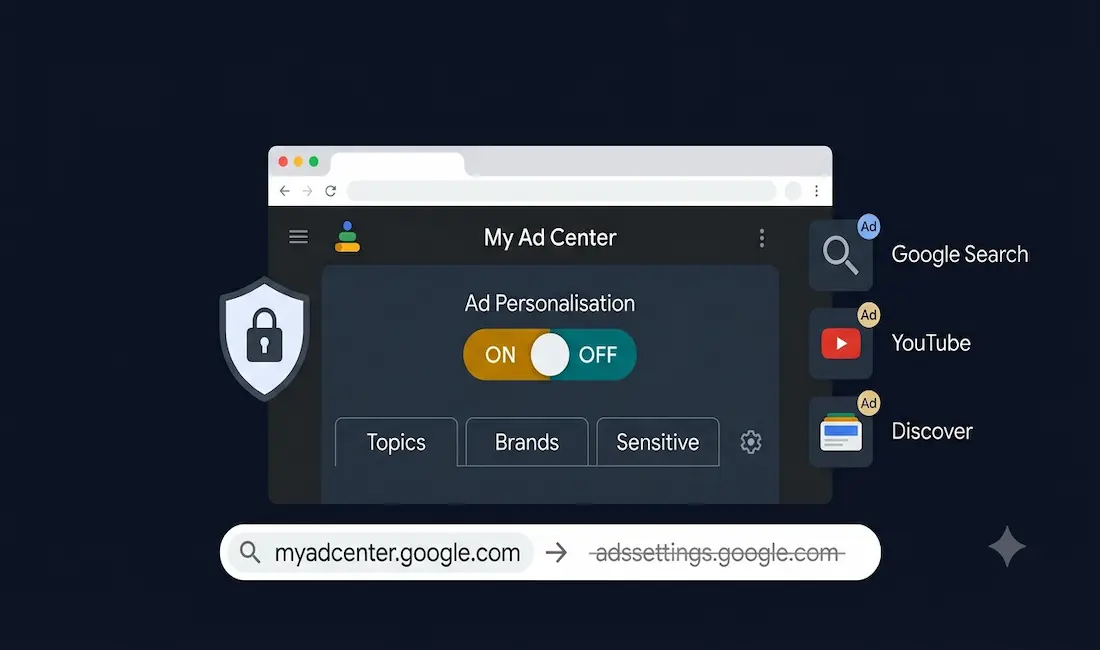
Google Ads is one of the most popular online advertising platforms, allowing businesses to reach their target audience through personalised ads. However, users often want more control over the ads they see. This is where Google’s ad preference management tools come in.
The URL adssettings.google.com was Google’s original dedicated page for managing ad preferences. As of 2022, Google retired adssettings.google.com and replaced it with My Ad Center at myadcenter.google.com. If you visit adssettings.google.com today, it redirects automatically to My Ad Center. All the functionality from the old interface — and significantly more — is available at the new destination.
This guide explains what My Ad Center is, how to access it, how to use each of its features to control your ad experience across Google Search, YouTube, and Discover, and how to manage your privacy settings from a security-conscious perspective.
What Is My Ad Center (Formerly adssettings.google.com)?
My Ad Center is Google’s centralised dashboard for managing your ad preferences across all Google services. It replaced adssettings.google.com in late 2022 and provides more granular control over the types of ads you see.
Through My Ad Center, you can:
- Turn personalised ads on or off entirely
- Choose topics you want to see more or fewer ads about
- Choose brands you want to see more or fewer ads about
- Limit ads about sensitive topics (alcohol, gambling, weight loss, dating, pregnancy, and parenting)
- Control what data Google uses to personalise your ads
- Manage partner ad settings that affect ads on non-Google websites
My Ad Center affects ads shown on Google Search, YouTube, and Discover — the three primary Google services where personalised ads appear. It does not control ads shown inside third-party apps or websites that use the Google Display Network, though the Partner ad settings section provides some control over those.
How to Access My Ad Center
There are three ways to reach My Ad Center:
Method 1 — Direct URL
Navigate directly to myadcenter.google.com and sign in with your Google account. The old URL adssettings.google.com also works — it redirects to My Ad Center automatically.
Method 2 — Through Google Account Settings
- Go to myaccount.google.com
- Click Data & Privacy in the left navigation
- Scroll down to the Ad settings section
- Click My Ad Center
Method 3 — From Any Google Ad
- On any ad you see on Google Search, YouTube, or Discover, look for the three-dot menu icon or the “Info” icon
- Tap My Ad Center
- You are taken directly to the settings page where you can adjust preferences for that specific ad, topic, or brand
Key Features of My Ad Center
1. Ad Personalisation Toggle
The most impactful single setting in My Ad Center is the Ad Personalisation toggle. When turned on, Google uses your search history, YouTube watch history, location, age, gender, and other activity data to show you ads it believes are relevant to your interests. When turned off, you see generic ads that are not tailored to your behaviour.
How to turn off personalised ads:
- Visit myadcenter.google.com
- Click Personalised ads
- Toggle the switch to Off
- Confirm your choice
Turning off personalised ads does not reduce the number of ads you see — it only makes them less targeted. You will still see the same volume of advertising, but the ads will be based on the content you are currently viewing rather than your browsing history.
2. Topic Customisation
The Topics tab lets you tell Google which ad categories you want to see more or fewer of. Popular topics include technology, travel, fashion, automotive, food, fitness, and finance.
To customise:
- Go to My Ad Center → Customise ads → Topics
- Browse or search for topics
- Select See more or See fewer for each topic
Choosing “See fewer” does not completely block ads on that topic — it reduces their frequency. Your browsing behaviour can still trigger relevant ads even after you reduce a topic.
3. Brand Customisation
The Brands tab works the same way as Topics but for specific companies and brands. If you are tired of seeing ads from a particular retailer or service, you can reduce their frequency.
4. Sensitive Topic Controls
My Ad Center provides specific controls for sensitive ad categories that some users find uncomfortable:
- Alcohol
- Gambling
- Weight loss
- Dating
- Pregnancy and parenting
When you limit a sensitive topic, Google makes its best attempt to not show you ads about that topic — this is a stronger restriction than the “See fewer” option for regular topics.
5. Partner Ad Settings
The Partner ad settings section controls how Google personalises ads on non-Google websites and apps that use Google’s advertising network. The key toggle is “Help advertisers select ads for you” — when enabled, Google shares some of your preference data with advertising partners to personalise ads outside of Google’s own services.
To manage:
- Go to My Ad Center → scroll to Related Google account controls
- Find “Help advertisers select ads for you”
- Toggle on or off based on your preference
What Data Does Google Use for Ad Personalisation?
Understanding what Google uses to personalise ads helps you make informed decisions about your settings:
- Google Search history — queries you have searched for
- YouTube watch history — videos you have watched, liked, or subscribed to
- Location history — places you have visited (if location history is enabled)
- Age, gender, and language — from your Google Account profile
- App activity — interactions within Google apps and services
- Website visits — sites you have visited that use Google Analytics or Google Ads tracking
You can review and delete this data separately through Google My Activity. My Ad Center controls how this data is used for advertising; My Activity controls the data itself.
Step-by-Step: Opting Out of Personalised Ads Completely
If you want the maximum reduction in ad tracking:
- Visit myadcenter.google.com
- Toggle Ad Personalisation to Off
- Scroll to Partner ad settings and toggle “Help advertisers select ads for you” to Off
- Visit myactivity.google.com and delete your Web & App Activity, YouTube History, and Location History
- In your Google Account → Data & Privacy → turn off Web & App Activity to prevent future data collection
Note: Opting out does not delete your existing data — it controls future ad targeting only. Use My Activity to delete historical data.
Ad Settings from a Privacy and Security Perspective
For readers of a networking and cybersecurity site, Google’s ad personalisation raises several privacy considerations worth understanding:
Tracking mechanisms: Google uses first-party cookies, logged-in account activity, and device identifiers to build ad profiles. Unlike third-party cookies (which Chrome is phasing out), first-party Google tracking operates within Google’s own services and is not affected by browser cookie restrictions.
Network-level implications: Ad tracking data flows over HTTPS between your browser and Google’s ad-serving infrastructure. Network administrators managing enterprise environments should be aware that Google ad-related traffic (to domains like googleads.g.doubleclick.net, pagead2.googlesyndication.com, and adservice.google.com) is part of normal Google service traffic and is encrypted. Blocking these domains at the network level (via DNS filtering or firewall rules) can break Google service functionality beyond just ads.
Browser-level controls: Beyond My Ad Center, modern browsers provide additional ad and tracking controls. Chrome’s Privacy Sandbox and Topics API (replacing third-party cookies) give users control over interest-based advertising at the browser level. Firefox’s Enhanced Tracking Protection blocks third-party trackers by default. These browser controls complement My Ad Center — one controls Google’s own ad system, the other controls cross-site tracking.
Enterprise and BYOD considerations: In enterprise environments where employees use personal Google accounts on work devices, ad personalisation data can reveal browsing patterns that cross work/personal boundaries. IT administrators should include Google ad settings in their privacy awareness training alongside VPN, HTTPS, and data-handling policies.
My Ad Center vs Other Platform Ad Settings
Google is not the only platform with ad preference controls. Here is how the major platforms compare:
| Platform | Settings URL | Key Controls |
|---|---|---|
| myadcenter.google.com | Topics, brands, sensitive categories, personalisation toggle, partner ads | |
| Apple | Settings → Privacy & Security → Apple Advertising | Personalised Ads toggle (on/off only) |
| Meta (Facebook/Instagram) | Settings → Ad Preferences | Ad topics, advertisers, data sources, off-platform activity |
| Microsoft | account.microsoft.com/privacy | Personalised ads toggle, ad interests, browsing data |
| TikTok | Settings → Privacy → Ads Personalisation | Personalised ads toggle, advertiser list |
Google’s My Ad Center offers the most granular topic and brand-level control of any major platform. Apple provides the simplest (binary on/off) option.
Conclusion
The URL adssettings.google.com now redirects to My Ad Center at myadcenter.google.com — Google’s current dashboard for managing your ad preferences across Search, YouTube, and Discover. My Ad Center gives you control over whether ads are personalised, which topics and brands appear more or less frequently, which sensitive categories are restricted, and how your data is shared with advertising partners. Turning off ad personalisation does not remove ads — it makes them less targeted. For complete privacy control, combine My Ad Center settings with data deletion through My Activity and browser-level tracking protection.
Frequently Asked Questions
What is adssettings.google.com and does it still exist?
Adssettings.google.com was Google’s original dedicated page for managing ad personalisation preferences. Google retired the standalone adssettings.google.com interface in late 2022 and replaced it with My Ad Center at myadcenter.google.com. If you visit adssettings.google.com today, your browser automatically redirects to My Ad Center. All the functionality that was available at adssettings.google.com — toggling personalised ads, blocking advertisers, and managing topic preferences — is available at My Ad Center with additional features including sensitive topic controls, brand-level customisation, and partner ad settings.
Can I permanently disable personalised ads through My Ad Center?
Yes. Navigate to myadcenter.google.com, find the Ad Personalisation toggle, and switch it to Off. This prevents Google from using your search history, YouTube activity, location, and other behavioural data to select ads for you. However, turning off personalisation does not reduce the number of ads you see — it only makes them generic rather than tailored to your interests. You will see the same volume of advertising, but the ads will be based on the content of the page you are currently viewing rather than your browsing history. To also control ads on non-Google sites, toggle off “Help advertisers select ads for you” in the Partner ad settings section.
Does My Ad Center delete my existing browsing data?
No. My Ad Center controls how your data is used for future ad targeting — it does not delete any existing data. To review and delete your historical browsing data, visit myactivity.google.com where you can delete your Web and App Activity, YouTube watch history, and Location History individually or in bulk. You can also set up automatic deletion (every 3 months, 18 months, or 36 months) so that historical data is purged on a rolling basis. Combining My Ad Center settings with My Activity deletion and auto-delete provides the most comprehensive privacy control within the Google ecosystem.
How is My Ad Center different from browser ad-blocking extensions?
My Ad Center controls which ads Google shows you within Google’s own services (Search, YouTube, Discover) — it adjusts ad targeting and topic preferences but does not remove ads entirely. Browser ad-blocking extensions (such as uBlock Origin or Adblock Plus) remove ad elements from web pages entirely by blocking the network requests to ad-serving domains. The two operate at different levels: My Ad Center is a preference system within Google’s ad platform, while ad blockers are browser-level tools that prevent ads from loading regardless of the platform. Using both together gives you the broadest control — My Ad Center for Google’s own ad system and a browser extension for ads across all websites.
Is My Ad Center free to use?
Yes. My Ad Center is a free tool available to anyone with a Google account. There is no paid tier or premium version. All features — ad personalisation controls, topic and brand customisation, sensitive topic restrictions, and partner ad settings — are available at no cost. Google provides these controls as part of its compliance with privacy regulations including the EU’s GDPR and California’s CCPA, which require platforms to give users meaningful control over how their personal data is used for advertising purposes.