
Search has quietly become one of the most AI-saturated categories on the internet — not just Google, but the broader world of people-search sites, background-check tools, and specialized lookup services that millions of people use to verify a name, check a landlord, or screen a date. The pitch is usually “AI makes search smarter.” That’s partly true. What usually gets left out is that AI can just as easily make search’s existing problems worse, not better — and anyone relying on these tools benefits from understanding both sides.
What AI-Powered Search Actually Does Differently
Traditional search engines and lookup databases work largely on fixed matching rules: does this query string match this record, yes or no. AI-powered search changes that in a few concrete, technical ways:
- Entity resolution and record linkage. This is the specific technique people-search sites rely on most: matching scattered, inconsistently formatted records (a name spelled slightly differently, an old address, a maiden name, a typo-ridden public record) to the correct single person. Machine learning models trained on how real records vary can connect “Robert Smith” at one address in 2015 to “Bob Smith” at a different address in 2022 far more reliably than exact-string matching, which simply wouldn’t link them at all.
- Natural language processing (NLP) for query understanding. Rather than requiring an exact phrase, NLP lets a search system interpret intent — understanding that “find someone’s current address” and “where does this person live now” are asking the same thing, and weighting results accordingly.
- Relevance ranking that improves with feedback. Search systems that incorporate click-through and correction signals over time can learn which of several same-named matches users actually meant, improving precision on common-name collisions that are a persistent headache for any people-search tool.
- Automated deduplication. Public records are famously messy — the same person’s criminal record, court filing, or address history can appear duplicated or fragmented across sources. AI-assisted deduplication can merge these into a single accurate profile instead of returning five partial, contradictory ones.
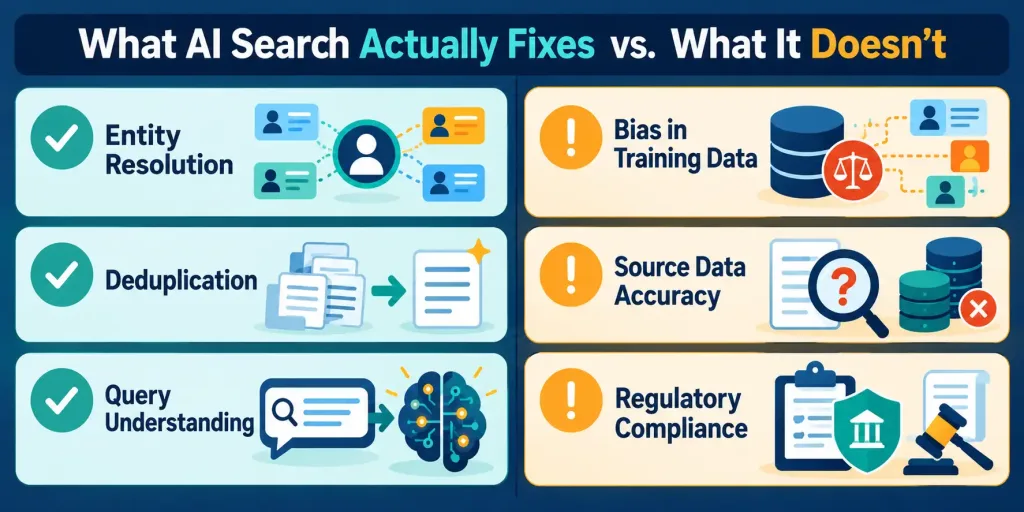
These are real, meaningful improvements over older rule-based systems — fewer missed matches, fewer duplicate or fragmented records, and faster handling of messy, inconsistent public data.
The Part Usually Left Out: AI Doesn’t Remove Bias — It Can Encode It
A common claim about AI search is that it’s inherently fairer than human judgment because it “doesn’t attach feelings or emotions to decisions.” That’s true in a narrow sense, but it skips the actual risk: AI systems don’t invent bias from nothing — they learn patterns from the data they’re trained on, and if that data reflects historical human bias, the system can reproduce or even amplify it, just without a human in the room to notice.
The clearest documented example is Amazon’s internal AI recruiting tool, which the company built to screen resumes and scrapped in 2018 after discovering it had taught itself to penalize resumes containing the word “women’s” (as in “women’s chess club captain”) and to downgrade graduates of two all-women’s colleges — a pattern it learned because the historical hiring data it trained on skewed male in technical roles. No one programmed the system to discriminate; it inferred the pattern from its training data and applied it quietly, which is exactly the failure mode that makes algorithmic bias harder to catch than an individual human’s bias — there’s no single decision to point to and question.
The same risk applies to any AI layered onto search or matching systems more broadly, including the kind people-search sites use: a model trained on historically skewed or incomplete records can learn to systematically under-match, over-match, or misrank certain names, locations, or demographic patterns without anyone intending it to. “AI removes human bias” is an oversimplification; the more accurate statement is that AI shifts where bias can enter a system, and makes it less visible when it does — which means it needs active auditing, not just an assumption of neutrality.
The “Garbage In, Garbage Out” Problem Is the Real Bottleneck
The article this piece is based on raised this concept — AI can’t produce accurate results from inaccurate source data — but it’s worth stating plainly rather than in passing: people-search sites compile data from social media profiles, employment and job sites, public court and criminal records, and various public record databases, and that underlying data is frequently outdated, misattributed, or simply wrong.
AI-assisted deduplication and entity resolution can reduce some of this noise by linking records more intelligently, but it cannot fix data that was wrong at the source — an incorrect criminal record tied to the wrong John Smith stays wrong no matter how well the matching algorithm links it to a profile. This is the same underlying accuracy problem businesses face in automated document verification, where AI-driven identity matching is only as reliable as the data and documents feeding it — and increasingly has to contend with deliberately falsified, AI-generated records rather than just messy ones.
Why People-Search Site Accuracy Is a Real Regulatory Issue, Not Just a UX Complaint
This is the context most coverage of “AI improving search” skips entirely: people-search and data-broker sites have drawn real regulatory scrutiny specifically over accuracy and privacy.
Spokeo, one of the best-known people-search sites, settled with the FTC for $800,000 in 2012 after regulators found it was marketing consumer profile data for employment and tenant-screening purposes without complying with the Fair Credit Reporting Act’s accuracy and dispute-resolution requirements — a legal framework that exists precisely because inaccurate background data can cost someone a job or a lease.
That underlying tension hasn’t gone away: any people-search or background-screening tool that influences real-world decisions (hiring, housing, lending) sits in a legally sensitive position where “mostly accurate” isn’t good enough, and AI-driven matching improvements don’t exempt a service from that obligation.
Most reputable people-search services now offer an opt-out process letting individuals request removal of their own listed information — worth knowing about and using if you’ve found inaccurate or unwanted personal data about yourself on one of these sites, since the sites themselves rarely surface this option prominently.
Where AI Search Improvements Are Genuinely Worth Embracing
None of this means the underlying technology is bad — it means the honest framing matters:
- Faster, more relevant results for genuinely ambiguous queries (common names, inconsistent historical records) is a real, measurable improvement over older exact-match systems.
- Automated flagging of likely-duplicate or fragmented records reduces a genuine, long-standing data-quality problem in public records aggregation.
- Feedback-driven relevance ranking helps surface the correct match among several same-named people faster than static ranking ever could.
The technology genuinely helps with the mechanical parts of search — matching, deduplication, ranking. It does not, on its own, solve the separate and harder problem of whether the underlying data was accurate and fairly collected in the first place, and treating “AI-powered” as a synonym for “unbiased” or “fully accurate” oversells what the technology actually does.
The Bottom Line
AI is a genuine upgrade to the mechanics of search and record-matching — better entity resolution, smarter query understanding, more effective deduplication of messy public records. What it isn’t is an automatic fix for bias or a guarantee of accuracy; both of those depend on the quality of the training data and the rigor of ongoing auditing, not on the presence of AI itself. Anyone using a people-search or background-check tool professionally (hiring, tenant screening, due diligence) should treat an AI-powered result the same way they’d treat any other unverified data point: useful as a lead, not as a final answer, and worth independently confirming before it affects a real decision about someone.
Frequently Asked Questions
Does AI make people-search sites more accurate?
It can improve certain mechanical aspects — matching records to the right person, deduplicating fragmented data, understanding ambiguous queries — but it can’t fix inaccurate data at the source. A wrong record linked more efficiently is still a wrong record.
Can AI search systems be biased?
Yes. AI systems learn patterns from their training data, and if that data reflects historical human bias (as in Amazon’s scrapped 2018 recruiting tool, which penalized resumes mentioning “women’s” organizations), the system can reproduce that bias without anyone intending it to. This makes algorithmic bias harder to catch than an individual human decision, not easier.
Are people-search sites regulated?
To a degree. Services marketing data for employment or tenant-screening purposes fall under the Fair Credit Reporting Act’s accuracy requirements — Spokeo settled with the FTC for $800,000 in 2012 over exactly this issue. Most reputable sites also offer an opt-out process for individuals who find inaccurate or unwanted information about themselves listed.
What’s “garbage in, garbage out” in this context?
It means an AI system’s output quality is limited by its input data quality. If the underlying public records, social profiles, or court data being searched are outdated or wrong, no amount of AI-driven matching sophistication will produce an accurate result.