Customer service has quietly split into two different experiences depending on which company you’re dealing with: one where a chatbot wastes your time with rigid menu options that never quite match your problem, and one where it actually resolves things faster than a human could. The difference almost always comes down to what kind of AI is actually running behind the scenes — a distinction most coverage of “AI chatbots” glosses over entirely.
Rule-Based Bots vs. Modern LLM-Based Chatbots
This is the single most important technical distinction in customer-service AI right now, and it’s the reason some chatbot experiences feel genuinely useful while others feel like a frustrating maze:
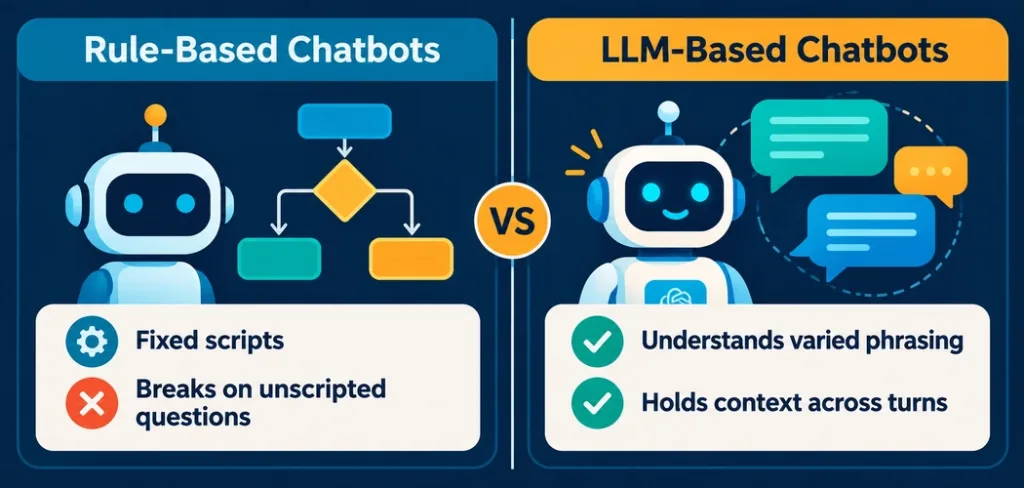
- Rule-based (decision-tree) chatbots follow a fixed, pre-programmed set of branching paths — “press 1 for billing, press 2 for technical support.” They work fine for narrow, predictable questions but break down immediately outside their scripted paths, which is the source of most people’s frustration with “chatbots” historically.
- LLM-based conversational AI (built on large language models, the technology behind tools like ChatGPT and increasingly integrated into customer-service platforms since 2023) can understand a question phrased in many different ways, hold context across a multi-turn conversation, and generate a relevant response rather than matching against a fixed script. This is the technology actually responsible for the recent jump in chatbot usefulness — not “AI” in some vague sense, but specifically this shift from rigid rules to flexible language understanding.
The practical implication for a business evaluating chatbot options: asking “is this an AI chatbot” is now the wrong question, since nearly every vendor markets their product as AI-powered regardless of which underlying approach it uses. The better question is whether it’s rule-based or genuinely LLM-based, since that determines whether it can actually handle an unscripted question.
Where Chatbots Genuinely Help
- Response time. An LLM-based chatbot can respond instantly, 24/7, to the significant share of customer questions that are repetitive and well-understood (order status, return policy, account basics) — freeing human agents for the harder cases that actually need judgment.
- Scaling during demand spikes. A support team sized for normal volume gets overwhelmed during a product launch, an outage, or a seasonal rush. A chatbot doesn’t have this ceiling in the same way, handling volume spikes without the lag time of hiring and training temporary staff.
- Consistency. A well-configured chatbot gives the same accurate answer to the same question every time, where human agents — especially less experienced ones — introduce natural variation that can mean inconsistent information reaching customers.
- Data capture for improvement. Every chatbot interaction is a logged data point about what customers are actually asking, which (handled correctly — see the privacy section below) can reveal patterns in product confusion or support gaps that wouldn’t surface as clearly from scattered individual support tickets.
The Privacy and Security Considerations That Actually Matter
Vague references to “privacy and security challenges” don’t tell a business much. Here’s what actually needs attention:
- What data the chatbot has access to. A chatbot integrated with order history, account details, or payment information is handling sensitive personal data, which means it falls under the same data-protection obligations as any other system touching that data — GDPR in the EU, CCPA in California, and equivalent regimes elsewhere, depending on where customers are located.
- Where conversation data is stored and for how long, particularly if the chatbot platform is built on a third-party LLM provider’s infrastructure — a business needs to know whether customer conversations are used to further train that provider’s models, and whether that’s compatible with its own privacy commitments to customers.
- Authentication before sensitive actions. A chatbot that can process a refund, change an account password, or access order details needs a clear verification step before doing so — the same way a human agent would verify identity before taking a sensitive action, not skip it just because the interaction is automated.
- Clear escalation to a human for anything genuinely sensitive — a billing dispute, a complaint involving potential fraud, or any interaction where the customer is upset enough that an automated response risks making things worse rather than better.
What a Real Hybrid Model Actually Looks Like
“Bots and humans working together” is the usual phrase, but the useful detail is how that division actually works in practice at companies doing it well:
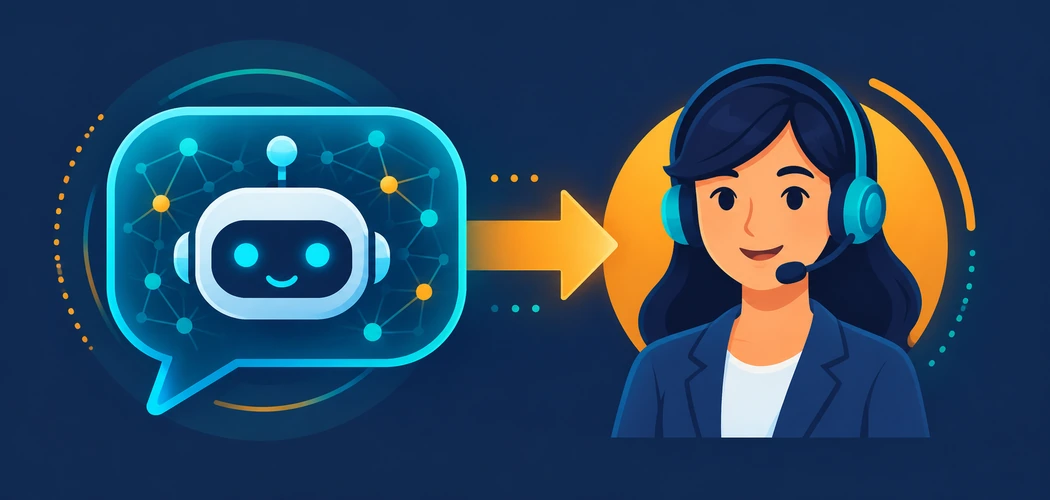
- Tiered routing — the chatbot handles the first interaction for every query, resolving the straightforward ones directly and routing anything it can’t confidently handle to a human agent, along with the full conversation context so the customer doesn’t have to repeat themselves.
- Confidence-based handoff — rather than the bot trying to force an answer it’s unsure about, well-designed systems are built to recognize low-confidence situations and hand off proactively, rather than giving a customer a wrong or unhelpful answer that then requires a frustrated follow-up to a human anyway.
- Human-in-the-loop for high-stakes categories — refunds above a certain amount, account security changes, or complaints, by policy, always route to a human regardless of how confident the bot’s response would be.
- Bots as a force-multiplier for human agents, not a replacement for them — the most effective implementations use chatbots to handle volume so human agents can spend more time on complex, relationship-sensitive interactions, rather than treating the bot as a cost-cutting replacement for the support team outright.
Cost Efficiency, Realistically
Chatbots do genuinely reduce the volume of tickets that need a human agent, which lowers the staffing needed to handle a given volume of customer contacts. The honest caveat: implementing a genuinely capable LLM-based system (as opposed to a cheap rule-based one) involves real setup cost — integration with existing systems, ongoing monitoring and tuning, and the privacy/security work described above. The cost savings materialize over time as ticket deflection scales, not immediately upon deployment, and a poorly implemented chatbot that frustrates customers and drives them to abandon purchases or contact support anyway can erase the savings it was meant to deliver.
The Bottom Line
The chatbot technology that actually improves customer service isn’t “AI” in a generic sense — it’s specifically the shift from rigid rule-based scripts to LLM-based conversational systems that can handle real, varied questions. The businesses getting genuine value from this aren’t using chatbots to replace human support entirely; they’re using tiered routing and confidence-based handoff to let bots absorb routine volume while reserving human judgment for the cases that actually need it, with privacy and security practices built in from the start rather than bolted on after a problem occurs.
Frequently Asked Questions
What’s the real difference between an old-style chatbot and a modern AI chatbot? Older rule-based chatbots follow fixed decision trees and only work within scripted paths. Modern LLM-based chatbots understand varied phrasing, hold context across a conversation, and generate relevant responses rather than matching a script — this is the specific technical shift behind the recent improvement in chatbot usefulness.
Can a chatbot handle sensitive customer data safely? It can, but only with deliberate safeguards: authentication before sensitive actions like refunds or account changes, clear policies on where conversation data is stored and whether it’s used to train third-party AI models, and compliance with relevant data-protection law (GDPR, CCPA, etc.) based on where customers are located.
Do AI chatbots actually save businesses money? Over time, yes, primarily by deflecting routine tickets away from human agents. The upfront cost of implementing a genuinely capable system is real, and a poorly implemented chatbot that frustrates customers can erase the intended savings by driving away business or generating extra follow-up contacts.
Will chatbots replace human customer service agents entirely? The evidence points toward a hybrid model rather than full replacement — chatbots handling high-volume routine queries through tiered routing, with confidence-based handoff to human agents for complex, sensitive, or emotionally charged interactions where automated responses carry more risk than value.