Network security used to be a matter of stacking up enough tools: a firewall here, an antivirus there, maybe an intrusion detection system if budget allowed. For a while, that approach was good enough. It isn’t anymore.
Modern attackers move across endpoints, networks, email, and cloud workloads in a single campaign, often within minutes. Meanwhile, the average enterprise security team is staring at a wall of disconnected alerts from a dozen different tools, trying to figure out which ones actually matter. This is the gap that Extended Detection and Response (XDR) was built to close: instead of monitoring each layer of the network in isolation, XDR correlates signals across endpoints, servers, email, identity, and cloud into a single, prioritized view.
The question most IT teams should be asking isn’t whether XDR is a good idea in theory. It’s whether their current setup is already showing the cracks that XDR is designed to fix. Here are five signs it’s time for an upgrade.
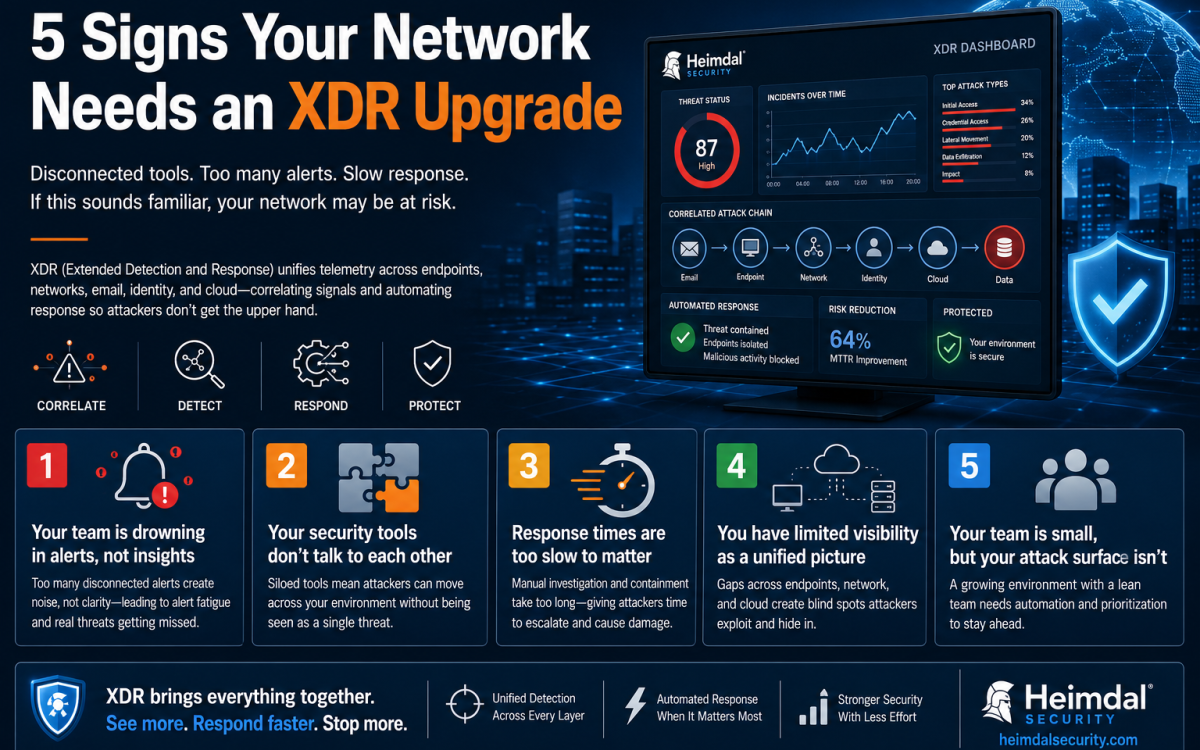
1. Your team is drowning in alerts, not insights
If a single phishing attempt triggers separate alerts from your email gateway, your endpoint protection, and your firewall, with no system tying them together, your analysts are spending more time correlating noise than responding to actual threats. This is alert fatigue, and it’s one of the most common reasons real incidents get missed: not because the tools failed to detect something, but because the signal was buried under hundreds of low-priority pings nobody had time to triage properly.
A network that needs XDR is one where “we got an alert” and “we understood what happened” are two very different, time-consuming steps.
2. Your security tools don’t talk to each other
Many networks run on a patchwork of point solutions bought over the years: an EDR product from one vendor, a network monitoring tool from another, separate logging for cloud workloads. Each does its job reasonably well in isolation, but none of them share context. An attacker who compromises an endpoint and then pivots toward a server might trip two unrelated alerts in two unrelated dashboards, and nobody connects them until the damage is done.
XDR exists specifically to break down these silos, pulling telemetry from multiple sources into one correlated timeline so a single attack chain looks like one incident, not five unrelated events.
3. Response times are too slow to matter
Detection without fast response doesn’t actually protect you. If your team identifies a compromised device but it takes hours to isolate it, manually chase down logs across tools, or get sign-off to act, attackers have more than enough time to escalate privileges, move laterally, or exfiltrate data. Ransomware operators in particular are increasingly fast: some campaigns move from initial access to full encryption in under an hour.
If your current setup relies heavily on manual investigation and manual containment, your mean time to respond is probably working against you, not for you.
4. You have limited visibility into endpoints, network, and cloud as a unified picture
It’s common for IT teams to have decent visibility into one layer of their environment, say, endpoints, while having only partial or after-the-fact visibility into network traffic or cloud activity. Attackers count on this. A foothold gained in the cloud that isn’t monitored with the same rigor as on-premises endpoints can sit undetected for weeks.
If you can’t answer “show me everything this user or device touched in the last 24 hours, across every layer” in a matter of minutes, your visibility has gaps that traditional, siloed tools weren’t built to close.
5. Your team is small, but your attack surface isn’t
This is especially common among small and mid-sized IT teams supporting growing organizations or among managed service providers handling multiple client networks. The attack surface, endpoints, cloud apps, remote workers, third-party integrations, keeps expanding, but headcount doesn’t grow at the same rate. Without a platform that automates correlation, prioritization, and at least some response actions, a lean team simply cannot keep pace with a complex, sprawling network.
This is arguably where XDR delivers the most practical value: not by replacing security analysts, but by giving a small team the leverage of a much larger one.
Choosing the Right XDR Platform
Recognizing these signs is the first step. The next is finding a platform that actually closes these gaps rather than adding yet another dashboard to check. When evaluating XDR vendors, look for genuine cross-layer correlation (not just rebranded EDR), automated response capabilities that reduce manual workload, and a track record of integrating cleanly with existing infrastructure.
Heimdal Security’s XDR solution is built around this kind of unified approach, correlating signals across endpoints, networks, email, and cloud environments into a single platform, with AI/ML-based detection and automated response actions designed to reduce the time between detecting a threat and remediating it. For IT teams recognizing one or more of the signs above, it’s a solid option worth evaluating as part of a broader XDR comparison.
Whichever platform you choose, the underlying point stands: if your network’s defenses are still a collection of disconnected tools, the gap between detection and response is where real damage happens. Closing that gap is no longer optional for any organization serious about its security posture.