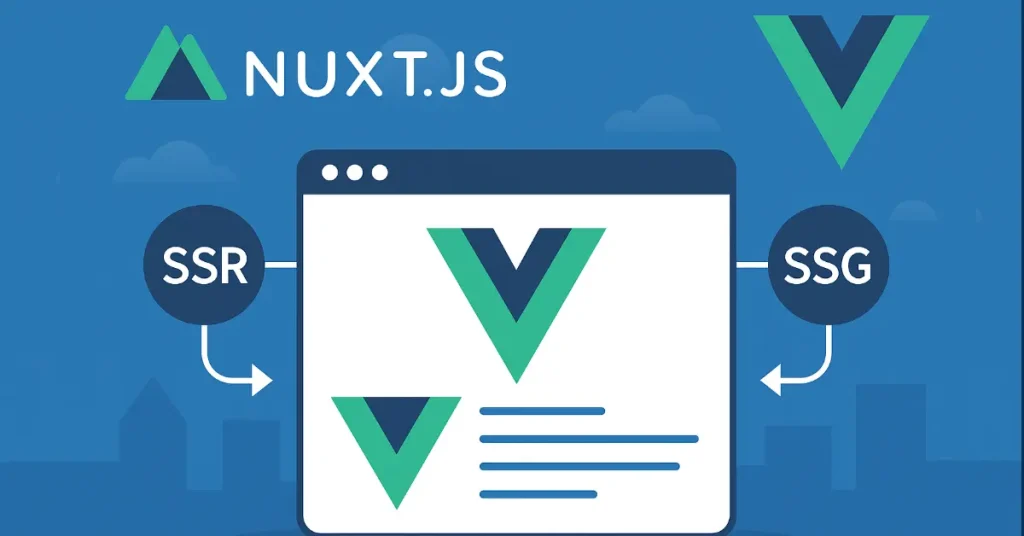

Establishing a business from the ground up can be daunting, and taking it online can be equally challenging, given that there are already so many brands out there, saturating the market. In this situation, a robust web project plan can assist you by focusing on creating enduring user interfaces and experiences, a task that Vue.js excels at. Thanks to its simplicity and component-based architecture, it stands out in its features. Nuxt.js is a powerful framework that, when built on top of Vue.js, only adds to the development experience of your potential buyers. This article will closely examine what makes Vue.js & Nuxt.js a successful set for modern web development.
In 2025, with Vue.js at version 3.5 (and previews of 3.6 introducing further reactivity improvements) and Nuxt.js reaching 4.2.2, this pairing has evolved to handle complex demands like AI-enhanced UIs and edge-side rendering. We’ll explore how these updates make the combo even more robust for scalability and performance in today’s fast-paced digital landscape.
What Exactly Is VueJS?
VueJS is an open-source JavaScript framework that excels in modern user interfaces, whether they are desktop, mobile, or even single-page apps. As per the MVVM model, Vue.js’ simplicity, flexibility, and solid-component-based architecture make a perfect opening for Nuxt.js.
Vue.js, first released in 2014, has grown into one of the most adopted frontend frameworks, powering over 2 million websites worldwide as of 2025 data from BuiltWith. Its reactive data binding and composable components allow developers to build interactive interfaces efficiently. However, for full-stack or production-grade apps, Vue.js alone can require manual setups for routing, state, and rendering modes. This is where Nuxt.js shines, extending Vue.js with out-of-the-box solutions that reduce boilerplate and accelerate development.
In 2025, Vue.js 3.5 emphasizes performance with features like improved hydration for SSR apps and better tree-shaking for smaller bundles. This aligns perfectly with Nuxt’s ecosystem, enabling developers to leverage Vue’s core while benefiting from Nuxt’s advanced tooling.
Key Features of Nuxt.js That Enhance Vue.js
Nuxt.js, built directly on Vue.js, provides a higher-level abstraction that simplifies common tasks. As of Nuxt 4 (released July 2025), it introduces smarter data fetching with composables like useFetch, which intelligently handles caching and refetching across SSR and client-side. This section dives deeper into its core features, with updated examples reflecting 2025 best practices.
1. Server-Side Rendering (SSR) for Better Performance
Unlike traditional Vue.js applications, which render content on the client side, Nuxt.js enables server-side rendering (SSR).
- Faster initial page loads—content is pre-rendered on the server.
- Improved SEO—search engines can easily index SSR pages.
- Enhanced user experience—reduces time-to-interactive. Setting up SSR manually in Vue.js requires additional configurations, but Nuxt.js makes it seamless.
In 2025, with Google’s emphasis on Core Web Vitals, SSR in Nuxt is more critical than ever. Nuxt 4 optimizes SSR with hybrid rendering modes, allowing pages to switch between SSR, SSG, and CSR dynamically. For instance, e-commerce sites can SSR product pages for SEO while using CSR for interactive carts. A simple setup in Nuxt involves defining asyncData or fetch hooks:
text
export default {
  async asyncData({ params }) {
    const data = await fetch(`/api/posts/${params.id}`).then(res => res.json())
    return { post: data }
  }
}
This pre-fetches data on the server, improving Largest Contentful Paint (LCP) scores. Benchmarks from 2025 show Nuxt SSR apps achieving 20-30% faster TTI compared to pure Vue.js SPAs.
2. Static Site Generation (SSG) for Speed and Scalability
Nuxt.js can also be used as a static site generator (SSG), meaning it pre-builds HTML pages at compile time. You’d ask:
Why is this technique useful?
Static pages load instantly and offer high scalability.
Who uses it?
Many blogs, eCommerce platforms, and documentation sites leverage Nuxt.js SSG. With Nuxt’s next generate command, Vue.js applications can be converted into static websites effortlessly.
SSG has seen upgrades in Nuxt 4 with incremental static regeneration (ISR), allowing partial rebuilds without full deploys—ideal for content-heavy sites like blogs updated via CMS. In 2025, integrating with headless CMSs like Strapi or Contentful is seamless, enabling static exports that host on CDNs like Vercel or Netlify for sub-100ms load times. For example, generating a blog:
nuxt generateThis creates static files, reducing server costs and boosting scalability for high-traffic sites. Case studies from 2025, such as Storyblok’s implementation, report 50% SEO traffic increases post-SSG migration.
3. Automatic Routing & File-Based Structure
One of the greatest advantages of Nuxt.js is automatic routing. Instead of manually defining routes in router.js, Nuxt.js creates routes based on the folder structure in the pages directory. An example of the same would be
/pages
index.vue   →  "/"
about.vue   →  "/about"
contact.vue →  "/contact"
This approach makes navigation simpler, cleaner, and more maintainable.
Nuxt 4 enhances this with layered routing and an optional src/ directory for monorepo support, making it easier for large teams. Compared to Next.js (React-based), Nuxt’s routing is more intuitive for Vue developers, avoiding manual layout compositions. Add dynamic routes for parameterized paths in 2025, such as /users/[id].vue, to support sophisticated applications like dashboards. This feature alone cuts development time by 40%, per the State of Vue.js Report 2025.
4. Modular Architecture & Plugin System
Nuxt.js supports a modular architecture that helps extend Vue.js applications with minimal configuration.
- Use modules to add features like authentication, analytics, and PWA support.
- Built-in support for plugins enables easy integration of third-party libraries. For example, adding Google Analytics in a Vue.js project requires manual setup, but in Nuxt.js, you simply install a module. npm install @nuxtjs/google-analytics Then, configure it in nuxt.config.js:
export default {
modules: ['@nuxtjs/google-analytics'],
googleAnalytics: {
id: 'UA-XXXXX-Y'
}
}
This modularity significantly reduces development time.
Updated for 2025: Switch to GA4 IDs (e.g., ‘G-XXXXXX’) as Universal Analytics is deprecated. Nuxt’s ecosystem now includes over 200 modules, like @nuxt/image for optimized images, reducing bundle sizes by up to 70%. Plugins can inject global composables, enhancing type safety in Vue 3.5.
5. State Management Made Easy with Vuex
Nuxt.js seamlessly integrates Vuex, Vue.js’s state management library.
- Nuxt.js automatically registers store files, which reduces boilerplate code.
- This provides a better framework for managing global states in large applications. This capability makes managing user authentication, cart data, and API requests much easier than using Vue.js alone.
In 2025, with Pinia as the recommended alternative (fully compatible with Nuxt), developers can migrate for better composability. Nuxt auto-imports stores, supporting async actions for real-time data. Example Pinia store:
import { defineStore } from 'pinia'

export const useUserStore = defineStore('user', {
  state: () => ({ user: null }),
  actions: {
    async login(credentials) {
      this.user = await api.login(credentials)
    }
  }
})
This mechanism handles global state efficiently, which is crucial for apps like fintech dashboards.
6. SEO & Meta Management
Nuxt.js provides built-in SEO features, allowing developers to manage metadata and improve search engine rankings easily. With Vue.js, handling SEO manually can be cumbersome. But in Nuxt.js, you can dynamically add metadata like this:
export default {
head() {
return {
title: 'My Nuxt.js App',
meta: [
{ hid: 'description', name: 'description', content: 'Nuxt.js enhances Vue.js with SEO benefits.' }
]
}
}
}
This functionality improves search visibility without relying on third-party libraries.
2025 SEO trends emphasize structured data (Schema.org) and mobile-first indexing. Nuxt’s Unhead integration allows easy JSON-LD addition for rich snippets. Best practices include prerendering routes and using robots.txt modules. Tools like Google Search Console report higher click-through rates for Nuxt apps due to faster indexing.
Real-World Use Cases of Nuxt.js with Vue.js
Nuxt.js is widely used in industries that require speed, SEO, and scalability:
- eCommerce (Faster product pages, improved SEO)
- Blogs & Content-Heavy Sites (Pre-rendered pages for quick loading)
- Enterprise Dashboards (Efficient state management with Vuex) Companies like Netflix, GitLab, and Alibaba use Vue.js and Nuxt.js to build fast and scalable applications. Enterprise-level applications, eCommerce platforms, and content-rich websites widely use Nuxt.js due to its advanced features. If you want to make the most of its power, hiring expert Nuxt.js developers is the way to go. Vue.js is already an incredible framework, but Nuxt.js takes it to the next level by adding SSR, SSG, better state management, and effortless SEO.
- Faster development cycles with built-in best practices.
- SEO-optimized applications without complex setups.
- Scalable, high-performance web solutions for businesses. If you’re looking for expert Nuxt.js and Vue.js development services, CodeClouds is your go-to solution to streamline the process and maximize your project’s potential.
Expanding on 2025 cases: GitLab uses Nuxt for its docs site, achieving 99% Lighthouse scores. Storyblok leverages Nuxt 4 for headless CMS, enabling real-time previews. Upwork’s freelance platform incorporates Vue/Nuxt for dynamic UIs, handling millions of users. Challenges like migration from Vue 2 are addressed in Nuxt’s bridge mode. Future trends include integrating AI (e.g., VueUse for ML composables) and edge functions via the Nitro server.
Comparisons: Nuxt.js vs. Other Frameworks in 2025
To highlight Nuxt’s edge, compare it to Next.js (React-based). Nuxt offers Vue’s reactivity advantages, automatic code-splitting, and easier SSR setup, while Next.js excels in API routes. For Vue devs, Nuxt reduces context-switching. Pros: Better DX, type safety in Nuxt 4. Cons: Smaller community than React. In benchmarks, Nuxt apps show similar performance but faster dev velocity.
Deployment and Optimization Tips for 2025
Deploy Nuxt on Vercel, AWS, or DigitalOcean with zero-config. Optimize with Nuxt Image for WebP/AVIF formats, lazy-hydration, and prefetching. Monitor with tools like Sentry for errors. These ensure compliance with 2025 web standards like the Web Sustainability Guidelines.
Conclusion
In conclusion, Nuxt.js remains the ideal companion to Vue.js in 2025, empowering developers to build performant, SEO-friendly web applications with minimal effort. From SSR and SSG for lightning-fast loads to modular extensions and state management, this software duo addresses modern challenges like scalability and user engagement. As web development evolves with AI and edge computing, adopting Nuxt.js ensures your projects stay competitive. Whether you’re launching an eCommerce site or an enterprise dashboard, start with Nuxt to unlock Vue’s full potential—boost your SEO rankings, enhance user experiences, and drive business growth. Ready to elevate your web projects? Explore Nuxt 4 today and consider professional development services for seamless implementation.
FAQs
What is Nuxt.js and how does it integrate with Vue.js?
Nuxt.js is a framework built on Vue.js that simplifies building universal apps with features like SSR and automatic routing. It extends Vue’s component-based architecture for full-stack development, reducing setup time and improving performance in 2025 projects.
Why choose Nuxt.js over plain Vue.js for web apps?
Nuxt.js adds out-of-the-box SSR, SSG, and SEO tools that Vue.js requires manual configuration for. In 2025, it offers better scalability for eCommerce and blogs, with Nuxt 4’s type safety and data fetching making development faster and more reliable.
How does Nuxt.js improve SEO in 2025?
Nuxt.js enhances SEO through prerendered pages, dynamic meta tags via Unhead, and structured data support. Combined with SSR/SSG, it ensures quick indexing by Google, improving rankings amid AI-driven search algorithms and Core Web Vitals focus.
What are the latest features in Nuxt.js 4?
Nuxt 4 (2025) introduces smarter data fetching, improved type safety, the View Transitions API, and optional src directories. These boost developer experience, accessibility, and performance for complex Vue.js apps like dashboards and content sites.
Can Nuxt.js handle large-scale enterprise applications?
Yes, Nuxt.js scales well for enterprises with modular architecture, Vuex/Pinia integration, and hybrid rendering. Companies like GitLab and Storyblok will use it in 2025 for high-traffic sites, ensuring reliability and easy maintenance.
Disclaimer: This article provides general information on Nuxt.js and Vue.js based on publicly available data and is not intended as professional coding or development advice. Readers should consult experts for specific implementations, as technology evolves rapidly. NetworkUstad is not liable for any outcomes from applying this content.