
The shift to hybrid work has been a game-changer for businesses, offering unprecedented flexibility, attracting top talent, and boosting productivity. But this new freedom has a hidden cost: it has fundamentally shattered the traditional concept of corporate security. Your company’s secure perimeter is no longer the four walls of your office; it now extends to every employee’s home, every coffee shop they work from, and every personal device they use.
Each of these locations is a potential entry point for cyber threats. Ignoring this reality is a high-stakes gamble. The global average cost of a data breach has reached an all-time high of $4.45 million, a figure that could cripple a small or medium-sized business.
This article will pull back the curtain on the top security blind spots of a hybrid model. More importantly, it will provide a clear, actionable framework to help you secure your distributed team, protect your critical data, and turn your biggest vulnerability into a well-defended asset.
Why Your Corporate Security Perimeter Now Includes Every Kitchen Table
Think of your old office network as a fortress with a single, heavily guarded gate. You knew who was coming and going, and you controlled the entry point. In a hybrid model, that fortress has been replaced by a sprawling neighborhood. Your company data now lives in dozens of houses, each with its own windows, doors, and unique set of locks—some of which might be unlocked or broken.
This isn’t just a minor IT headache; it’s a top-level business concern. Top security professionals agree, with almost half (49%) of CISOs citing hybrid and remote employees as the single greatest source of security risk for their organizations. Every employee’s kitchen table is now a part of your corporate network.
In the Pacific Northwest, a Seattle managed services provider like Fidelis offers the technical expertise required for modern cybersecurity compliance. By deploying local engineers to implement robust endpoint protection and automated data backups, firms can secure remote workflows without compromising productivity. This “done-for-you” approach ensures that every home office is integrated into a defensible network infrastructure, moving your security strategy beyond the office walls and into a stable, audit-ready environment.
The 5 Biggest Security Blind Spots in Your Hybrid Team
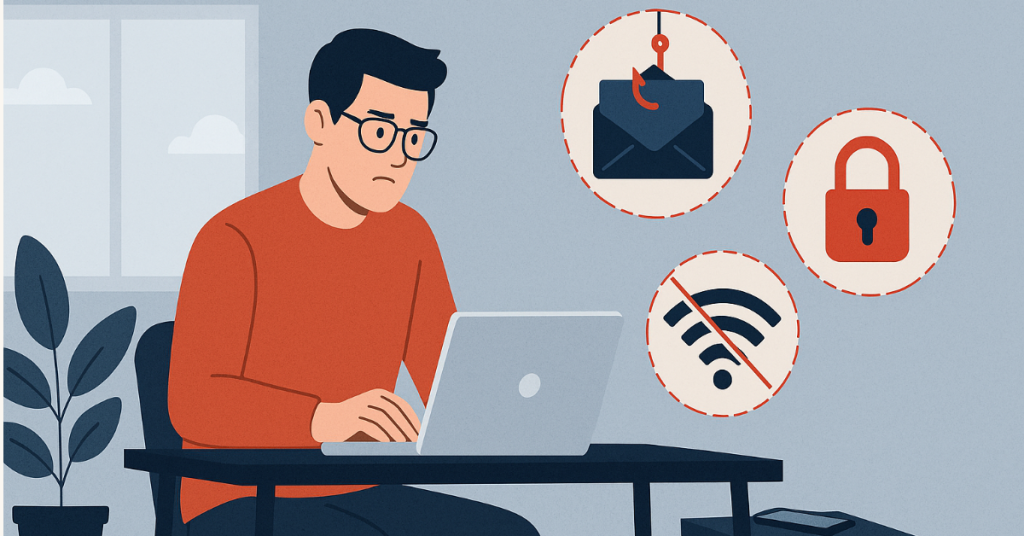
If you’re feeling uneasy about these new risks, you are not alone. A recent study found that 85% of organizations regard remote and hybrid working as the biggest contributor to their heightened threat levels. Let’s break down the five most common and dangerous vulnerabilities.
1. Unsecured Home & Public Wi-Fi Networks
Your office Wi-Fi is managed, monitored, and configured for security. An employee’s home network is the exact opposite. Most consumer-grade routers are set up with default passwords and rarely receive critical firmware updates, making them easy targets for attackers to compromise.
2. The Proliferation of Personal Devices (BYOD)
Bring-Your-Own-Device (BYOD) is a common practice in hybrid environments, where employees use their personal computers, tablets, and phones to access company files and applications. While convenient, it creates a massive security gap. Research shows that 80% of employees use personal devices for work, yet these devices rarely have the enterprise-grade security controls found on company-issued equipment.
3. Heightened Vulnerability to Phishing & Social Engineering
When working remotely, employees lose the benefit of physical proximity. They can’t quickly turn to a colleague and ask, “Does this email from the CEO look weird to you?” This isolation makes them more susceptible to phishing and social engineering attacks, where criminals impersonate trusted figures to manipulate employees into revealing passwords, sending money, or downloading malware.
4. The Rise of “Shadow IT”
Shadow IT refers to the use of unapproved software, applications, and cloud services by employees to get their work done. This could be a project manager signing up for a new, unvetted task management tool or a sales representative using their personal Google Drive to share files with a client because it’s faster.
5. Weak Identity and Access Management (IAM)
In a distributed workforce, strictly controlling who can access what data is more critical than ever. The “Principle of Least Privilege” should be your guide: employees should only have access to the specific files, folders, and systems they absolutely need to perform their jobs, and nothing more.
You Don’t Have to Go It Alone
Implementing this three-pillar framework is a significant undertaking, especially for a business leader juggling dozens of other priorities without a dedicated, in-house cybersecurity expert. This is where the right IT partner becomes invaluable.
A Seattle managed or co-managed IT partner provides the specialized expertise, 24/7 monitoring, and strategic guidance needed to build and maintain a secure hybrid work environment. They handle the technical heavy lifting—deploying endpoint security, managing VPNs, and monitoring for threats—while you focus on running your business. A good partner ensures you achieve both productivity and security for your livelihood, giving you confidence that your biggest risks are being professionally managed.
Conclusion: Secure the Weakest Link, Strengthen the Whole Chain
The home office is the new security frontier, and treating it as an afterthought is no longer an option. The risks are real, but they are manageable.
A proactive, multi-layered strategy that combines the right Technology, clear Policies, and well-trained People is the only effective defense against the threats of a distributed workforce. By methodically securing each remote workspace, you are not just patching a single weak link. You are fundamentally strengthening the security of your entire organization. Hybrid work security is a challenge, but with the right strategy and support, it is an achievable and essential goal.