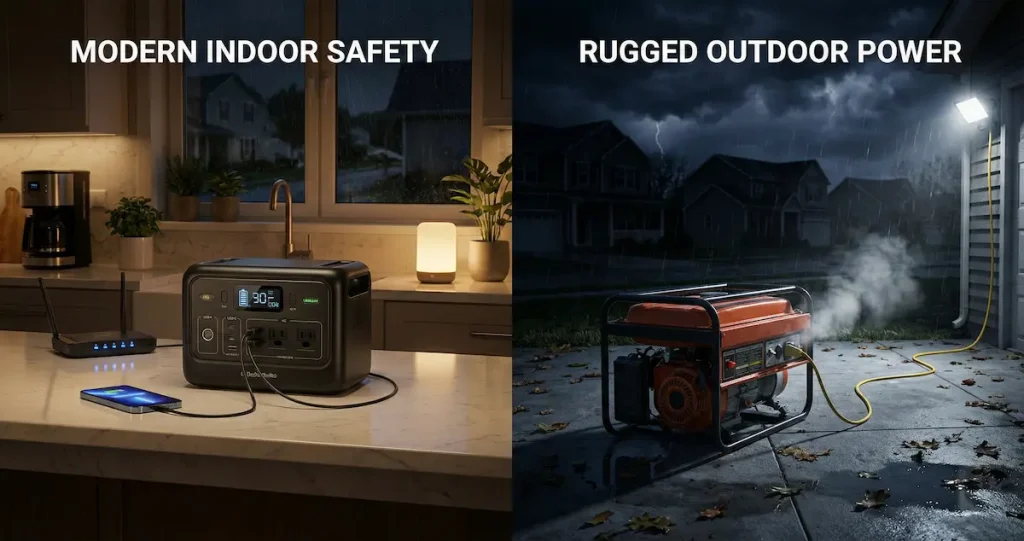

When the power goes out, you usually need electricity for three things: staying safe (heat/cooling, medical devices), staying informed (phone, router), and protecting essentials (refrigerator/freezer). The best backup choice depends on your loads, outage length, and where you can operate the equipment safely.
In this guide, you’ll learn when a portable power station is the smarter emergency tool, when a gas/propane generator wins, and how a hybrid setup can cover almost every scenario.
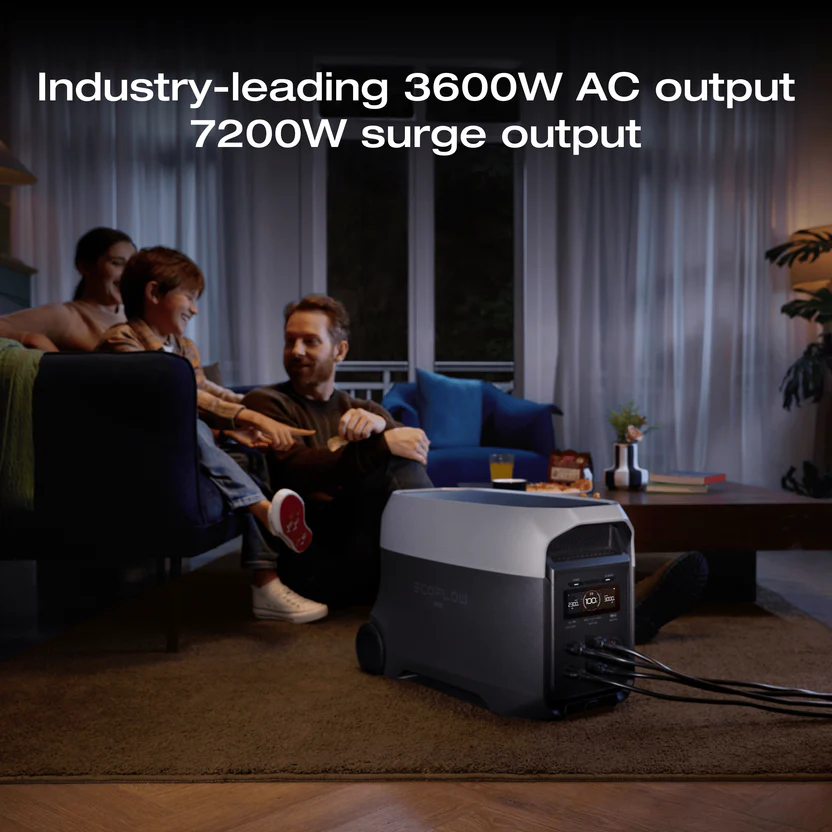
Quick answer: which is better in an emergency?
Choose a power station if you need:
- Indoor-safe power (no exhaust, no fuel fumes)
- Quiet operation (sleep, apartment, neighborhood restrictions)
- Instant, low-maintenance backup for essentials (phones, lights, router, CPAP)
- Short-to-medium outages (hours to ~1–2 days) or you can recharge via solar/car/wall
Choose a generator if you need:
- High continuous power for heavy loads (multiple appliances, power tools, electric cooking)
- Long outages where refueling is easier than recharging
- Fast “energy replenishment” (pour fuel = keep running)
Safety is the divider: generators must be used outdoors and far from openings to prevent carbon monoxide poisoning. Agencies explicitly warn: never run a generator indoors, even with doors/windows open.
The biggest emergency difference: indoor safety
A portable generator produces carbon monoxide (CO)—an odorless gas that can kill quickly. Major safety guidance is consistent:
- Never use a generator inside a home, garage, basement, shed, or other enclosed/partially enclosed areas.
- Place the generator at least 20 feet away from the home and away from doors/windows/vents.
- Use battery-powered or battery-backup CO detectors in the home when operating a generator.
Power stations don’t burn fuel, so they avoid CO exhaust risk. That’s why power stations are often the first recommendation for apartments, garages, tents, and overnight indoor use—places where a generator is either unsafe or impractical.
| Category | Power Station (battery) | Generator (gas/propane) |
| Indoor safety | Yes (no exhaust) | No (CO risk; outdoor-only) |
| Noise | Quiet to moderate (fans) | Loud (engine) |
| Startup | Instant, push-button | Fuel + pull/start + warmup |
| Maintenance | Low | Regular (oil, spark plug, fuel storage) |
| Output power | Moderate (depends on model) | Often higher continuous watts |
| Surge power | Limited by inverter rating | Generally strong for motor starts |
| Runtime | Limited by Wh capacity | As long as fuel lasts |
| Refill / recharge | Slower (AC/solar/car) | Fast (refuel in minutes) |
| Best for | Essentials, indoor, short-to-mid outages | High loads, long outages, refuel-friendly setups |
What each one can realistically power in an emergency
Power stations are best for “essential loads”
Typical essentials:
- Phones, laptops, lights
- Wi-Fi router/modem
- CPAP (often best via DC output)
- Small fans
- TV for news
- Some refrigerators (if you have enough surge watts + capacity)
Generators shine for “whole-home-ish” or heavy loads
More realistic for:
- Running a refrigerator + freezer + lights + microwave (depending on generator size)
- Space heaters (still huge power draw—often not practical without a large setup)
- Power tools, sump pumps, larger appliances
- Multi-day outages where you can safely operate outside and have fuel
Decision point #1: How long is the outage likely to be?
0–12 hours (most common):
A power station is usually the simplest and safest solution—charge it ahead of time, use it instantly, no fumes.
12–48 hours:
Power station still works great if:
- your loads are mostly essentials, and/or
- you can recharge via solar, car, or periodic grid restoration.
Multi-day outages:
Generators become more attractive if you can store fuel safely and operate outdoors properly. Many households end up choosing a hybrid approach (more on that below).
Decision point #2: What loads must stay on?
If your “must run” list is mostly small electronics:
Power station wins.
If your “must run” list includes motor loads (fridge, pump, power tools):
Either can work, but you must plan for:
- Starting surge (fridge/pumps can spike)
- Total continuous watts you’ll run at once
- For generators: outdoor placement, CO detectors, heavy-duty cords.
Cost & ownership reality (not just sticker price)
Power station ownership is “pay once, maintain less”
- Minimal maintenance
- No fuel rotation
- Easy to store and use
- Long-term value depends on battery type and warranty terms
Generator ownership is “cheap watts, more upkeep”
- Ongoing fuel cost
- Maintenance required
- Must manage storage and safe operation
- Risk of CO incidents rises when people take shortcuts during storms/outages—safety agencies repeatedly warn against indoor/near-home use.
Best practice: the hybrid emergency setup
If you want reliability across short and long outages, a hybrid approach is hard to beat:
Power station = indoor essentials + overnight power
Generator = daytime heavy loads + recharge the power station
This keeps the loud, outdoor, fuel-burning generator running less often, while you use the power station inside for quiet, safe power—especially while sleeping.
Emergency safety checklist (generator)
If you use a generator, follow these non-negotiables:
- Outdoor-only, never in a home/garage/shed/crawlspace.
- 20 feet away from windows/doors/vents.
- Use CO detectors (battery or battery-backup).
- Keep exhaust pointed away from the home.
- Avoid risky backfeeding (don’t plug generator into a wall outlet).
Emergency buying guidance: which one should you buy first?
If you’re buying one thing first for emergencies:
Buy a power station first if:
- You live in an apartment/condo
- You need safe indoor power (CPAP, baby monitor, router)
- You want quiet, instant backup with minimal setup
- Your outages tend to be short
Buy a generator first if:
- You expect multi-day outages
- You need higher watts for appliances/tools
- You can operate it outdoors safely and manage fuel storage
FAQ
Can I run a generator in the garage with the door open?
No. Safety authorities explicitly warn against running generators inside garages or enclosed/partially enclosed spaces—even with doors/windows open—because CO can build to lethal levels.
How far from the house should a generator be?
Guidance commonly says more than 20 feet away from windows, doors, and vents.
Do I need a carbon monoxide detector if I use a generator outside?
Yes—recommendations include using CO detectors (battery-powered or battery-backup) when operating generators, because CO can still infiltrate a home.
conclusion
For most households, a portable power station is the easiest, safest way to keep essentials running during an emergency—especially indoors and overnight. A generator is best when you need higher watts for longer outages and can operate it safely outside. If you want the most reliable setup, combine both: use a generator for heavy loads and to recharge, and use a power station for quiet indoor power.