
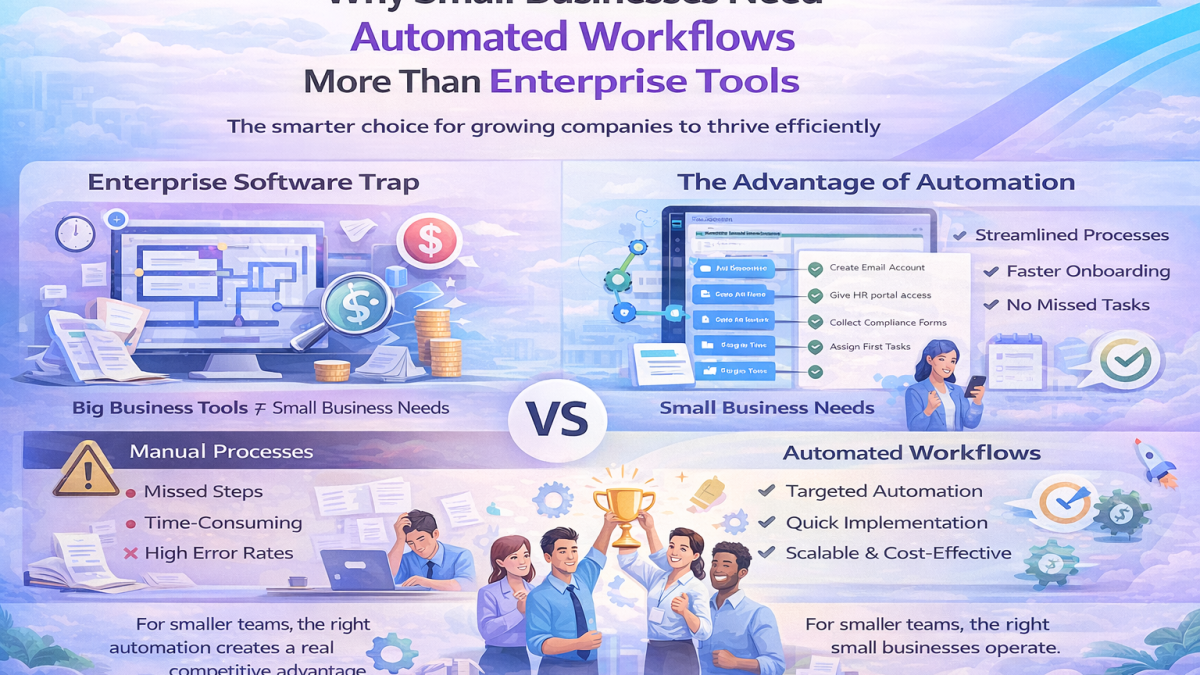
There’s a pattern that repeats across growing companies. They hit a point where manual processes start breaking. Tasks get missed. Information lives in too many places. People spend more time coordinating than actually working.
The instinct is to buy enterprise software. Big platforms with endless features that promise to solve everything. It rarely works out that way.
The enterprise software trap
Large-scale business tools are built for large-scale businesses. They assume you have dedicated IT staff, months for implementation, and budgets that match Fortune 500 companies.
When a 30-person company tries to adopt these systems, the mismatch becomes obvious fast. Configuration takes forever. Training eats up weeks. Half the features sit unused because nobody has time to learn them.
Meanwhile, the original problems remain unsolved. People still rely on spreadsheets and email chains because the new system is too complicated to use for simple tasks.
This isn’t a failure of technology. It’s a failure of fit. Enterprise tools solve enterprise problems. Small businesses have different needs.
What actually works for smaller teams
The smarter approach is targeted automation. Instead of replacing everything at once, identify the processes that cause the most friction and automate those specifically.
Not every workflow needs automation. Some things work fine with manual coordination when your team is small enough. The goal is to find the bottlenecks where human effort creates delays, errors, or inconsistencies.
Common candidates include repetitive administrative tasks, multi-step processes that span departments, anything that depends on someone remembering to do something, and workflows with real consequences.
Employee onboarding hits all of these criteria. It’s repetitive, involves multiple people, depends heavily on memory, and failures directly impact retention. Yet most small businesses still handle it manually.
The hidden cost of manual onboarding
When someone new joins a company, dozens of things need to happen. Equipment setup, account creation, system access, document collection, training schedules, introductions, and compliance paperwork. The list varies by role, department, and location.
In most small businesses, this coordination happens through email and hope. Someone sends a message to IT. Someone else is supposed to schedule training. A manager somewhere needs to prepare the first week’s tasks.
Things get missed constantly. The new hire shows up, and their laptop isn’t ready. Nobody told facilities they needed a desk. The compliance forms that should have been signed on day one don’t surface until week three.
Each individual failure seems minor. But together they create a chaotic first experience that makes new employees question their decision to join.
Studies consistently show that employees form lasting impressions within their first week. A disorganized onboarding experience signals a disorganized company. People who feel abandoned early are far more likely to leave within months.
How automation changes the equation
Automated onboarding workflows eliminate the coordination overhead that causes these failures.
When a new hire is added to the system, tasks automatically generate and are assigned to the right people. IT gets notified about equipment needs. HR receives the compliance checklist. The manager gets a reminder to prepare the first week’s agenda.
Deadlines are automatically attached to each task, with automatic escalation. If something isn’t completed on time, the system follows up before it becomes a problem. Nothing depends on someone remembering to check.
Document collection happens digitally with tracking. You can see exactly which forms are complete and which are outstanding. No more chasing people down or wondering if paperwork got lost.
The new hire receives a structured experience regardless of how busy their manager is that week. Consistency becomes automatic instead of aspirational.
Choosing the right tools
Not every automation platform delivers real value. Some are just traditional software with modern marketing. Others are genuinely useful but designed for different scales.
For small businesses, several factors matter more than feature lists.
Implementation time is critical. If setup takes months, you’ve already lost. The best tools work within days, not quarters. They should feel usable almost immediately, with refinement happening over time.
Integration beats isolation. A tool that connects with your existing systems creates more value than one with impressive standalone capabilities. If your team uses Google Workspace, the automation platform should work natively with it. Same for Slack, Microsoft 365, or whatever stack you’ve already built around.
Simplicity compounds over time. Every unnecessary feature adds cognitive load. When evaluating platforms, ask whether your team will actually use each capability. Features that sound good in demos often sit untouched in practice.
Platforms like FirstHR are built around these principles. They focus specifically on small businesses with minimal setup requirements and straightforward workflows. No enterprise complexity, just the automation that actually matters.
Starting small and scaling smart
The most successful automation implementations start narrow. Pick one painful process and fix it completely before moving to the next.
Onboarding makes an excellent starting point because the benefits are immediate and visible. Every new hire experiences the improvement directly. The reduction in coordination overhead frees up time for other work.
Once that workflow runs smoothly, patterns emerge. You start noticing similar inefficiencies elsewhere. The same principles that fixed onboarding apply to other processes: clear task assignment, automatic deadlines, and escalation when things stall.
Gradual expansion beats big-bang transformation. Each successful automation builds confidence and capability. The organization learns to identify good candidates for automation and implement changes without disruption.
The real competitive advantage
Large companies have resources to absorb inefficiency. They can hire coordinators and project managers to keep manual processes running. Small businesses don’t have that luxury.
But they have a different advantage: agility. A small team can implement automation in days that would take an enterprise months of approvals and change management.
The businesses that recognize this opportunity pull ahead of competitors who are still drowning in manual coordination. They deliver better employee experiences with less overhead. They scale without proportionally scaling their administrative burden.
This isn’t about replacing people with software. It’s about freeing people from work that software handles better. The coordination tasks that eat up hours every week aren’t valuable uses of human intelligence. They’re just necessary overhead.
Automation turns that overhead into something that runs in the background. The time freed up goes toward work that actually requires human judgment, creativity, and connection.
Moving forward
The gap between how small businesses operate today and how they could operate is enormous. Most haven’t scratched the surface of what targeted automation makes possible.
The starting point isn’t a massive technology investment. It’s identifying one process that causes consistent pain and fixing it properly. Onboarding is usually the best first candidate because the impact is so directly visible.
From there, the path forward becomes clearer. Each automation creates capacity for the next. The compound effect over time transforms how the entire organization operates.
Enterprise software isn’t the answer for small businesses. Smart, targeted automation is. The companies figuring this out now will have significant advantages over those still running on spreadsheets and hope.
About This Content
