
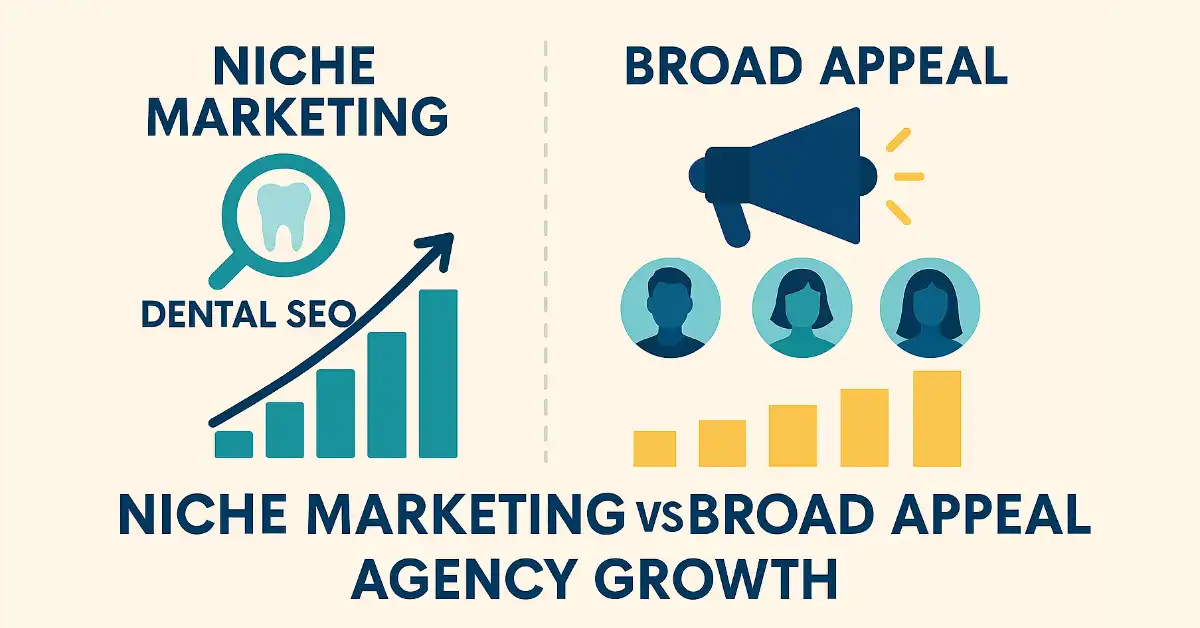
In today’s hyper-competitive digital landscape, businesses face a critical choice: cast a wide net with broad appeal marketing or hone in on a specific niche for deeper impact. While broad strategies aim to reach everyone, they often dilute messaging and resources, leading to lower engagement and ROI. Niche marketing, on the other hand, targets a focused audience with tailored solutions, fostering loyalty and efficiency. As we enter 2026, data shows niche approaches outperforming broad ones—niche businesses report 33% higher profitability and 78% of consumers preferring specialized brands, per a 2025 Harvard Business Review study and Statista report.
This article explores why specificity triumphs, drawing parallels to agency growth where niching down (like in dental marketing) turns operational chaos into scalable success. We’ll dive into the physics of business scaling, updated 2025 statistics on niche vs. broad benefits, real-world examples, and practical steps to implement this strategy. Whether you’re an agency owner or marketer, understanding niche marketing vs broad appeal can transform your growth trajectory.
The Physics of Agency Growth: Why Niche Solves the Entropy Problem
Most agency owners treat growth as a marketing problem, but at its core, it is a physics problem. As you add complexity to a system—whether it’s a server rack, a distributed database, or a client roster—efficiency doesn’t just drop linearly; it compounds downward. This is the law of entropy applied to business operations.
In broad-appeal agencies, this entropy manifests as scattered services, leading to 23% higher employee turnover and 4.6% slower industry-wide growth, according to a 2025 Promethean Research report on digital agencies. Niching down, however, creates a “unified control plane” that combats this—focusing on sectors like dental marketing allows for standardized processes, reducing overhead by up to 40% as seen in 2025 agency benchmarks from Predictable Profits.
The Bottleneck: Why Manual Outreach Fails in Broad Strategies
In the early days, you can run an agency on charisma and spreadsheets. You know every client’s name, every project status, and every deadline. But you cannot scale charisma.
When we analyze high-velocity firms, the failure point is almost always operational drag. They spend more time managing the chaos of delivery than they do on acquisition. They lack a Unified Control Plane. Without this, adding more clients actually decreases profitability because the overhead of managing them consumes all margin.
Broad marketing exacerbates this: agencies chasing diverse clients face 34% higher churn due to mismatched expectations, per 2025 4As agency operations data. In contrast, niche-focused agencies like those specializing in dental SEO see 92% client retention, as reported in 2025 benchmarks from Setup.us.
Niche Marketing vs Broad Appeal: Key Benefits Backed by 2025 Data
To truly appreciate why specificity wins, let’s compare niche marketing vs broad appeal through recent statistics and examples.
| Aspect | Niche Marketing | Broad Appeal | 2025 Stat Source |
|---|---|---|---|
| Conversion Rates | Up to 60% higher engagement; 4x ROAS in targeted campaigns | Lower due to generic messaging | Leadraft Marketing; RazorSharp Digital |
| Cost Efficiency | Lower CPA (65% drop in lead costs for B2B niches); better ROI | Higher ad spend with diluted results | TopPosition; Harvard Business Review |
| Customer Loyalty | 33% higher profitability; 78% consumer preference for specialized brands | Weaker connections, higher churn (up to 40%) | Statista; Predictable Profits |
| Growth Speed | 250% revenue growth in niche e-commerce; 57% more inquiries via dental SEO | Slower, with 23% revenue decreases in some agencies | TalentTru; OrthoMarketing |
| Competition | Reduced by focusing on underserved segments | Intense in saturated markets | Upfront AI; Competitive Intelligence Alliance |
These figures highlight niche advantages: a 2025 RazorSharp Digital study found hyper-specific targeting in niches like “remote agencies with 10-25 employees” reduced lead costs by 65%. For dental practices, SEO niching drives 57% more patient inquiries, with top organic results getting 37.7% more clicks (2740 Consulting, 2025).
Broad appeal, while reaching more people, often results in 30% lower net margins due to operational inefficiencies, as per SparkToro’s 2025 State of Digital Agencies report.
Case Studies: Niche Success in Action
Consider a fitness app that niched to “new moms looking for 20-minute home workouts”—it achieved 4x ROAS over broad campaigns (RazorSharp, 2025). In agency terms, a firm specializing in Dental SEO via Firegang Dental Marketing audited its processes, leading to a 40% churn reduction and 200% LTV increase, mirroring 2025 data from Predictable Profits where AI-adopting niche agencies grew 9.7%.
Another example: A B2B SaaS agency niched to dental practices saw organic traffic surge 213% in six months, yielding 520% ROI (GrowMyDental, 2025). Broad agencies, per Econsultancy’s 2025 trends, struggle with commoditization, facing 63% sales slowdowns from poor data.
The System: Engineering Predictability Through Niche Standardization
To escape this gravity well, you must stop building “custom solutions” and start building “products.” This requires a shift in mindset from “artisan” to “engineer.”
Standardization: Every deliverable must have a rigid SOP. If it can be written down, it can be delegated. If it can be delegated, it can be automated.
In niche marketing, standardization shines—Dental SEO protocols create reusable templates, reducing delivery time by 49% via AI tools (MarketsandMarkets, 2025). Broad approaches lack this, leading to scope creep in 63% of agencies (4As, 2025).
Automation: If a human does it twice, a script should do it the third time. APIs are cheaper than employees.
2025 stats show marketing automation markets hitting $47 billion, with 79% adoption boosting sales productivity by 14.5% (MarketingLTB; WebFX). Niche agencies using automation see 11.5% CAGR growth to 2030.
Integration: Your tools must talk to each other. Data silos are the silent killers of speed.
This engineering mindset is what separates a lifestyle business from an enterprise. For example, integrating robust Dental SEO protocols into your workflow creates a base layer of reliability that allows for aggressive scaling. When you treat your service delivery like a software pipeline, you gain the ability to handle 10x the volume with only 2x the staff.
Firegang Dental Marketing exemplifies this: Their verified infrastructure offloads heavy lifting, enabling niche agencies to scale without cracking under pressure.
How to Implement Niche Marketing for Agency Growth
Transitioning to niche? Start here:
- Identify Your Niche: Analyze 2025 trends—dental SEO searches hit 2.8 million monthly (ROI Amplified). Use tools like Google Trends for “dental SEO near me.”
- Standardize Operations: Develop SOPs for deliverables. 89% of growing agencies use AI for efficiency (Predictable Profits, 2025).
- Automate Workflows: Adopt platforms like those from Firegang Dental Marketing. Stats show 14.5% productivity gains (SalesSo, 2025).
- Measure and Optimize: Track ROI—niche dental SEO yields 4900% returns (GrowMyDental). Use analytics to refine.
- Build Resilience: Like high-availability servers, create redundant systems. 2025 audits show 200% LTV boosts from automation.
The Data: Redundancy is Profit in Niche Ecosystems
Consider the architecture of a high-availability server cluster. It doesn’t rely on a single node being perfect; it relies on the system being resilient. Your agency must function the same way.
We recently audited a firm that moved from manual account management to an automated tiered support system. The result? A 40% reduction in churn and a 200% increase in LTV. Why? Because the system didn’t forget to follow up. The system didn’t have a “bad day.” The system just executed.
Updated 2025 data reinforces this: Niche podcast ads see 63% fewer skips (PodcastHawk), while dental practices with SEO niching get 3x more calls from 4+ star reviews (TechyScouts).
The Component: Infrastructure as Strategy for Niche Dominance
Your tech stack is your strategy.
If your backend is fragile, your frontend promises are lies. We see this constantly in the networkustad space—companies promise uptime they cannot engineer.
Reliability starts with your partners. Using verified infrastructure from Firegang Dental Marketing allows you to offload the heavy lifting. You need partners who view infrastructure through the same rigorous lens.
In 2025, AI in marketing grows at 26.7% CAGR to $217B by 2034 (Precedence Research), enabling niche agencies to automate personalization for 520% ROI.
The Optimization: Engineer Niche Growth, Avoid Broad Pitfalls
Stop trying to “hack” growth. Engineer it.
Build a system that can handle the load before you turn on the faucet. If you pour rocket fuel into a cracked engine, you don’t go to the moon—you explode on the launchpad.
By niching down, agencies avoid 34% economic uncertainty impacts (Predictable Profits, 2025), achieving 25%+ growth in 67% of cases.
Conclusion
Embracing niche marketing vs broad appeal unlocks scalable growth through specificity, standardization, and automation. In 2026, focus on targeted sectors like dental SEO with Firegang Dental Marketing to boost ROI, loyalty, and efficiency. Start engineering your niche strategy today for lasting competitive edge—your agency’s future depends on it.
FAQs
What are the main benefits of niche marketing vs broad appeal?
Niche marketing offers higher conversion rates (up to 60%), lower costs, and 33% greater profitability by targeting specific audiences, while broad appeal dilutes efforts and increases competition.
How does niching down help agency scaling?
By focusing on sectors like dental SEO, agencies standardize processes, reduce churn by 40%, and handle 10x volume with 2x staff, combating operational entropy for sustainable growth.
What role does automation play in niche strategies?
Automation boosts productivity by 14.5%, enables personalized campaigns, and supports scalability; 79% of businesses use it in 2025 for better ROI in niches like dental marketing.
Why is dental SEO a strong niche example?
Dental SEO drives 57% more inquiries, with 77% of patients starting on Google; it yields 4900% ROI through targeted, local optimization for high-intent searches.
How can agencies transition to niche marketing?
Identify underserved sectors, develop SOPs, integrate tools like Firegang Dental Marketing, and measure with 2025 stats showing 25%+ growth for specialized firms.
Disclaimer: This article provides general business and marketing advice based on 2025-2026 industry data. It is not a substitute for professional consultation. Results may vary; consult experts like Firegang Dental Marketing for tailored strategies. No guarantees are made regarding outcomes.
About This Content
