
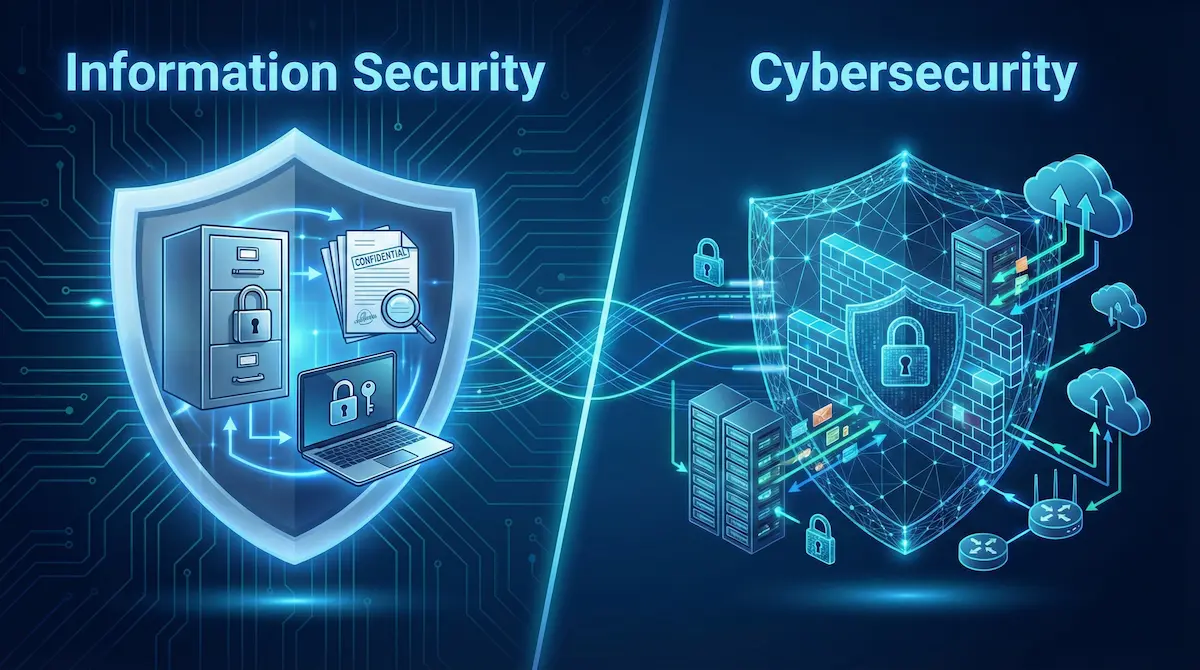
You’ve probably heard both terms thrown around—information security vs cybersecurity. Many people use them interchangeably. But are they really the same thing?
Not quite. While they overlap significantly, understanding the difference is crucial for anyone working in IT, managing business security, or simply trying to protect their digital assets.
Let’s clear up the confusion once and for all.
cybersecurity
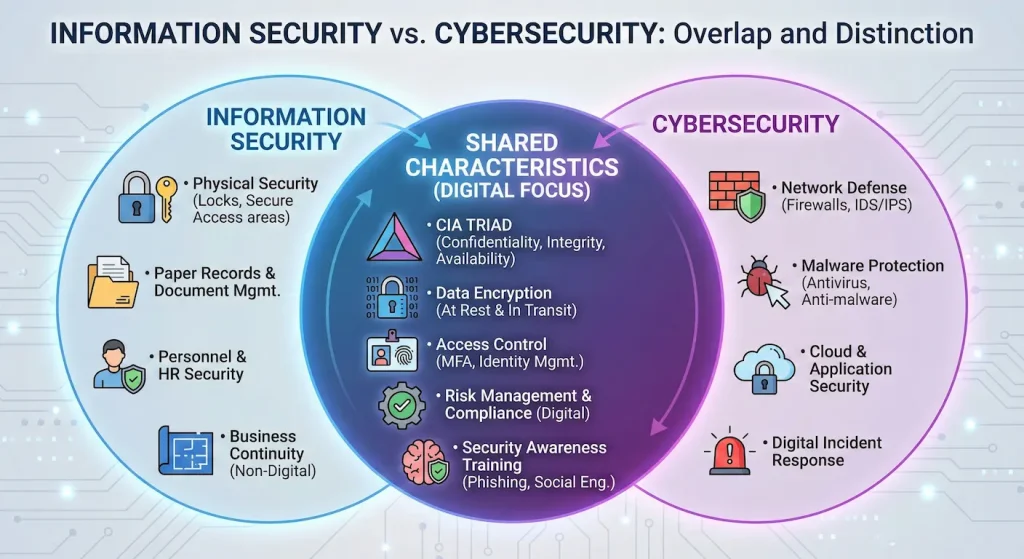
Information Security (InfoSec) is about protecting ALL information—digital and physical—from unauthorized access, use, disclosure, disruption, modification, or destruction.
Cybersecurity is specifically about protecting digital assets, networks, computers, and data from cyber threats and attacks.
Think of it this way: information security is the umbrella, and cybersecurity is one of the spokes underneath it.
Breaking Down Information Security
Information security has been around since ancient times when kings used sealed letters and trusted messengers to protect sensitive communications.
What InfoSec Covers
Information security protects data in ALL formats:
- Digital files stored on computers and servers
- Physical documents like printed contracts and reports
- Verbal communications in meetings and phone calls
- Visual information on whiteboards and presentations
InfoSec Focus Areas
Data Classification: Labeling information based on sensitivity levels (public, internal, confidential, top secret).
Access Management: Controlling who can view, edit, or share information regardless of format.
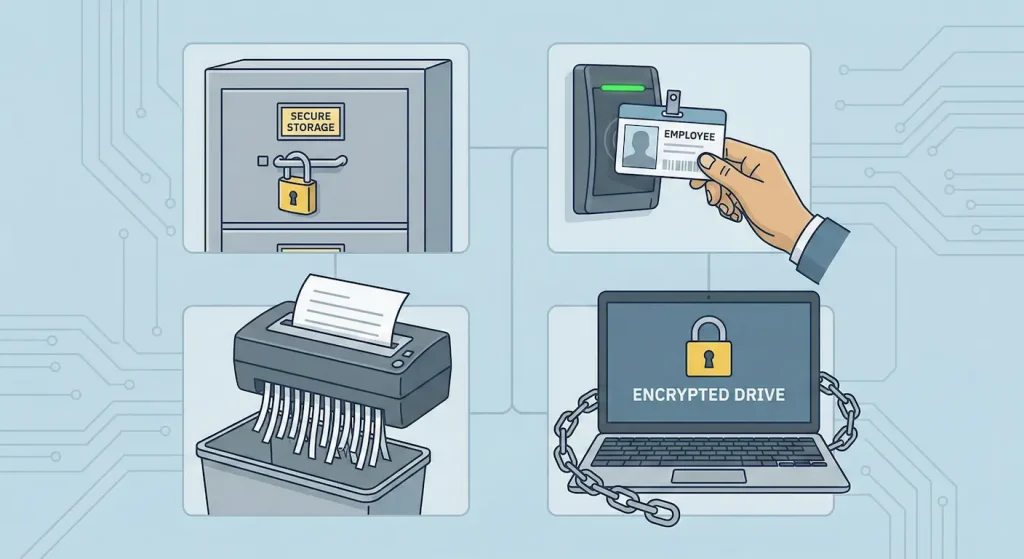
Physical Security: Locked file cabinets, secure document disposal (shredding), controlled building access, and security cameras.
Policy Development: Creating guidelines for handling information throughout its lifecycle—from creation to destruction.
Compliance: Meeting legal and regulatory requirements like GDPR, HIPAA, or SOX.
Real-World InfoSec Example
A hospital’s information security program includes:
- Encrypted patient databases (digital)
- Locked medical record rooms (physical)
- Secure fax machines for sensitive documents
- Privacy screens on computer monitors
- Employee training on handling patient information
- Shredding old paper records
Notice how this covers both digital AND physical information protection.
Understanding Cybersecurity
Cybersecurity is newer, emerging with the rise of digital technology and internet connectivity. It’s specifically focused on threats that come through digital channels.
What Cybersecurity Covers
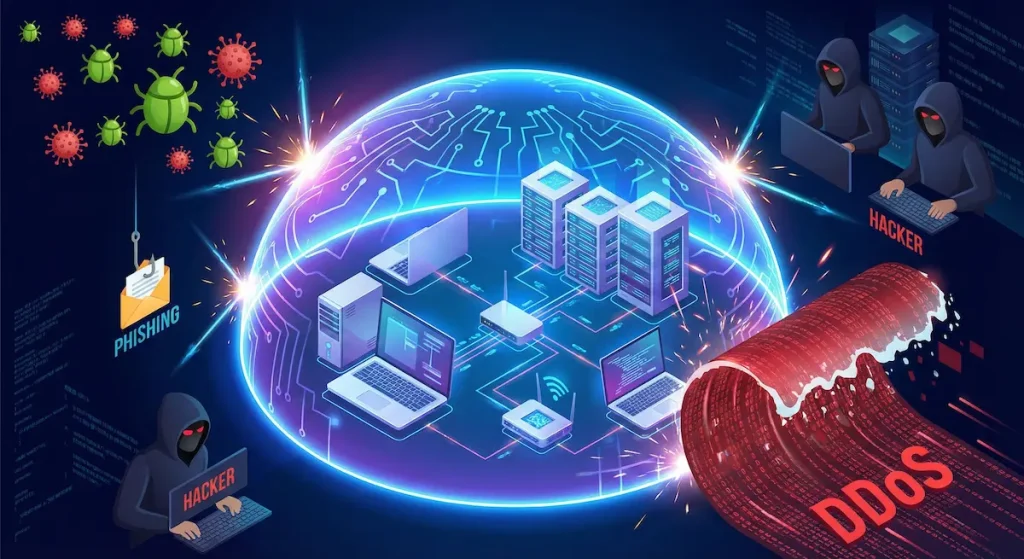
Cybersecurity deals exclusively with digital threats:
- Malware like viruses, ransomware, and trojans
- Hacking attempts and unauthorized network access
- Phishing attacks via email or fake websites
- DDoS attacks that overwhelm systems
- Data breaches through digital vulnerabilities
- Insider threats from malicious employees
Cybersecurity Focus Areas
Network Security: Firewalls, intrusion detection systems, VPNs, and network segmentation.
Endpoint Protection: Antivirus software, EDR solutions, and device security.
Application Security: Secure coding practices, vulnerability testing, and patch management.
Cloud Security: Protecting data and applications in cloud environments.
Threat Intelligence: Monitoring and analyzing cyber threat landscape.
Incident Response: Detecting, containing, and recovering from cyber attacks.
Real-World Cybersecurity Example
A financial institution’s cybersecurity program includes:
- Firewall monitoring 24/7
- Multi-factor authentication for all accounts
- Regular penetration testing
- Employee phishing simulation training
- Security Operations Center (SOC) monitoring
- Incident response team for breaches
All of these focus exclusively on digital threats and protections.
The Key Differences
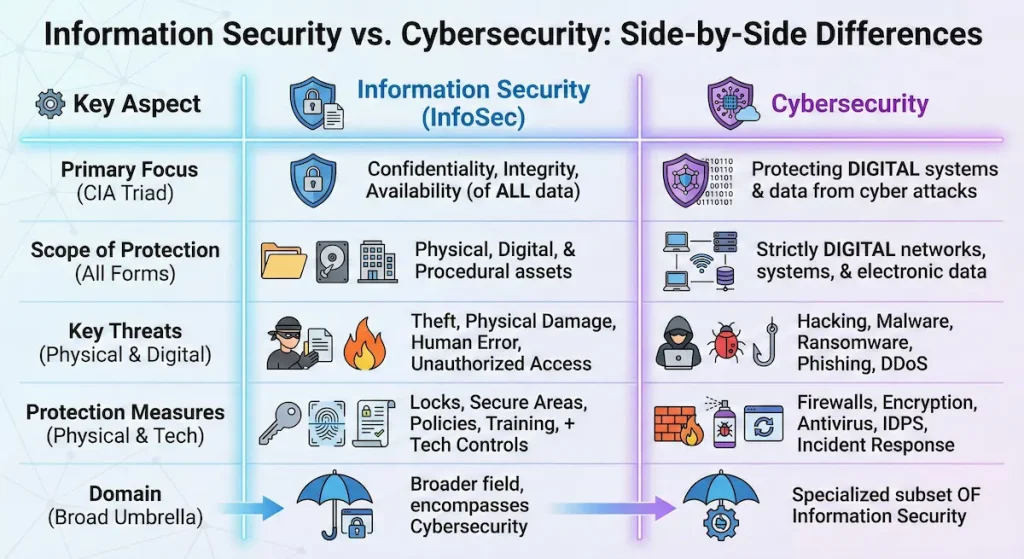
Scope
Information Security: Broad—covers all information in any format (digital, paper, verbal).
Cybersecurity: Narrow—focuses only on digital information and systems.
Threats Addressed
Information Security: Physical theft, document loss, unauthorized disclosure, improper disposal, social engineering in person.
Cybersecurity: Hacking, malware, phishing, DDoS attacks, ransomware, network intrusions.
Protection Methods
Information Security: Policies, physical locks, access badges, document shredding, employee training, classification labels.
Cybersecurity: Firewalls, encryption, antivirus, intrusion detection, security patches, network monitoring.
Primary Goal
Information Security: Maintain confidentiality, integrity, and availability of ALL information assets.
Cybersecurity: Protect digital infrastructure and data from cyber threats.
Historical Context
Information Security: Centuries old—existed before computers.
Cybersecurity: Relatively new—emerged with digital technology (1970s-1980s).
Regulatory Focus
Information Security: Broad compliance requirements (GDPR, HIPAA, SOX) covering all data handling.
Cybersecurity: Often specific technical standards (NIST Cybersecurity Framework, ISO 27001, PCI DSS).
Where They Overlap
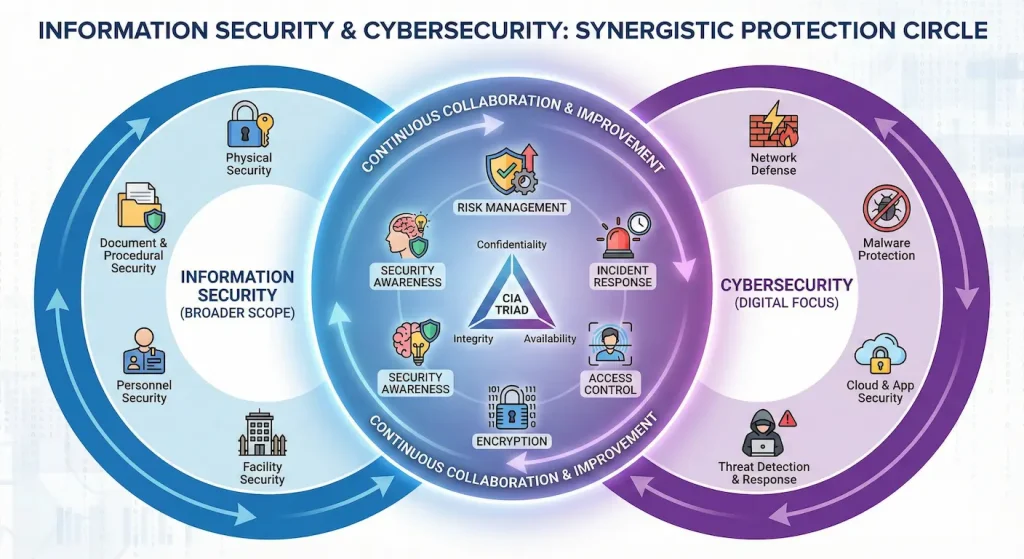
Despite their differences, there’s significant overlap between information security and cybersecurity.
Both focus on protecting data’s confidentiality, integrity, and availability (the CIA Triad we discussed in the previous article).
Both require:
- Risk assessment and management
- Access controls and authentication
- Employee training and awareness
- Incident response planning
- Regular audits and monitoring
The overlap is so significant that many organizations combine both under a single department or leadership role like CISO (Chief Information Security Officer).
Why the Distinction Matters
Understanding the difference helps organizations:
Allocate Resources Properly: Knowing what falls under each category helps budget and staff appropriately.
Identify Gaps: If you only focus on cybersecurity, you might neglect physical security risks.
Choose the Right Solutions: The problem determines whether you need InfoSec or cybersecurity tools.
Hire the Right Talent: Job descriptions and qualifications differ for information security vs cybersecurity specialists.
Comply with Regulations: Some laws emphasize broad information protection, others focus on cyber defense.
Job Roles: Information Security vs Cybersecurity
The career paths have some differences too.
Information Security Roles
- Information Security Manager
- Security Policy Analyst
- Risk Management Specialist
- Compliance Officer
- Data Privacy Officer
These roles focus on governance, policy, compliance, and risk management across all information types.
Cybersecurity Roles
- Security Operations Center (SOC) Analyst
- Penetration Tester
- Incident Response Specialist
- Security Engineer
- Threat Intelligence Analyst
These roles are more technical, focusing on defending against and responding to cyber attacks.
Many professionals work in both areas, but specialization is becoming more common as threats grow more sophisticated.
Which Does Your Organization Need?
The short answer: both.
Modern organizations face threats from multiple directions. You need comprehensive information security policies AND robust cybersecurity defenses.
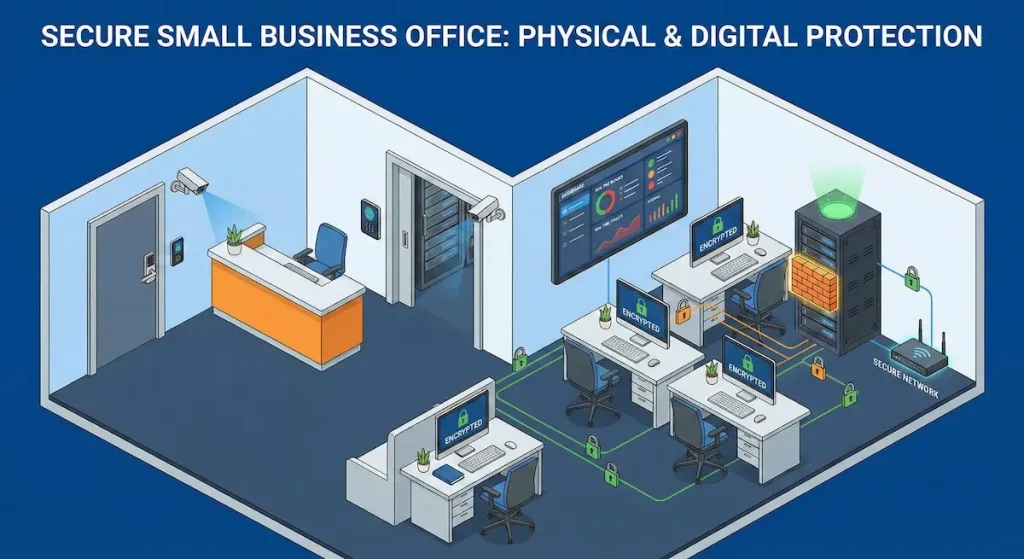
Small Business Approach
Start with information security basics:
- Classify your data
- Create basic security policies
- Train employees on data handling
Then layer cybersecurity protections:
- Install firewalls and antivirus
- Enable multi-factor authentication
- Back up data regularly
- Keep software updated
Enterprise Approach
Large organizations typically need:
- Dedicated InfoSec team for policy and governance
- Separate Cybersecurity team for technical defense
- Integrated approach with regular collaboration
- CISO overseeing both areas
- Distinct budgets for physical and digital security
Common Misconceptions
Misconception 1: “They’re exactly the same thing.” Reality: Cybersecurity is a subset of information security.
Misconception 2: “Cybersecurity has replaced information security.” Reality: Physical and non-digital information still needs protection.
Misconception 3: “I only need to worry about cyber threats.” Reality: Data breaches often involve physical security failures too.
Misconception 4: “Information security is old-fashioned.” Reality: Comprehensive protection requires both traditional and modern approaches.
Practical Example: A Data Breach
Let’s see how both come into play during an incident.
A company discovers an employee’s laptop was stolen from their car. The laptop contained customer data.
Information Security Response:
- Determine what data was on the laptop (classification)
- Assess physical security policy violations
- Review document handling procedures
- Check if data should have been on laptop
- Update physical security policies
- Train employees on device security
Cybersecurity Response:
- Check if disk encryption was enabled
- Verify remote wipe was successful
- Scan network for suspicious access attempts
- Review endpoint security logs
- Strengthen device encryption policies
- Implement device tracking software
Both teams work together to fully address the breach from all angles.
The Future Convergence
As organizations become increasingly digital, the lines between information security and cybersecurity continue to blur.
Emerging Trends:
- Most information is now digital, making cybersecurity central
- Physical security systems are network-connected (IoT), requiring cyber protection
- Cloud computing makes the distinction less relevant
- Integrated security platforms combine both approaches
- Unified security operations centers handle all threats
Despite convergence, the fundamental principles remain distinct. Good security professionals understand both perspectives.
Conclusion
Information security vs cybersecurity are related but distinct concepts.
Information security is comprehensive, protecting ALL information regardless of format—digital, physical, or verbal. It’s about policies, governance, risk management, and compliance across the entire information lifecycle.
Cybersecurity is specialized, focusing exclusively on protecting digital assets from cyber threats through technical defenses like firewalls, encryption, and intrusion detection.
Both are essential. Neither alone provides complete protection.
Understanding the difference helps you:
- Build comprehensive security programs
- Allocate resources effectively
- Identify and address gaps
- Choose appropriate solutions
- Communicate clearly about security needs
The best approach? Think “information security first” to set the strategic direction, then implement strong cybersecurity measures to protect your digital assets.
Key Takeaways:
- Information security covers ALL information types; cybersecurity focuses on digital threats only
- Information security is the umbrella term; cybersecurity is a specialized subset
- Both use the CIA Triad but apply it to different contexts
- Modern organizations need both broad InfoSec policies and specialized cybersecurity defenses
- Career paths overlap but have distinct specializations
- The distinction matters for resource allocation, hiring, and comprehensive protection
Related Articles:
- Understanding the CIA Triad: Confidentiality, Integrity, and Availability
- Cybersecurity Fundamentals 2026: Build Strong Defense
- Corporate Security: Home Office as Weakest Link
- Email Security 2025: End-to-End Encryption Secrets
Next Article Preview:
In the next article, we’ll explore “Types of Hackers: White Hat, Black Hat, Grey Hat, and Beyond” to understand who’s trying to break into your systems and why—essential knowledge for both information security vs cybersecurity professionals!
