
Inaccurate time tracking is more than a minor administrative headache; it’s a significant drain on your company’s bottom line. For every minute unaccounted for, profitability erodes. Yet, as an operations manager, you face a critical challenge: how do you implement robust employee verification without crossing the line into privacy intrusion? This is the biometric threshold—the crucial point where the need for accuracy meets the responsibility to protect your team’s personal data.
Navigating this threshold can feel daunting, filled with technical jargon and legal complexities. This article is your guide. We’ll demystify how modern biometric systems work, explain the legal requirements you must follow, and provide a clear framework for choosing a solution that enhances both security and trust. You’ll discover how today’s advanced, touchless systems are specifically engineered to solve this dual challenge, offering a path to eliminating time theft while respecting employee privacy.
The High Cost of Inaccurate Attendance
Time theft isn’t always malicious. It can be as simple as an employee forgetting to clock out for a long lunch or rounding up their hours at the end of the day. However, one of the most deliberate and costly forms is “buddy punching,” where one employee clocks in or out for an absent or tardy colleague. While it might seem like a small favor between coworkers, the financial impact accumulates rapidly.
The scale of this problem is staggering. Buddy punching costs businesses an estimated $373 million annually in the US alone. When combined with other forms of inaccurate reporting, the weekly damage becomes clear. On average, employers lose about 4.5 hours per week per employee to time theft. For a company with even a modest number of employees, these lost hours translate into tens of thousands of dollars in unearned wages and lost productivity every year.
How Modern Biometric Systems Protect Privacy
For any prudent manager, the primary concern with biometrics is data security. What happens to an employee’s facial scan? Where is it stored? Could it be stolen or misused? These are valid questions, and the answers lie in understanding how today’s technology is fundamentally designed with privacy at its core. The system isn’t capturing and storing a gallery of employee photos; it’s using a far more sophisticated and secure method.
It’s a Template, Not a Photograph
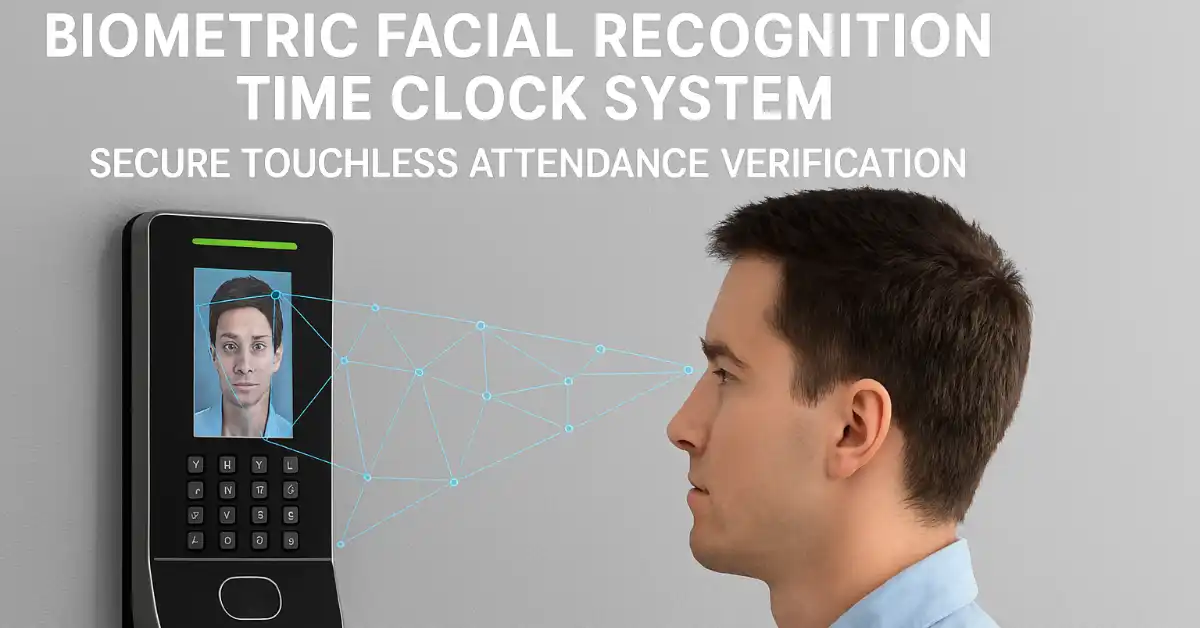
The most critical concept to grasp is the difference between a picture and a biometric template. When an employee first registers with a modern time clock, the system scans their face and converts its unique characteristics—like the distance between eyes—into a string of numbers. This encrypted, mathematical data is the template.
This process is a one-way street; the template cannot be reverse-engineered to recreate the original image. This technical safeguard renders the stored data useless to a hacker. Even if they managed to breach the system’s security, they would only find a collection of encrypted numerical data, not a database of faces. This principle is the foundation of secure biometric verification.
Integrating a modern facial recognition time and attendance system ensures that your operational efficiency never comes at the cost of employee trust. By utilizing a platform that prioritizes accuracy, you provide your staff with a touchless, rapid way to clock in while guaranteeing their biometric data remains protected. This modern approach to workforce management replaces outdated, hackable passwords with a resilient layer of encryption, allowing you to streamline payroll and eliminate time theft with complete peace of mind.
The Rise of AI-Powered Verification and Security
Beyond the foundational security of templates, modern systems employ a defense-in-depth approach driven by Artificial Intelligence. AI doesn’t just match a face to a template; it analyzes the clock-in attempt in real-time to ensure its legitimacy, creating a system that is both more accurate and much harder to fool.
Key AI-driven features include:
- Advanced Facial Liveness Detection: This is the system’s defense against spoofing. Older systems could sometimes be tricked by a high-resolution photograph or a video of an employee. Liveness detection prevents this by analyzing subtle cues like depth, texture, and micro-movements that are unique to a living person. It ensures the person in front of the camera is physically present, not just a digital replica.
- Adaptive Recognition: People change. They grow beards, get new glasses, or change their hairstyle. An effective biometric system must adapt without compromising security. AI-powered adaptive recognition allows the system to learn and adjust to these minor changes over time, ensuring accurate identification without requiring frequent re-enrollment.
- Touchless Clock-In: In today’s environment, hygiene is a top priority. A touchless clock-in system using facial recognition eliminates the need for employees to touch a common surface, reducing the spread of germs. It also streamlines the clock-in process, preventing lines from forming during shift changes and getting your team to work faster and more efficiently.
Staying Compliant: Navigating the Legal Landscape
Technology is only one part of the equation. Addressing valid employee privacy concerns begins with understanding and adhering to your legal obligations. While the technology is secure, implementation must be transparent and consensual to build trust and avoid legal jeopardy.
First and foremost, you must obtain clear, written consent from employees before collecting any biometric data. This isn’t just a best practice; in many places, it’s the law. Your consent form should clearly explain what data is being collected, how it will be used (for time and attendance), how it will be stored and protected, and for how long it will be retained.
Currently, there is no single federal law in the United States that governs the use of biometric data in the private sector. This means compliance is dictated by a patchwork of state and local regulations. Several states have enacted strict laws, and it’s essential to know the rules that apply to your business. A prime example is The Illinois Biometric Information Privacy Act (BIPA), which requires companies to request consent from employees before collecting their data and imposes strict data retention and destruction policies.
Conclusion: Achieving a Secure and Private Workplace
The biometric threshold—that balance point between verification and privacy—is not an obstacle to be feared. Instead, it’s a standard that modern technology is designed to meet. By adopting a thoughtful and informed approach, you can successfully eliminate time theft and improve payroll accuracy without compromising the trust you’ve built with your employees.
A successful implementation rests on three pillars: understanding the technology and its privacy safeguards, ensuring full legal compliance through transparency and consent, and choosing a system with advanced features like liveness detection.
Adopting a secure, touchless time clock is a proactive step toward modernizing your workforce management. By prioritizing both robust verification and employee privacy, you can build a more efficient, honest, and trusting workplace for everyone.
FAQs
What is buddy punching and how much does it cost businesses?
Buddy punching is when employees clock in/out for absent colleagues. It costs US businesses approximately $373 million annually in unearned wages.
How do biometric templates protect employee privacy?
Biometric systems convert facial features into encrypted numerical data that cannot be reversed into photos, making stolen data useless to hackers.
What is liveness detection in facial recognition systems?
Liveness detection analyzes depth, texture, and micro-movements to verify a real person is present, preventing spoofing with photos or videos.
Do employers need employee consent for biometric attendance?
Yes, clear written consent is required before collecting biometric data, explaining what’s collected, how it’s used, stored, and retained.
What are the benefits of touchless biometric clock-in systems?
Touchless systems improve hygiene by eliminating shared surfaces, streamline shift changes, and prevent employee lines while ensuring secure verification.
About This Content
