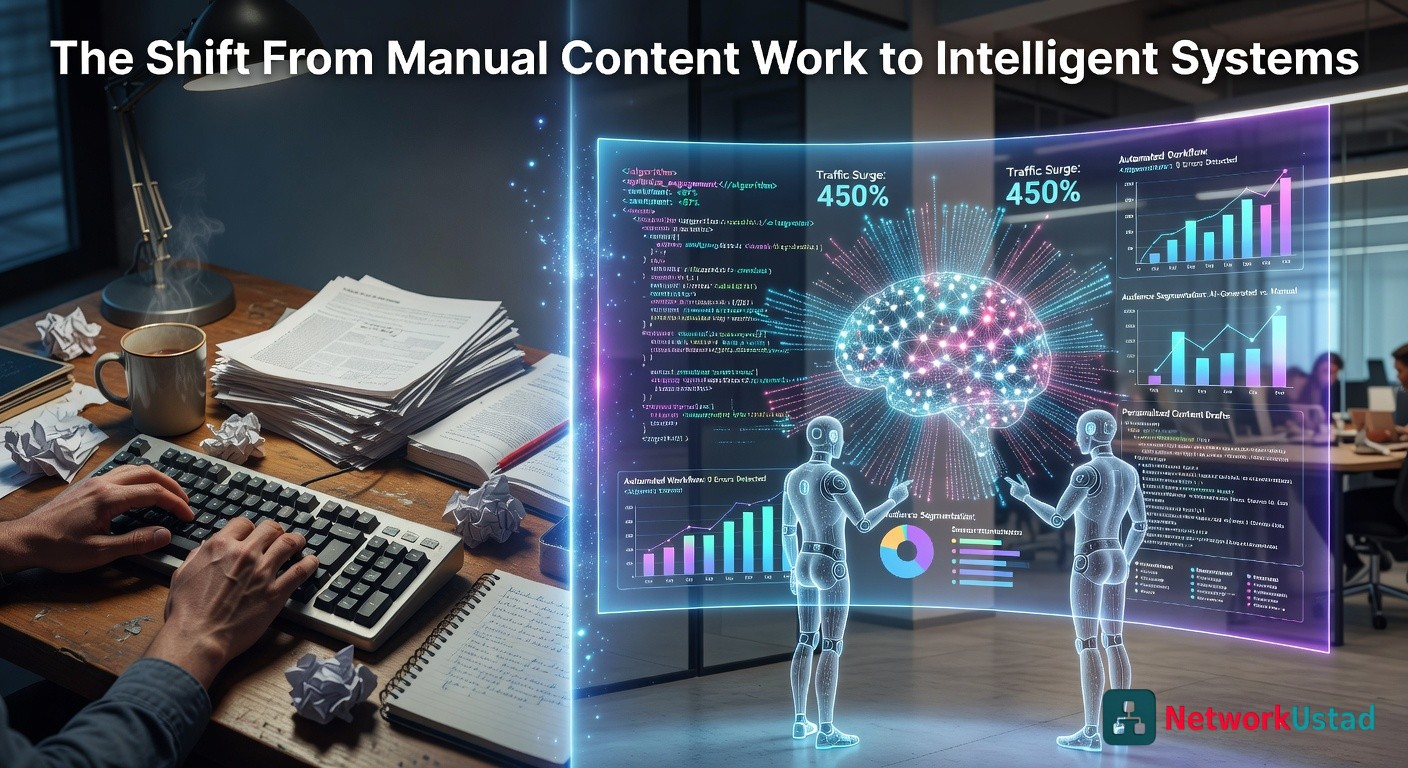
Content marketing has changed more in the last five years than in the previous decade combined. What once required large teams, long production cycles, and manual coordination is now being reshaped by automation, data, and artificial intelligence.
But the most important shift is not just speed. It is how decisions around content are being made.
Instead of relying only on editorial planning and human intuition, marketers now have access to systems that can analyze performance in real time, identify content gaps, and even suggest what should be created next.
This is changing content marketing from a purely creative discipline into something more operational and system-driven.
Why Traditional Content Workflows Are Becoming Inefficient
In a typical content marketing setup, there are several moving parts. Strategy is defined by marketing leads, content is produced by writers, SEO teams optimize it, and distribution is handled separately across multiple channels.
While this structure has worked for years, it becomes increasingly difficult to manage as content volume grows.
Common challenges include:
slow content production cycles
inconsistent optimization across pages
difficulty scaling across multiple channels
delayed decision-making due to fragmented workflows
At a small scale, these issues are manageable. At scale, they become bottlenecks.
This is where the industry is starting to shift toward more integrated and intelligent systems.
The Rise of AI in Content Decision-Making
Artificial intelligence is no longer limited to writing assistance or basic automation. It is increasingly being used to support strategic decisions in content marketing.
Modern AI systems can now:
analyze audience behavior patterns
identify high-performing content themes
recommend updates to existing content
optimize distribution timing and channels
What makes this especially powerful is that it reduces the gap between insight and execution.
Instead of analyzing data in one tool and manually applying changes in another, AI-enabled systems can connect these steps into a more continuous workflow.
From Automation to Autonomous Assistance
There is an important difference between simple automation and more advanced AI-driven systems.
Automation follows predefined rules. It executes tasks that humans already define.
AI-assisted systems, however, can adapt. They can evaluate context, learn from outcomes, and adjust recommendations based on changing data.
In content marketing, this means moving beyond scheduled publishing and basic keyword optimization toward systems that actively support decision-making throughout the content lifecycle.
This is where the concept of agentic AI for content marketers becomes relevant. Instead of acting as a passive tool, these systems can assist in planning, prioritizing, and refining content strategies based on real-time signals and defined goals.
How This Changes the Role of Content Teams
As AI becomes more integrated into content workflows, the role of marketers is also evolving.
Instead of spending most of their time on execution tasks, teams are increasingly focused on:
defining strategy and goals
guiding AI-assisted systems
interpreting insights and performance data
refining messaging and brand positioning
This shift does not remove the need for human input. Instead, it changes where that input is most valuable.
Creativity, judgment, and strategic thinking remain central. What changes is how much time is spent on repetitive operational work.
Scaling Content Without Losing Consistency
One of the biggest challenges in content marketing is scaling without losing quality or consistency.
As content volume increases, it becomes harder to maintain a unified tone, ensure SEO alignment, and keep messaging consistent across platforms.
AI-supported systems help address this by:
standardizing content guidelines
flagging inconsistencies
suggesting improvements based on historical performance
streamlining updates across multiple assets
This allows teams to scale output while maintaining control over quality and messaging.
Data-Driven Content Strategy Is Becoming the Norm
Content strategy is no longer built only on assumptions or periodic reporting. It is increasingly driven by continuous data feedback loops.
Marketers can now see:
which topics are gaining traction in real time
how users interact with content across journeys
where drop-offs occur in engagement
what content drives conversions vs. awareness
This level of visibility allows for faster iteration and more informed decision-making.
Instead of quarterly adjustments, content strategies can evolve continuously.
The Competitive Advantage of Smarter Systems
As more businesses adopt AI-assisted workflows, the competitive advantage will shift away from simply producing more content.
Instead, it will depend on how efficiently teams can:
turn insights into action
scale content production without losing quality
adapt strategies based on real-time performance
reduce time between idea and execution
In other words, success will depend less on volume and more on system intelligence.
Conclusion
Content marketing is moving into a new phase where strategy, execution, and optimization are becoming increasingly interconnected.
Artificial intelligence is not replacing marketers, but it is changing how they work and what they focus on.
The teams that adapt fastest will be the ones that understand how to combine human creativity with intelligent systems to create scalable, efficient, and high-performing content operations.