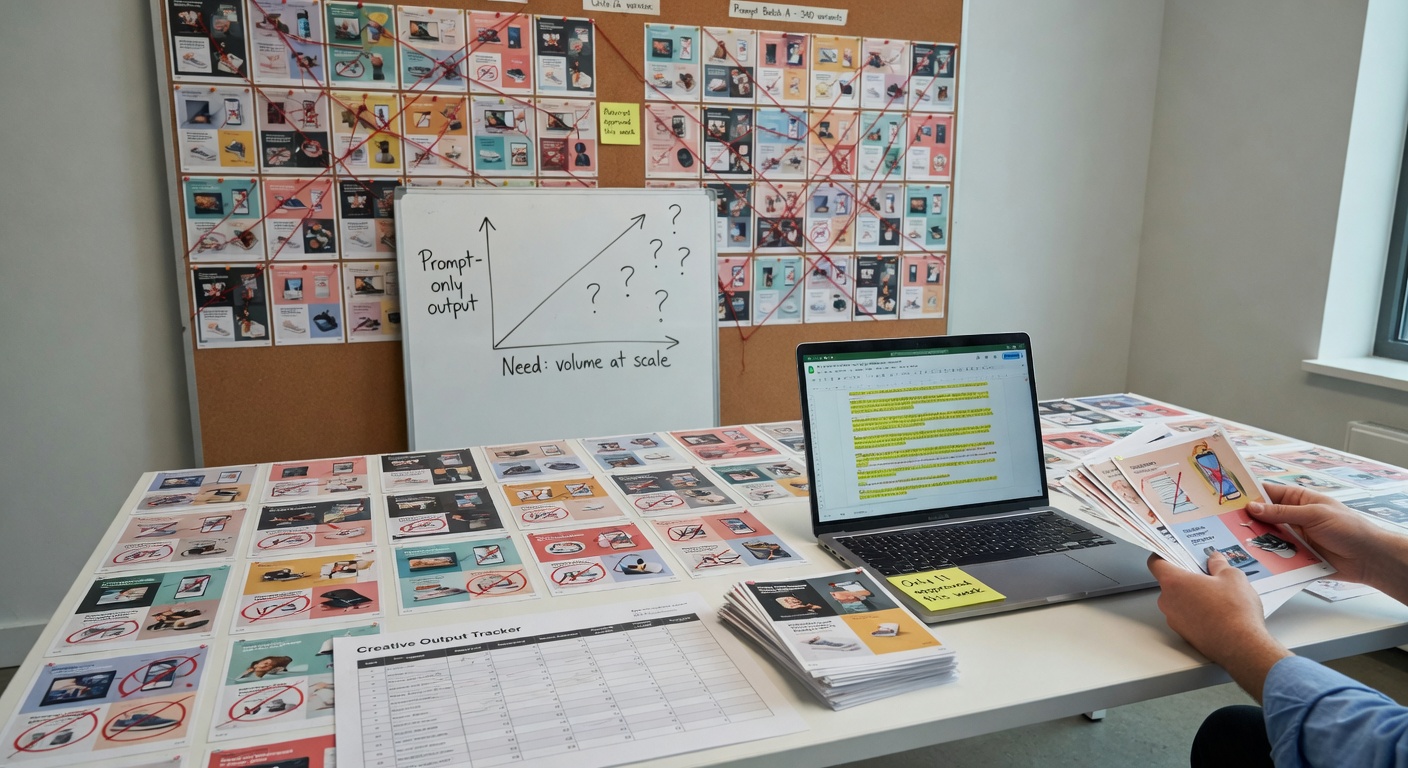
The promise of generative AI in performance marketing was simple: unlimited creative variations at the push of a button. For teams running high-velocity multivariate tests on Meta, TikTok, or Google Display, the bottleneck was always creative production. In theory, AI solves this. In practice, however, many teams find that simply “prompting” their way to a hundred ads creates a new kind of friction. The output is often inconsistent, aesthetically disjointed, or technically unusable for high-resolution placements.
Scaling ad creative volume requires moving beyond the “magic box” mentality of prompt engineering. A prompt is an instruction, but it isn’t a pipeline. To maintain a high return on ad spend (ROAS), marketing teams need a systematic way to ensure every asset generated—whether it’s the 1st or the 1,000th—adheres to brand logic, technical specs, and conversion-focused design principles. This shift requires a focus on structural control and post-generation refinement, rather than just chasing the perfect string of text.
The Iteration Paradox in Modern Performance Marketing
Performance marketers are currently caught in what we call the iteration paradox. To find a “winning” creative, you need to test a wide variety of hooks, visual styles, and calls to action. However, as the volume of variations increases, the likelihood of brand dilution increases alongside it. If a generative model produces fifty images of a product and ten of them feature distorted logos or lighting that doesn’t match the brand’s color palette, the cost of manual oversight begins to outweigh the speed of the AI.
The traditional “one-off” prompt approach fails at scale because it relies on probability. You are hoping the model understands the nuance of your brand’s aesthetic in every single generation. In a high-volume environment, “hope” is an expensive strategy. Hallucinated elements—like extra fingers on a hand holding a product or a nonsensical background texture—immediately signal “low quality” to a consumer. Even if the click-through rate (CTR) is temporarily high due to novelty, the long-term impact on brand trust can be negative.
For an asset to be truly “production-ready,” it must cross a threshold of technical and visual reliability. This means it isn’t just a pretty image; it’s an image that fits the 9:16 ratio of a TikTok ad without losing the focal point, maintains the same lighting across a set of 20 variations, and is high-enough resolution to not look pixelated on a 4K display.
Architecting the Pipeline with Kimg AI
To overcome these hurdles, teams are shifting toward models and workflows that prioritize structural integrity over raw “creative” flair. This is where tools like Nano Banana Pro AI enter the production stack. Unlike general-purpose models that prioritize broad stylistic variety, a production-focused model allows for more granular control over the relationship between the prompt and the pixels.
A robust pipeline uses a combination of text-to-image and image-to-image logic. Instead of asking the AI to “create an ad for a coffee brand” repeatedly, a systematic team will create a “master” composition or a sketch. They then use image-to-image functions to generate variations based on that specific layout. This ensures that the product placement stays consistent across every single test variant, even as the background or the lighting changes.
High-volume teams are increasingly moving away from “black box” generators and toward environments that offer precise visual control. They need to know that if they adjust a single word in a prompt, the entire image won’t rearrange itself. Using Nano Banana Pro as a foundational engine allows creators to lock in certain visual parameters, ensuring that the variations generated for an A/B test are actually testing the variable intended (like a different background) rather than a completely different composition.
Enforcing Consistency Across Multi-Channel Campaigns
Quality control in generative media is largely a matter of seed management and style locking. When a campaign spans Instagram, TikTok, and web banners, the assets must feel like they belong to the same universe. If the Instagram creative looks like a professional studio shoot and the TikTok variation looks like a stylized 3D render, the campaign loses its cohesive narrative.
One of the most effective ways to manage this is through “style consistency” settings and seed manipulation. By using a consistent seed or a reference style image, teams can ensure that the color grading, saturation, and “mood” of the assets remain identical across different formats.
There is also the matter of spatial adaptability. A single winning concept often needs to exist in 16:9, 1:1, and 9:16 aspect ratios. Prompting a model to generate three separate images in these ratios usually results in three different compositions. A more professional workflow involves generating a core asset and then using inpainting and outpainting to expand the canvas. This allows the team to “grow” the background to fit a vertical frame while keeping the central product and subject exactly as they appeared in the landscape version.
However, it is worth noting a current limitation: despite advancements, generative AI still struggles with “perfect” text rendering within complex scenes. While Nano Banana Pro handles text better than many legacy models, any ad requiring specific, legally mandated fine print or highly stylized brand typography still necessitates a layered approach where the AI generates the visual base and the text is overlaid in a traditional design suite.
The Kimg AI Ecosystem: From Raw Generation to K-Level Quality
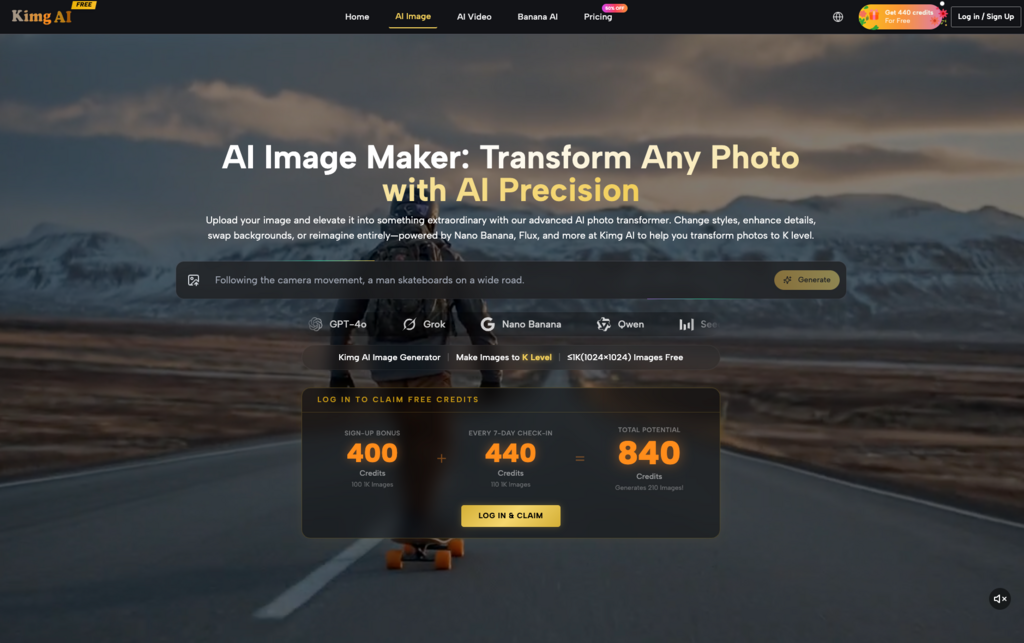
Even the best generative models often produce “raw” outputs that fall short of technical audit requirements for premium media buys. A raw 1024×1024 image might look great on a phone screen, but it will fail when used for high-definition YouTube overlays or large-scale digital out-of-home (OOH) displays.
This is where the Kimg AI ecosystem provides the necessary execution layer. The transition from a “generated image” to a “commercial asset” involves several post-processing steps:
-
High-Resolution Upscaling: Using a dedicated upscaler to bring an image to “K-level” resolution (4K or higher) without introducing the “mushy” textures often seen in standard bicubic interpolation.
-
Detail Refinement: Enhancing textures—such as skin, fabric, or product surfaces—to ensure they look realistic rather than synthetic.
Model Fusion: Sometimes, the best creative results come from using different models for different tasks. A team might use Nano Banana Pro for the core subject and then fuse it with a specialized model like Flux for hyper-realistic background textures.

By centralizing these tools, the workflow moves from a disconnected series of experiments to a unified production line. The ability to inpaint away a small defect or outpaint a background directly within the editor means the creative team doesn’t have to restart the generation process from scratch every time a minor tweak is needed.
Limits of Generative Autonomy and the Human-in-the-Loop
We must be realistic about what AI cannot—and should not—do on its own. While “automated quality scores” exist, they are currently an unreliable proxy for human creative judgment. An algorithm might tell you an image is technically “high quality” based on contrast and sharpness, but it cannot tell you if the image feels “off” for your specific brand voice.
There is also the issue of the “uncanny valley.” In performance marketing, specifically for direct-response ads involving human faces, even a 2% “unnaturalness” in an AI-generated eye or mouth can cause a significant drop in conversion. Users have become hyper-aware of AI-generated content. If an ad feels too synthetic, the user’s brain registers it as “spam” or “fake,” leading to lower engagement.
Consequently, the most successful creative ops teams use a “Human-in-the-loop” model. The AI handles the heavy lifting of generating 500 variations, but a human editor performs the “vibe check,” discarding the 20% that fall into the uncanny valley and selecting the top 5% for the highest-spend placements. We are not yet at the stage where you can safely set a generative pipeline to “autopilot” with a million-dollar ad budget.
Measuring the Yield of AI-Integrated Creative Ops
Ultimately, the goal of integrating tools like Nano Banana Pro into a marketing workflow is to improve the “creative win rate.” In the old model, the metric was “cost per image.” In the new model, the metric is “time to market” and the “yield” of successful variations.
Standardizing a generative pipeline reduces the feedback loop between the media buyers (who need more variants to combat ad fatigue) and the creative team (who traditionally couldn’t keep up). When the creative team can produce a month’s worth of multivariate tests in an afternoon using a controlled environment, the entire marketing department becomes more agile.
The future of ad creative isn’t about finding the one “perfect prompt.” It’s about building a robust execution layer—using a combination of controlled models, high-resolution upscalers, and human oversight—to ensure that every output is not just an image, but a usable, high-converting asset. By treating generative AI as a structured pipeline rather than a novelty, teams can finally scale their volume without sacrificing the brand integrity that drives long-term ROI.