Asad Ijaz
NetworkUstad's lead networking architect with CCIE certification. Specializes in CCNA exam preparation and enterprise network design. Authored 2,800+ technical guides on Cisco systems, BGP routing, and network security protocols since 2018. Picture this: I'm not just someone who writes about tech; I'm a certified expert in the field. I proudly hold the titles of Cisco Certified Network Professional (CCNP) and Cisco Certified Network Associate (CCNA). So, when I talk about networking, I'm not just whistling in the dark; I know my stuff! My website is like a treasure trove of knowledge. You'll find a plethora of articles and tutorials covering a wide range of topics related to networking and cybersecurity. It's not just a website; it's a learning hub for anyone who's eager to dive into the world of bits, bytes, and secure connections. And here's a fun fact: I'm not a lone wolf in this journey. I'm a proud member and Editor of Team NetworkUstad. Together, we're on a mission to empower people with the knowledge they need to navigate the digital landscape safely and effectively. So, if you're ready to embark on a tech-savvy adventure, stick around with me, Asad Ijaz Khattak. We're going to unravel the mysteries of technology, one article at a time!"
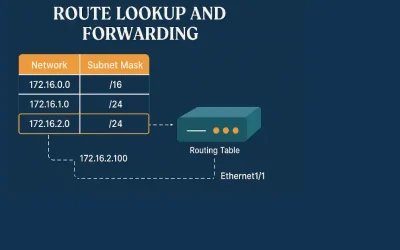
Best Route, Routing Table Terms, and Lookup Process (Updated 2025)
The best route is the longest match route to the destination IP address. The route lookup process matches the destination IP address with the available routes in the routing table and selects the longest-matched route as the forwarding route. To match the destination IPv4 address of a packet with the routes in the routing table,...
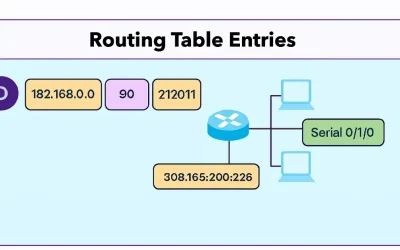
What is the Routing Table Entries
The routers are typically responsible for directing traffic across multiple networks. Each router maintains a list of known networks and directions in its routing table. The router performs a routing table entries lookup to find the proper interface that leads to the destination address. Each entry in a routing table is called a “route entry:...
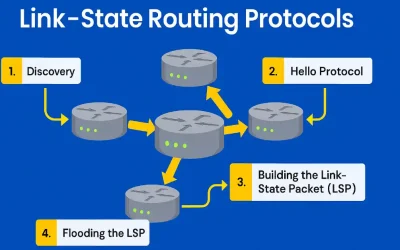
Link-State Routing Protocol
Link-state routing protocols are also known as shortest-path first protocols. They maintain a complete picture of all the routers running a link-state routing protocol in the complete network. All routers running a link-state routing protocol originate information about themselves and their directly connected routers, links, and the state of those links as multicast messages. The...
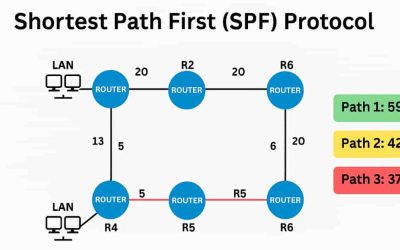
Understanding the Shortest Path First (SPF) Protocol: Link-State Routing with Dijkstra’s Algorithm
In networking, efficient routing is crucial for data transmission across complex topologies. The Shortest Path First (SPF) Protocol, also known as Link-State Routing, uses Edsger Dijkstra’s SPF Algorithm to determine the optimal path for packets. Protocols like Open Shortest Path First (OSPF) and Intermediate System-to-Intermediate System (IS-IS) are prime examples of link-state routing protocols. These...
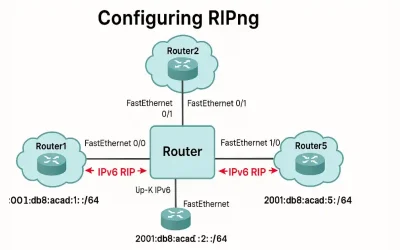
How to Advertise IPv6 Networks in RIPng
IPv6 Routing Information Protocol (RIP), also known as RIPng (RIP Next Generation), supports IPv6 addresses. It is a Distance Vector routing protocol that uses a hop count as a routing metric. After enabling IPv6 RIP, we also need to configure the advertisement of IPv6 RIP routes. We can display IPv6 RIP settings to verify the...
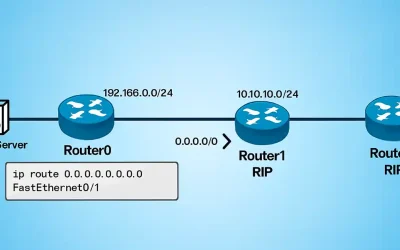
Propagating a Default Route in RIP: Step-by-Step Cisco Configuration Guide (Updated 2025)
Propagating a default route in RIP is a key feature of the Routing Information Protocol (RIP), a distance-vector routing protocol commonly used in small networks. It uses hop count as its metric and is suitable for CCNA-level studies, where understanding basic dynamic routing is key. A default route (0.0.0.0/0), also known as the gateway of...
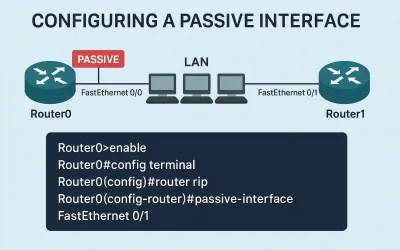
How to Configure RIP Passive Interface
By default, the Routing Information Protocol (RIP) sends routing table updates every 30 seconds on all enabled interfaces. In RIP version 1 (RIPv1), these are broadcasts to 255.255.255.255, while RIP version 2 (RIPv2) uses multicasts to 224.0.0.9. However, updates should only be sent on interfaces connected to other RIP-enabled routers to avoid unnecessary traffic. This...
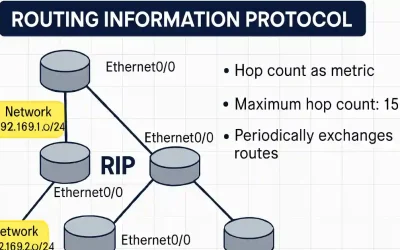
How to Configure Routing Information Protocol (RIP)
Routing Information Protocol (RIP) is a dynamic routing protocol that defines a way for routers to connect different networks using the Internet Protocol (IP) to share information about how to route traffic among these other networks. The Routing Information Protocol (RIP) uses hop count as a routing metric to determine the best path between the source and...
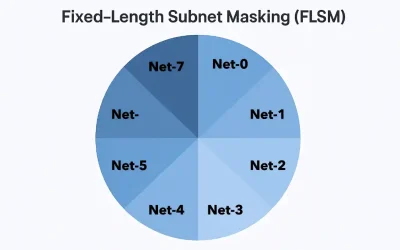
Fixed-Length Subnet Masking (FLSM) Exclusive Explanation
Fixed-Length Subnet Masking (FLSM), also known as traditional or classful subnetting, is a foundational concept in IP addressing that CCNA students must master before advancing to more efficient techniques like VLSM in CCNP. In FLSM, an equal number of addresses is allocated to each subnet using a uniform mask length, which simplifies routing in internal...
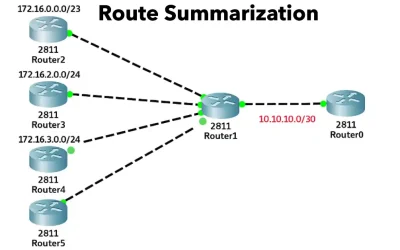
What is Classless Inter-Domain Routing (CIDR)
The IETF introduced RFC 1517 in 1993, introducing classless inter-domain routing (CIDR). The CIDR replaced the old classful network assignments. The classful address has now become obsolete due to the CIDR scheme. The CIDR network address is determined by the subnet mask instead of the value of the address’s first octet. The network and host...