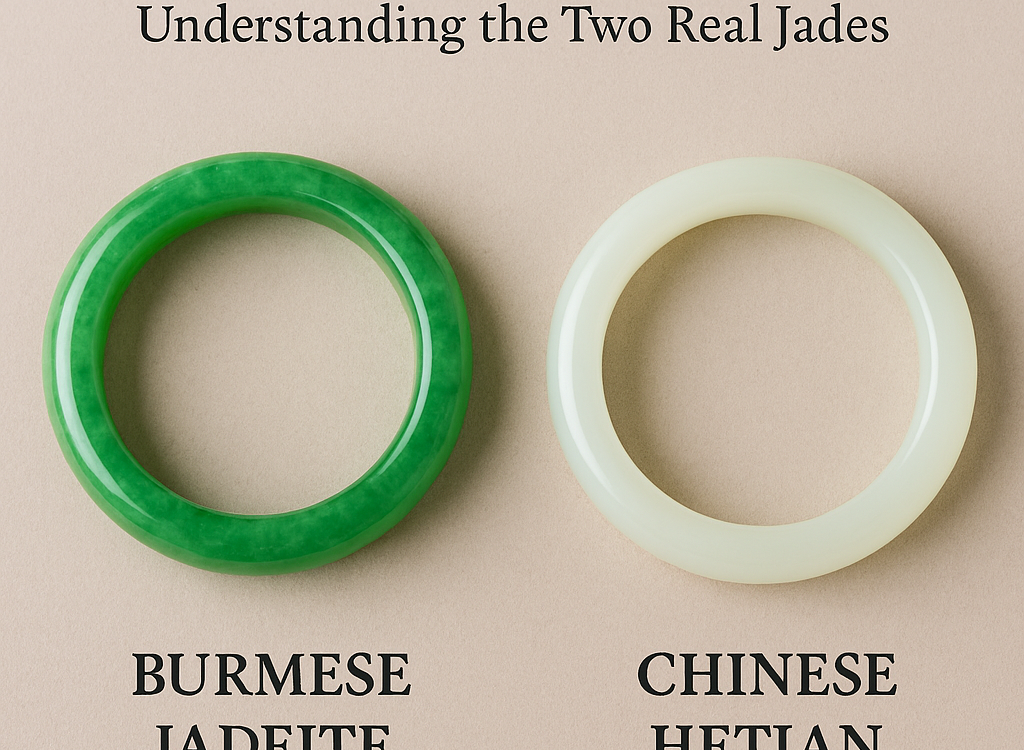
A complete comparison of the two minerals that the world calls jade — their geology, history, value, and which one belongs in your collection
Most people who buy jade jewelry never realize that the word “jade” actually refers to two completely different minerals. They share visual similarities, both have been treasured for millennia, and both are universally accepted as authentic jade — but their geological origins, physical properties, cultural histories, and market values diverge in fundamental ways. Choosing between them is not a matter of one being better than the other; it is a matter of understanding what each represents and which suits your purpose.
This guide compares Burmese jadeite and Chinese Hetian nephrite — the two materials that the international gemological community recognizes as real jade. Everything else sold under the name “jade” is either one of these two stones or a misnamed substitute. By the end of this article, readers will understand the practical, aesthetic, historical, and financial differences between the two, and will be equipped to choose pieces that match their values, climate, lifestyle, and budget.
The Geological Origin of “Two Jades”
Until 1863, Western science treated all jade as a single material. That year, French mineralogist Alexis Damour analyzed two specimens from the Chinese imperial collection and discovered that they belonged to entirely different mineral families. One — which he named jadeite — was a sodium aluminum silicate from the pyroxene group. The other — nephrite — was a calcium magnesium silicate from the amphibole group. Damour’s discovery resolved centuries of confusion: the Chinese had been using two different stones under the same cultural label for thousands of years.
The two minerals form under different geological conditions. Jadeite requires extreme high-pressure, low-temperature environments typical of subduction zones, where tectonic plates collide and one slides beneath another. These conditions are rare on Earth, which is why gem-quality jadeite is found in only a handful of locations worldwide, with Myanmar’s Hpakant region producing more than 70% of the global supply.
Nephrite, by contrast, forms in serpentinite or contact metamorphic environments and is far more geographically widespread. Significant deposits exist in China, Russia, Canada, New Zealand, the United States, Australia, and Taiwan. Among all these sources, Hetian nephrite from Xinjiang, China — particularly the white “mutton-fat” variety — has been considered the supreme grade of nephrite for over two thousand years.
Burmese Jadeite: The Stone of Modern Imperial Luxury
Geological Profile and Mining Region
Virtually all gem-quality jadeite originates from the Hpakant area of Kachin State in northern Myanmar. The mining region covers approximately 400 square kilometers and has been worked since at least the 13th century, though large-scale commercial extraction began only in the 18th century. The Uru River boulders that produce the finest material are known among traders as “the world’s most expensive geology” — single rough stones have sold for tens of millions of dollars at auction.
The geographical specificity of Hpakant matters because trace element analysis (LA-ICP-MS spectroscopy) can confirm Burmese origin in laboratory testing. This origin verification has become a significant value driver: jadeite from Hpakant commands premiums of 30 to 50% over visually similar material from Guatemala, Russia, or Japan.
Visual Characteristics and Color Range
Jadeite is the more visually dramatic of the two jades. Its hardness (6.5 to 7.0 on the Mohs scale) and tighter crystal structure produce a glassy, almost crystalline luster when polished — light refracts off the surface with a depth that nephrite cannot match. The translucency of fine jadeite ranges from semi-transparent (“glass-type” or boli zhong) to softly translucent (“ice-type” or bing zhong), creating an almost luminous quality in well-cut pieces.
The color palette of jadeite is famously broad. The most prized variety is imperial green, a vivid emerald color caused by trace chromium and historically reserved for the Chinese imperial court. Other significant colors include lavender (caused by manganese), icy white, sky blue, sunny yellow, and the rare and increasingly sought-after “galaxy” black. Some of the most valuable contemporary pieces feature blue jadeite, a translucent cool-toned variety that has gained particular collector interest in recent years.
Cultural and Historical Position
Despite its dominant position in modern Chinese jade culture, Burmese jadeite is a relative newcomer to China. It was introduced through trade caravans in the 18th century, during the reign of the Qianlong Emperor (1735 to 1796). The emperor became personally obsessed with the new stone, particularly imperial green specimens, and his favor elevated jadeite from a curiosity to the supreme luxury material of the Qing court.
This historical position explains jadeite’s modern association with status, wealth, and contemporary luxury. Imperial-grade jadeite pieces still set auction records — the 27-bead Hutton-Mdivani Cartier necklace sold at Sotheby’s Hong Kong in 2014 for over $27 million, establishing what was then the highest price ever paid for a jadeite piece. The market for fine jadeite has only grown since.
Best Use Cases for Jadeite
Jadeite’s hardness and translucency make it ideal for jewelry pieces where light interaction is essential — rings with cabochon settings, drop earrings, pendants, and translucent bangles. Its color range allows jadeite to coordinate with virtually any wardrobe palette, and its glassy luster reads as distinctly modern even in traditional carvings. For buyers seeking pieces with strong visual presence, contemporary luxury appeal, and significant investment potential, jadeite is generally the more suitable choice.
Hetian Nephrite: The Soul of Classical Chinese Civilization
Geological Profile and Mining Region
Hetian (also spelled Khotan) is an oasis region in the southwestern Xinjiang Uyghur Autonomous Region of China, lying along the ancient Silk Road at the foot of the Kunlun Mountains. The Yurungkash River — known historically as the “White Jade River” — has yielded river-tumbled nephrite boulders for over six thousand years. Mountain mining and river collection both continue today, though the highest-quality material is now extremely scarce.
The most prized Hetian variety is yangzhi yu, or “mutton-fat jade” — a translucent creamy white nephrite with a soft, almost organic glow that resembles rendered fat. Top-grade mutton-fat material from the Yurungkash river-bed sources commands prices comparable to imperial-green jadeite per gram, though its appeal is more cultural than visual; Western buyers often need exposure to traditional Chinese aesthetics to fully appreciate it.
Visual Characteristics and Color Range
Nephrite differs from jadeite in nearly every visual respect. Where jadeite is glassy, nephrite is soapy. Where jadeite shows depth and crystalline sparkle, nephrite shows softness and warmth. The slightly lower hardness (6.0 to 6.5 Mohs) and densely interlocking fibrous crystal structure produce a luster that has been described as waxy, oily, or even flesh-like — a tactile quality that traditional Chinese connoisseurs prized above all other gemstone properties.
The color range of nephrite is more restrained than jadeite’s. The classical Hetian colors are creamy white (mutton-fat), spinach green, yellow, gray-black, and various earth tones. Pure white mutton-fat is the supreme grade, followed by sugar-white (slightly off-white with subtle warmth), and topaz-yellow. The colors tend to feel grounded and timeless rather than vibrant; nephrite reads as classical where jadeite reads as luxurious.
Cultural and Historical Position
Hetian nephrite is the original Chinese jade. Archaeological evidence shows that Hetian material was being carved into ritual objects, ornaments, and ceremonial weapons by the Hongshan culture as early as 6000 BCE, predating Chinese writing by thousands of years. The Liangzhu culture (3300 to 2300 BCE) left behind hundreds of nephrite ritual cong tubes and bi disks that remain among the most important early Chinese artifacts ever discovered.
By the Shang and Zhou dynasties, jade had become inseparable from Chinese civilization itself. Confucius famously compared the eleven virtues of the gentleman to the qualities of jade — benevolence, justice, propriety, wisdom, sincerity. Imperial seals from the Qin Dynasty onward were carved from Hetian nephrite, and the famous Heirloom Seal of the Realm, said to legitimize the rule of any Chinese emperor who held it, was carved from a legendary Hetian boulder.
Every classical reference to jade in Chinese poetry, philosophy, and statecraft — for over four thousand years — refers specifically to Hetian nephrite, not Burmese jadeite. This is why nephrite still carries deeper cultural weight in traditional Chinese contexts, even though jadeite has dominated the modern luxury market.
Best Use Cases for Nephrite
Nephrite’s exceptional toughness — actually higher than jadeite’s, and the highest of any natural mineral — makes it the supreme material for carved figures, ritual objects, and intricate sculptural work. The fibrous crystal structure resists chipping and breakage even under fine tool work, allowing carvers to create details impossible in harder but more brittle materials. For collectors interested in classical Chinese aesthetics, religious artifacts, family heirlooms, or pieces with deep philosophical resonance, Hetian nephrite is the historically grounded choice.
Side-by-Side Comparison: Jadeite and Nephrite
The table below summarizes the most important practical differences between the two materials, drawing on standards from major gemological laboratories and traditional Chinese connoisseurship.
| Property | Burmese Jadeite | Hetian Nephrite |
| Mineral Family | Pyroxene group (sodium aluminum silicate) | Amphibole group (calcium magnesium silicate) |
| Primary Origin | Hpakant region, Kachin State, Myanmar | Hetian (Khotan), Xinjiang, China |
| Mohs Hardness | 6.5 to 7.0 | 6.0 to 6.5 |
| Specific Gravity | 3.30 to 3.38 g/cc | 2.90 to 3.03 g/cc |
| Toughness | Very high | Exceptional (highest of any natural stone) |
| Luster | Glassy, vitreous when polished | Soft, waxy, soapy |
| Translucency | Translucent to semi-transparent | Translucent to opaque |
| Signature Colors | Imperial green, lavender, ice white, blue, yellow | Mutton-fat white, spinach green, yellow, black |
| Cultural Origin in China | Introduced 18th century (Qing Dynasty) | Used since Neolithic times (8,000+ years) |
| Best Suited For | Vivid color statements, rings, pendants, bangles | Carved figures, ritual objects, classical bangles |
How the Two Jades Feel Different in Daily Wear
Beyond the visual and historical differences, jadeite and nephrite produce distinctly different experiences when worn. Understanding these tactile and behavioral differences helps buyers anticipate how a piece will integrate into their daily lives.
Temperature and Touch
Jadeite has higher thermal conductivity (around 2.1 to 6.6 W/m·K) than nephrite (1.7 to 3.2 W/m·K), meaning jadeite feels noticeably colder against the skin and stays cold longer. For wearers in warm climates, this property is often perceived as soothing — jade’s traditional reputation for “cooling fevers” originates in this real physical effect. In cold climates, the same property can make jadeite feel slightly harsh against bare skin.
Nephrite, with its lower thermal conductivity and waxy surface texture, feels softer to the touch. Many wearers describe it as feeling more “alive” or skin-friendly. Traditional Chinese carvers selected nephrite for body-contact pieces — beads, prayer rings, hand-held thumb rings — partly for this tactile warmth.
Durability Under Daily Use
Both jades are durable, but in different ways. Jadeite is harder, meaning it resists scratching better than nephrite. A jadeite ring worn daily will typically maintain its polish longer. However, jadeite’s tighter crystal structure also makes it slightly more prone to chipping under sharp impact — a hard knock against a kitchen counter can cause damage that nephrite would absorb.
Nephrite’s exceptional toughness makes it nearly impossible to break under normal handling. Archaeological nephrite pieces buried for thousands of years routinely emerge intact. The trade-off is that nephrite scratches more easily, and its softer luster benefits from periodic re-polishing to maintain its glow. For active lifestyles, sports, or hands-on professions, nephrite is generally more forgiving.
Aging and Patina
Jadeite’s character changes very little with age. A piece worn for thirty years looks essentially the same as one worn for one year, provided it has not been damaged. The stone’s chemical stability is one of its most attractive features for buyers seeking permanence.
Nephrite, by contrast, develops what Chinese connoisseurs call yang yu (“nourishing the jade”) — a subtle deepening of color and increase in luster from prolonged contact with skin oils. Antique nephrite pieces often show a warmth and depth that newer pieces lack, and this aging process is considered one of the material’s most valued qualities. Wearing nephrite is, in this sense, a long-term collaboration between the stone and the wearer.
Market Value and Investment Considerations
From a pure investment perspective, the two markets behave differently. Burmese jadeite has shown stronger and more consistent global price appreciation over the past two decades, driven by depleting Hpakant reserves, expanding Asian luxury demand, and growing Western auction interest. Top-grade imperial green jadeite has appreciated approximately 8 to 12% annually, with auction-grade pieces appreciating considerably faster.
Hetian nephrite has a more concentrated geographic market — primarily mainland China, Hong Kong, and Taiwan — and price movements depend heavily on Chinese domestic demand, government cultural policy, and supply restrictions on the Yurungkash River. Top-grade mutton-fat material has appreciated as much as fine jadeite within China but has had less international price discovery, making it harder to value reliably outside the Chinese market.
For international buyers prioritizing financial returns, Burmese jadeite generally offers better liquidity and broader market acceptance. For collectors prioritizing cultural significance and traditional Chinese provenance, fine Hetian nephrite carries depth that jadeite simply cannot replicate. Many serious jade collections include examples of both.
How to Choose Between the Two
The choice between Burmese jadeite and Hetian nephrite comes down to a series of practical questions about purpose, aesthetic preference, climate, and budget.
1. What is the piece for? Statement jewelry and contemporary luxury favor jadeite. Heirloom carvings, ritual objects, scholarly accessories, and pieces with classical Chinese resonance favor nephrite.
2. What aesthetic do you respond to? If you find vivid color, glassy luster, and crystalline depth appealing, jadeite delivers those qualities at a higher level than any other natural stone. If you prefer soft, warm, organic, and timeless looks, nephrite’s mutton-fat white or spinach green cannot be matched by jadeite.
3. What is your climate? Hot, humid environments often favor jadeite for its cooling effect. Cold or temperate climates often favor nephrite for its softer thermal experience.
4. How active is your lifestyle? Sports, manual work, and rough-and-tumble lifestyles favor nephrite’s superior toughness. Office and lifestyle wear can showcase jadeite’s superior hardness without exposing it to impact damage.
5. What is your budget? Both materials span enormous price ranges. Entry-level Type A jadeite from established sources typically begins around $50 to $200 for simple pieces; entry-level Hetian nephrite begins at similar levels. Top-tier examples in both materials run into seven figures.
6. Where will you buy from? Both materials require independent laboratory certification (NGTC for Chinese-issued pieces, GIA for international). The reputation of the seller matters more than the material — fine examples of both jades exist alongside disappointing examples of both.
Buyers comparing options across both materials may benefit from examining established sellers who specialize in one form deeply rather than offering both superficially. Yunnan-based ateliers such as Bmjade focus exclusively on Burmese Type A jadeite, sourcing rough material directly from Myanmar and overseeing carving in Yunnan workshops — a vertically integrated approach that allows full provenance disclosure for every piece. Specialized Hetian nephrite dealers based in Xinjiang and Beijing operate similar single-material focuses.
Common Misconceptions About Jadeite and Nephrite
“Jadeite Is the Real Jade and Nephrite Is the Cheaper Substitute”
This is incorrect, though widely believed in Western markets. Both are universally recognized as authentic jade by international gemological standards. The misunderstanding likely stems from the fact that jadeite dominates contemporary auction markets, where prices are most visible. Within traditional Chinese culture, fine Hetian nephrite has historically been considered the supreme jade, and top-grade nephrite still commands prices equivalent to top-grade jadeite within Chinese markets.
“Green Jade Is Always Jadeite”
Green is a major color in both materials. Spinach-green nephrite (often from Russian or Canadian sources) is sometimes mistaken for jadeite, particularly when polished to a high luster. The differences become obvious under magnification — jadeite shows interlocking grain structure, while nephrite shows fibrous matting — but to the casual observer, the colors can overlap.
“Hetian Jade Means Anything from China”
Strictly, Hetian nephrite refers specifically to material from the Hetian region of Xinjiang. The term has been broadened in modern Chinese commerce to refer to any high-quality nephrite, including material from other regions of China and Russia. For investment-grade purchases, buyers should request laboratory verification of the specific origin, as price differences between Xinjiang Hetian and similar-looking material from other sources can be substantial.
“Type A, B, C Classifications Apply to Both”
The Type A, B, C system was developed specifically for jadeite and is most often applied to it. While nephrite can also be treated (typically dyed), commercial fraud is less common in nephrite markets, and the Type designation is rarely used in nephrite certification. Nephrite buyers should still request laboratory certification confirming the material is natural and untreated, but the specific Type A label may not appear on certificates.
Two Stones, Two Traditions, One Continuous Heritage
The choice between Burmese jadeite and Chinese Hetian nephrite is not really a choice between better and worse. It is a choice between two distinct traditions that have, over the centuries, woven together into the broader fabric of jade culture. Nephrite carries the weight of four thousand years of Chinese civilization — the ritual objects of ancient cultures, the seals of emperors, the philosophical metaphors of Confucius. Jadeite carries the brilliance of the late imperial court and the energy of the modern luxury market — vivid, dramatic, internationally celebrated.
A jade collection that includes examples of both is a collection that reflects the full sweep of jade history. A piece chosen carefully from either material can become an heirloom that lasts for generations. What matters most is not which mineral the stone belongs to but whether it is genuinely what the seller claims it to be — naturally formed, untreated, properly certified, and ethically sourced.For buyers building a collection of fine Burmese Type A jadeite specifically, examining the work of established Yunnan ateliers offers a useful frame of reference for what proper sourcing, carving, and certification documentation look like. The full collection at https://bmjade.com/ provides one example of how a single-material specialist handles provenance, NGTC certification, and traditional Yunnan carving across the full range of jadeite jewelry types.